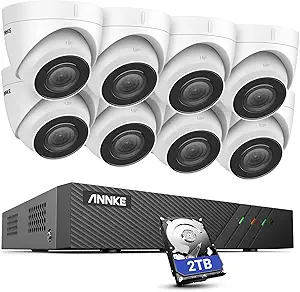








Ring vs Annke: Overview
Comparing Ring and Annke helps you determine which brand is best suited for your needs in Security Cameras. Both brands offer strong choices depending on your budget and key feature requirements.
Key Features & Comparison
Evaluate factors such as build quality, warranty, customer satisfaction, and total value before making your final purchase choice between Ring and Annke.
Picture Quality
When evaluating picture quality, Annke generally holds an architectural advantage over Ring due to its focus on commercial-grade optical sensors and high-throughput video pipelines. Annke’s flagship cameras frequently feature true 4K Ultra HD resolution (3840x2160) powered by large Sony STARVIS sensors and wide f/1.0 apertures, branded as NightChroma technology. This hardware setup allows Annke cameras to capture exceptionally crisp daylight footage and vivid, full-color imagery in near-total darkness without relying on harsh supplemental white light. Because Annke cameras primarily operate over wired Power-over-Ethernet (PoE) connections, they can stream at high bitrates (often 8–16 Mbps using efficient H.265+ compression) without suffering from aggressive compression artifacts, motion blur, or dropped frames during high-action events.
Ring, by contrast, designs its imaging pipeline around consumer accessibility and wireless bandwidth management, with most of its popular models capping resolution at 1080p or 2K (1536p on select Pro models). While Ring utilizes advanced High Dynamic Range (HDR) processing to balance harsh shadows and overexposed sunlight effectively, the resulting image is noticeably softer and more compressed compared to Annke's dedicated surveillance glass. Ring’s color night vision typically requires sufficient ambient light or activation of an integrated LED spotlight; otherwise, it defaults to standard infrared monochrome. For suburban monitoring and facial recognition within twenty feet, Ring delivers solid, consumer-friendly clarity, but Annke is vastly superior for resolving fine details such as distant license plates, subtle clothing textures, and broad peripheral landscapes.
Smart Features & Connectivity
In the domain of smart ecosystem integration and consumer-oriented features, Ring is a market leader with an intuitive, highly responsive platform. Operating predominantly on dual-band Wi-Fi, Ring devices seamlessly integrate into the Amazon Alexa ecosystem, enabling automated routines, rapid live-view streaming to Echo Show displays, and synchronized interactions with Ring Alarm and third-party smart locks. Ring’s proprietary software features—such as 3D Motion Detection with radar-guided bird's-eye view, precise customizable motion zones, and the collaborative Neighbors network—deliver an exceptional, plug-and-play user experience with minimal false alerts. However, because Ring relies heavily on cloud infrastructure, features like push notifications and live feeds require a stable internet connection and can experience momentary latency depending on local network health.
Annke approaches connectivity from an enterprise infrastructure perspective, relying heavily on hardwired PoE and local Network Video Recorders (NVRs), though it also offers select standalone Wi-Fi cameras. Annke’s smart detection features are processed locally on the edge via advanced deep learning algorithms that classify humans and vehicles with remarkable accuracy, circumventing cloud latency entirely. The connectivity trade-off lies in third-party interoperability and consumer ease of use: while Annke excels at industry-standard protocols like ONVIF, RTSP, and integration into open-source platforms like Home Assistant, its native integration with consumer smart home assistants like Alexa or Google Assistant is basic and cumbersome compared to Ring's polished ecosystem. Setting up Annke requires physical cabling and network configuration, catering to DIY prosumers rather than casual smart home users.
Privacy & Data Control
Privacy and data sovereignty represent the most stark divergence in engineering philosophy between these two brands. Annke champions absolute local data ownership, designing systems that record directly to internal NVR hard drives or onboard microSD cards. Because Annke systems can operate on a closed, fully isolated local area network (air-gapped from the public internet entirely), users retain 100% control over their video feeds and metadata. There is virtually zero risk of external server breaches, unauthorized remote access by corporate employees, or unprompted firmware-level changes modifying user terms. Users who demand complete data sovereignty without third-party intermediaries will find Annke’s local architecture structurally superior and immune to broad cloud vulnerabilities.
Ring has faced significant public scrutiny regarding data privacy and law enforcement access in past years, which prompted Amazon to overhaul its security framework with the Ring Control Center. Ring now offers robust end-to-end encryption (E2EE) for compatible devices, mandatory two-factor authentication, and explicit opt-ins for data sharing, making it one of the more transparent cloud-based platforms available today. Nevertheless, the fundamental reality of Ring is that video data, account telemetry, and device interactions are routed through Amazon Web Services (AWS) servers. While Ring provides robust consumer-grade cloud security protections, users must inherently trust a corporate entity with their home data, whereas Annke gives technical users the tools to eliminate third-party trust altogether.
Subscription Plans
The cost of ownership and recurring financial commitment strongly differentiate Ring and Annke. Ring employs a cloud-first, SaaS-based subscription model known as Ring Protect (offered in Basic, Plus, and Pro tiers). Without an active subscription, Ring hardware is substantially crippled: users are restricted to real-time notifications, two-way audio, and live streaming, completely losing the ability to record, save, review, or share motion events. While the Ring Protect plans are reasonably priced on an annual basis and include perks like cellular backup and professional monitoring for the Ring Alarm system on top tiers, the ongoing operational cost accumulates significantly over the lifetime of multi-camera deployments.
Annke operates on a traditional, zero-subscription ownership model that yields massive long-term financial savings. Because video recording, intelligent motion classification, and 24/7 continuous archiving are handled entirely by onboard NVR hardware or localized storage, Annke charges no monthly or annual fees whatsoever to access the system's full feature suite. Users can review months of continuous 4K footage locally and utilize the Annke Vision mobile application for remote viewing without a paywall. While Annke requires a higher upfront capital investment for cameras, PoE switches, and surveillance-grade hard drives, the total cost of ownership over a typical three-to-five-year period is dramatically lower than maintaining an equivalent multi-camera Ring array.