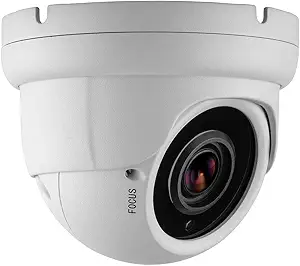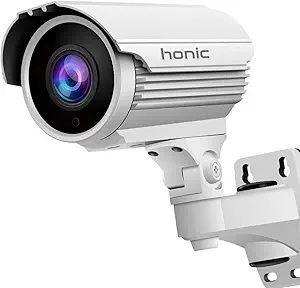







Honic vs AREB: Overview
Comparing Honic and AREB helps you determine which brand is best suited for your needs in Security Cameras. Both brands offer strong choices depending on your budget and key feature requirements.
Key Features & Comparison
Evaluate factors such as build quality, warranty, customer satisfaction, and total value before making your final purchase choice between Honic and AREB.
Picture Quality
When evaluating optical engineering and sensor capabilities, Honic leans heavily toward commercial-grade imaging pipelines that excel in challenging illumination environments. Typically equipped with high-aperture lenses and larger CMOS sensors, Honic cameras produce exceptionally sharp daylight footage characterized by accurate dynamic range and low artifacting, particularly in high-contrast outdoor scenes. Their hardware-driven wide dynamic range (WDR) prevents the overexposure of bright skies while retaining detail in shadowed foregrounds. At night, Honic’s reliance on powerful infrared arrays and ambient-assisted color night vision delivers crisp, noise-free monitoring over extended distances, ensuring reliable facial and license plate recognition without significant motion blur.
In contrast, AREB focuses on optimized consumer clarity, leveraging aggressive digital image enhancement and high megapixel counts to appeal to residential users. While AREB cameras offer impressive static sharpness and vibrant color balance under direct sunlight, their software-based dynamic range processing can occasionally introduce edge halos and compression artifacts during fast motion. In low-light conditions, AREB relies on localized spotlight illumination and integrated digital noise reduction; this provides vivid color night capture up to moderate distances, but it struggles with grain and reduced depth of field in expansive, pitch-black environments. For raw optical fidelity and distant clarity, Honic maintains the technical advantage, whereas AREB delivers a vivid, consumer-tuned image best suited for localized perimeter tracking.
Smart Features & Connectivity
Honic approaches smart functionality from an infrastructure perspective, prioritizing rock-solid connectivity protocols and industrial telemetry. Many Honic systems emphasize Power-over-Ethernet (PoE) deployment or dual-band Wi-Fi with external high-gain antennas, which dramatically reduces latency and dropped packets in complex architectural setups. While their onboard analytics feature standard human and vehicular classification alongside customizable motion tripwires, Honic prioritizes low false-alarm rates over expansive smart-home ecosystem integration. Their API and ONVIF profile support make them ideal for open-platform surveillance networks, though users seeking direct, plug-and-play voice assistant automations may find the setup slightly more technical and utilitarian.
AREB, by comparison, delivers a feature-rich, highly accessible smart ecosystem engineered specifically for modern smart home interoperability. AREB models feature seamless integration with platforms like Amazon Alexa, Google Assistant, and unified mobile apps that prioritize intuitive push notifications and instant two-way audio. On the edge-computing front, AREB incorporates advanced machine learning algorithms capable of pet detection, package recognition, and continuous facial tracking right out of the box. However, AREB's reliance on 2.4 GHz wireless bands in several baseline models makes them more susceptible to local RF congestion, trading Honic’s enterprise-level network resilience for superior consumer convenience and third-party automation.
Privacy & Data Control
Privacy architecture represents one of the starkest differentiators between these two manufacturers, with Honic emphasizing localized sovereignty. Built with enterprise-adjacent frameworks, Honic systems give users total control over their data streams by natively supporting local network video recorders (NVRs), Network Attached Storage (NAS) via RTSP/ONVIF, and direct microSD storage without mandatory cloud tethering. By facilitating completely air-gapped network setups and providing robust user privilege management, Honic ensures that sensitive video feeds never leave the local intranet unless explicitly routed by the administrator. Firmware-level encryption and strict control over inbound/outbound ports provide strong defense against unauthorized remote access.
AREB approaches privacy with a cloud-first methodology, implementing advanced transport-layer security (TLS) and end-to-end AES-256 encryption for data in transit and at rest on their hosted servers. While AREB provides comprehensive in-app privacy controls—such as customizable privacy masking zones, physical lens shutters on select indoor units, and geofenced disarming—the architecture is inherently tied to their proprietary cloud ecosystem for core alert processing. While convenient and compliant with standard consumer data regulations, users who mandate absolute data isolation may view AREB’s persistent cloud telemetry as an unnecessary external footprint compared to Honic's locally autonomous architecture.
Subscription Plans
Honic's commercial heritage translates into a highly cost-effective, zero-subscription ownership model that appeals to budget-conscious and institutional buyers alike. Nearly all core functionalities—including advanced perimeter detection, high-resolution recording, scheduling, and multi-user access—are processed directly on the hardware without paywalls. Because Honic cameras are designed to interface seamlessly with third-party software and local storage media, users avoid recurring monthly overheads, resulting in a predictable total cost of ownership (TCO) that only scales with physical hardware expansion.
Conversely, AREB operates on a modern recurring-service framework, where basic continuous live-view and fundamental motion alerts are free, but the system's most capable smart capabilities are gated behind tiered subscription plans. Features like extended cloud video history, rich notification previews, AI-driven package and pet detection, and automated event categorization typically require an active monthly or annual fee. While AREB’s subscriptions offer premium conveniences such as seamless off-site backup and continuous software-level feature updates without manual maintenance, the cumulative costs over several years make AREB a more expensive proposition over its operational lifespan compared to Honic.