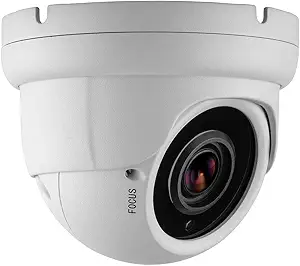
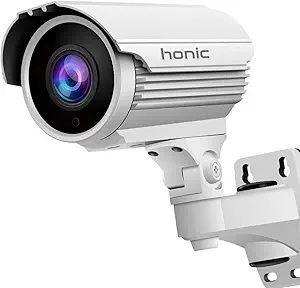
Honic vs AES: Overview
Comparing Honic and AES helps you determine which brand is best suited for your needs in Security Cameras. Both brands offer strong choices depending on your budget and key feature requirements.
Key Features & Comparison
Evaluate factors such as build quality, warranty, customer satisfaction, and total value before making your final purchase choice between Honic and AES.
Picture Quality
When evaluating picture quality, Honic emphasizes consumer-grade optical versatility, generally fielding sensors that output crisp 2K to 4K resolutions with vibrant color profiles optimized for residential surveillance. Their cameras frequently incorporate balanced High Dynamic Range (HDR) tuning and adaptive color night vision through high-output integrated spotlights. This delivers sharp daylight details and distinguishable facial features at typical entryway distances. However, Honic units can exhibit software over-sharpening and digital noise in extreme low-light environments when relying purely on ambient illumination, occasionally muddling fine textures like vehicular license plates at long range.
AES approaches imaging from a more industrial, perimeter-focused standpoint, deploying specialized lenses engineered for optical clarity and high signal-to-noise ratios rather than consumer color vibrancy. AES hardware frequently utilizes wider aperture lenses coupled with high-sensitivity Sony Starvis sensors, ensuring superior native low-light performance without relying heavily on aggressive artificial gain or blooming supplemental lights. While Honic offers punchier, social-ready contrast, AES delivers more scientifically accurate color gamuts and superior dynamic range under high-contrast conditions, making it more reliable for evidence-grade forensics despite a potentially steeper initial calibration curve.
Smart Features & Connectivity
Honic excels in modern edge-computing conveniences, packing its hardware with sophisticated AI algorithms capable of discerning people, vehicles, pets, and package deliveries out of the box. The integration ecosystem is tailored for mainstream smart homes, offering seamless two-way audio latency, responsive native apps, and deep compatibility with voice assistants such as Amazon Alexa and Google Assistant. Dual-band Wi-Fi (2.4GHz/5GHz) connectivity ensures agile deployment and rapid live-stream access, though the reliance on wireless networks can make high-bitrate streaming susceptible to interference or bandwidth throttling on crowded home networks.
Conversely, AES adopts a networking philosophy rooted in stability and professional integration, favoring Power over Ethernet (PoE) and enterprise-grade RTSP/ONVIF connectivity over purely wireless, app-centric setups. While AES includes core smart detection features such as line crossing, intrusion zones, and basic object classification, its user interface is less consumer-friendly and prioritizes integration with third-party Network Video Recorders (NVRs) and professional home automation systems like Control4. Honic wins on plug-and-play smart convenience, but AES establishes a more robust, low-latency, and failure-resistant connection model for mission-critical installations.
Privacy & Data Control
Privacy architecture represents a distinct point of divergence between the two brands. Honic operates predominantly within a hybrid cloud-and-local framework, offering onboard microSD storage alongside its proprietary cloud ecosystem. While Honic utilizes standard TLS/AES-256 encryption in transit and at rest, its reliance on internet connectivity for advanced notification metadata and remote access creates a broader attack surface, requiring users to place substantial trust in the vendor's cloud server infrastructure and firmware patching cadence.
AES, adhering to industrial standards, is designed with a strict local-first architecture that prioritizes sovereign data control. AES cameras can operate entirely air-gapped on dedicated VLANs, transmitting streams directly to local storage arrays or localized NVRs without ever phoning home to external servers. This design virtually eliminates unauthorized cloud telemetry, third-party data profiling, and remote service exploitation. For privacy-conscious consumers and high-security enterprise environments, AES provides an objectively superior security posture, whereas Honic trades absolute containment for accessible remote convenience.
Subscription Plans
The total cost of ownership between Honic and AES is defined by fundamentally different monetization strategies. Honic utilizes a tiered software-as-a-service (SaaS) model to unlock its full potential, placing features like extended cloud recording history, advanced AI detection filters, and smart notification zones behind recurring monthly or annual paywalls. While Honic’s hardware is comparatively affordable upfront, the long-term operational costs can escalate significantly over a multi-camera deployment if users desire the seamless, cloud-backed feature set.
In stark contrast, AES rejects the recurring subscription paradigm, offering a license-free, hardware-complete purchase model. All analytical capabilities, recording schedules, and multi-stream outputs are permanently unlocked at the point of sale, with storage capacity dictated entirely by the user's hard drive selection in their local recording infrastructure. While AES hardware commands a premium upfront investment alongside the added cost of local storage hardware, it offers predictable lifetime economics and zero ongoing fees, presenting a far more economical long-term value for multi-camera deployments.