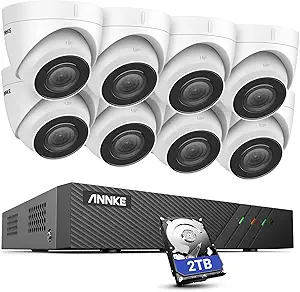
Eufy vs Annke: Overview
Comparing Eufy and Annke helps you determine which brand is best suited for your needs in Security Cameras. Both brands offer strong choices depending on your budget and key feature requirements.
Key Features & Comparison
Evaluate factors such as build quality, warranty, customer satisfaction, and total value before making your final purchase choice between Eufy and Annke.
Picture Quality
When evaluating picture quality, the fundamental distinction between Eufy and Annke lies in their primary deployment architectures and sensor engineering. Eufy primarily designs consumer-focused wireless and wired smart cameras, with top-tier models like the eufyCam 3 offering crisp 4K UHD resolution driven by proprietary BionicMind image processing. In well-lit environments, Eufy balances dynamic range effectively, leveraging high dynamic range (HDR) algorithms to tame harsh backlighting and bring out facial clarity. However, because many Eufy models rely on battery power and Wi-Fi transmission, their video feeds are subject to aggressive bitrate compression, which can introduce artifacting or soft edges during rapid motion, particularly in low-light scenarios where color night vision relies heavily on built-in spotlights rather than purely raw sensor sensitivity.
Conversely, Annke brings commercial-grade surveillance hardware into the residential and SMB sphere, predominantly utilizing Power over Ethernet (PoE) and dedicated NVR setups. High-end Annke cameras, such as those featuring their NightChroma technology, employ significantly larger image sensors (such as 1/1.2-inch ultra-large sensors) paired with F1.0 super-aperture lenses. This optical hardware allows Annke to capture true full-color footage in near-total darkness without relying on supplemental white light, dramatically outperforming Eufy in optical light gathering. Furthermore, because Annke's PoE systems operate over unconstrained wired bandwidth, they transmit at vastly higher bitrates (often utilizing efficient H.265+ encoding), preserving fine details such as license plates, distant foliage, and rapid movement without the compression compromises inherent to battery-powered Wi-Fi cameras.
Smart Features & Connectivity
Eufy excels significantly in user-centric smart functionality, edge processing, and ecosystem cohesion. The centerpiece of Eufy's modern intelligence is its HomeBase 3 hub, which houses on-device BionicMind AI capable of facial recognition, vehicle classification, pet detection, and human package tracking with self-learning capabilities. Integration into consumer smart homes is smooth, with robust compatibility across Amazon Alexa, Google Assistant, and select support for Apple HomeKit (including HomeKit Secure Video on specific 2K models). The mobile companion app is intuitive, delivering rapid push notifications with rich video previews and facilitating effortless two-way audio. However, Eufy's connectivity is tightly bound to Wi-Fi and its proprietary sub-1GHz HomeBase link, which can suffer from range constraints, signal degradation through masonry, and susceptibility to local 2.4GHz interference.
Annke approaches intelligence from a utilitarian, closed-circuit security angle, emphasizing standardized protocols over plug-and-play consumer smart integrations. While modern Annke systems incorporate deep learning algorithms for human and vehicle categorization (AcuSense-derived analytics) to minimize false motion alerts, they lack the polished consumer conveniences like facial identification and seamless voice assistant controls found in Eufy's suite. However, Annke's connectivity infrastructure is undeniably superior for heavy-duty reliability. By prioritizing wired PoE (IEEE 802.3af) and full ONVIF/RTSP compliance, Annke cameras can effortlessly interface with third-party network video recorders, smart home automation hubs like Home Assistant, and platforms like Blue Iris or Synology Surveillance Station, offering an industrial-grade backbone immune to Wi-Fi drops and jamming.
Privacy & Data Control
Eufy built its primary market reputation on the promise of local privacy, championing an architecture where video analysis and storage remain within the physical confines of the user's home via the HomeBase hub. Video files are secured using bank-grade AES-128 or AES-256 encryption, eliminating mandatory cloud transit for standard operations. Despite this solid foundation, Eufy encountered significant reputational friction due to past vulnerabilities that exposed unencrypted thumbnail paths accessible via cloud servers without authentication. While Anker/Eufy has since updated its transparency protocols, implemented WebRTC end-to-end encryption, and provided explicit user toggles for cloud features, the ecosystem still relies on cloud-assisted signaling for remote app connections, leaving a minimal, albeit present, theoretical attack vector.
Annke represents the gold standard for absolute data sovereignty, catering directly to users who prioritize complete isolation from third-party ecosystems. Because Annke's PoE hardware adheres to open standards and communicates directly via local IP infrastructure, the cameras and NVRs can be air-gapped from the wider internet entirely. Users can manage all feeds, recordings, and analytic logs within a local subnet, granting access only via private VPN or self-hosted management software without a single byte of data leaving the premises. There are no mandatory centralized vendor accounts required for core operation, and Annke has no access to user feeds. For security purists who view any consumer cloud connectivity as a systemic risk, Annke’s open, local-first architecture provides vastly superior privacy assurance.
Subscription Plans
Eufy positions itself as an anti-subscription solution in the smart security space, ensuring that virtually all primary functions—including high-resolution local storage, AI-driven facial recognition, and rich notifications—are fully accessible without recurring monthly fees. For users seeking off-site redundancy, Eufy does offer an optional cloud storage tier starting around $2.99 per month for a single camera or $9.99 per month for up to 10 cameras (providing 30-day event history). However, the hardware is explicitly designed to render these subscriptions unnecessary, particularly with the HomeBase 3, which allows users to expand local storage up to an enormous 16TB using standard 2.5-inch SATA hard drives, delivering months or even years of footage archive capability for a one-time hardware cost.
Annke operates on a completely subscription-free philosophy, eschewing recurring cloud fees entirely across its core PoE and analog product catalog. The brand does not attempt to monetize post-purchase software features; all onboard analytics, advanced motion triggers, and multi-channel playback tools are unlocked out of the box. Storage is handled via pre-installed or user-upgraded surveillance-grade HDDs (such as Western Digital Purple or Seagate SkyHawk) housed within their standalone NVRs, easily supporting 4TB to 16TB or more of continuous 24/7 footage. While this model eliminates the operational expenditure of subscriptions entirely, it shifts the financial obligation to upfront capital expenditure, as users must purchase the NVR, cameras, cabling, and storage drives upfront, making Annke a larger initial investment that yields significant long-term cost efficiency.
Compare current retail pricing, active promotions, and verified stock availability directly from authorized stores: