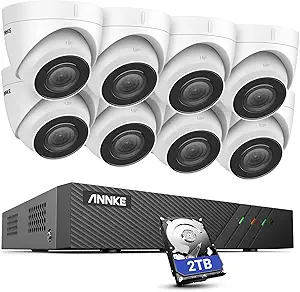








Blink vs Annke: Overview
Comparing Blink and Annke helps you determine which brand is best suited for your needs in Security Cameras. Both brands offer strong choices depending on your budget and key feature requirements.
Key Features & Comparison
Evaluate factors such as build quality, warranty, customer satisfaction, and total value before making your final purchase choice between Blink and Annke.
Picture Quality
When evaluating picture quality, Blink and Annke cater to fundamentally different tiers of optical engineering. Blink, designed primarily for wire-free convenience, standardizes on 1080p Full HD resolution across its mainstream lineup, with modest CMOS sensors optimized for minimal power draw rather than high dynamic range. Under ideal daytime lighting, Blink cameras produce clear, serviceable video with natural colors and adequate wide-angle coverage for basic residential monitoring. However, its compressed bitrates and digital zoom capabilities quickly reveal pixelation, making long-distance facial recognition or reading vehicle license plates challenging. At night, Blink relies on standard 850nm infrared LEDs to produce monochrome footage that performs reliably within a narrow 15-to-25-foot corridor, though high-contrast motion often results in motion blur and ghosting.
Annke, by contrast, operates with professional-grade imaging hardware that dramatically outperforms Blink in visual fidelity. Specializing in hardwired Power-over-Ethernet (PoE) and high-bandwidth analog setups, Annke routinely offers true 4K (8MP) Ultra HD resolution paired with high-performance Sony Starvis sensors, large f/1.0 apertures, and superior optical glass. This allows Annke cameras to maintain exceptionally high bitrates and capture crisp, fine details even at significant distances. Furthermore, Annke’s proprietary NightChroma and Color Night Vision technologies utilize ultra-sensitive sensors and supplemental warm lighting to produce vivid, full-color nocturnal footage in near-total darkness, eliminating the muddy infrared wash typical of battery-operated systems like Blink.
Smart Features & Connectivity
In the smart home ecosystem, Blink shines with streamlined, cloud-centric usability and effortless integration within the Amazon Alexa environment. Powered by proprietary low-power chips, Blink modules establish a low-frequency radio link with the Blink Sync Module, which offloads processing to preserve camera battery life while connecting to standard 2.4 GHz Wi-Fi networks. Smart capabilities include customizable motion detection zones, basic temperature monitoring, and low-latency two-way audio. The Blink companion app offers an intuitive, consumer-friendly interface that triggers Alexa announcements and displays live feeds on Echo Show devices seamlessly. However, Blink lacks native support for Google Home, Apple HomeKit, or third-party automated protocols, and its advanced motion analytics are relatively basic compared to enterprise surveillance systems.
Annke approaches connectivity and intelligence from a robust, standalone security framework, prioritizing wired stability over battery simplicity. Utilizing PoE or coaxial standards, Annke bypasses the common Wi-Fi congestion, signal dropouts, and latency issues that can plague wireless systems like Blink. On the smart feature side, Annke incorporates edge-based AI algorithms capable of sophisticated human and vehicle classification, virtual tripwire crossing, and perimeter intrusion detection directly on the camera or Network Video Recorder (NVR). While Annke supports mobile alerts, remote viewing, and partial smart assistant integration, its companion interfaces and configuration menus are far more technical, appealing to users who prefer industrial-grade automation, ONVIF compliance, and RTSP streaming over plug-and-play voice assistant gimmicks.
Privacy & Data Control
Privacy and data governance represent a stark philosophical divergence between Blink and Annke. As an Amazon subsidiary, Blink is inherently cloud-tethered, routing video streams, authentication, and push notifications through Amazon Web Services (AWS) infrastructure. Although Blink encrypts footage in transit and at rest, users must trust Amazon's broader privacy policies and data handling practices. Blink does provide a local storage option via a USB flash drive connected to the Sync Module 2, but initial configuration, clip indexing, and live-view features still mandate an active internet connection to Amazon's servers. For users concerned about corporate telemetry, cloud vulnerabilities, or potential remote service deprecation, Blink’s cloud dependencies present unavoidable trade-offs.
Annke positions itself as a champion of decentralized, user-controlled security where the property owner retains total sovereignty over all recorded assets. Operating primarily via local NVRs, DVRs, or onboard microSD cards, Annke systems do not require any internet connection to record, store, or review footage. Users can isolate Annke cameras entirely within an offline Virtual Local Area Network (VLAN), preventing external data exfiltration and insulating the network from unauthorized internet intrusion. Because there are no mandatory corporate accounts or external servers managing video retention, Annke delivers an exceptionally private, zero-trust infrastructure that is ideally suited for privacy purists, commercial deployments, and high-security residential perimeters.
Subscription Plans
Blink employs a typical platform-as-a-service model, offering affordable entry-level hardware subsidized by recurring cloud subscription plans. The Blink Subscription Plan is split into Basic (covering a single device) and Plus (covering unlimited devices at a single location), unlocking 60 days of rolling cloud video history, rapid video sharing, and custom motion recording lengths. While users can circumvent monthly fees by inserting a USB drive into the Sync Module 2 for local clip storage, the experience without a subscription is distinctly compromised: users forfeit thumbnail previews, batch video deletions, and instant video access. Over multiple years of ownership, these small monthly or annual fees accumulate, noticeably increasing the total cost of ownership for multi-camera installations.
Annke completely upends the subscription paradigm by offering a hardware-first, subscription-free ownership model. When you purchase an Annke PoE or analog system, 100% of the hardware and software functionality—including 24/7 continuous recording, full-resolution AI human/vehicle detection, remote push notifications, and multi-channel playback—is completely unlocked out of the box. Storage capacity is dictated solely by the size of the hard drive installed in your NVR, meaning terabytes of footage can be archived locally for months without incurring a single recurring fee. While Annke demands a higher upfront investment in cables, hard drives, and mounting equipment, it delivers vastly superior long-term financial value, freeing consumers permanently from monthly security overhead.