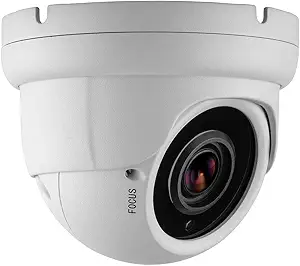
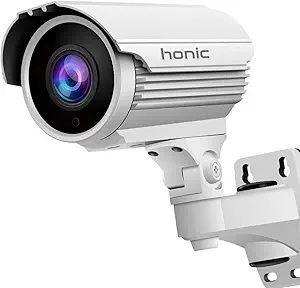
Amcrest vs Honic: Overview
Comparing Amcrest and Honic helps you determine which brand is best suited for your needs in Security Cameras. Both brands offer strong choices depending on your budget and key feature requirements.
Key Features & Comparison
Evaluate factors such as build quality, warranty, customer satisfaction, and total value before making your final purchase choice between Amcrest and Honic.
Picture Quality
When evaluating picture quality, Amcrest holds a notable engineering advantage by offering native Ultra HD 4K (8-megapixel) sensors paired with sophisticated optical setups, including motorized varifocal lenses and advanced wide dynamic range (WDR) processing. Amcrest leverages specialized low-light image processors and wide-aperture lenses that excel at handling extreme contrast, such as direct sunlight or shadowed entryways, while their night vision capabilities span both high-powered infrared arrays and full-color night vision LED options. The resulting video feeds demonstrate superior edge sharpness, accurate color balance, and fine detail retention across varied focal lengths, which is critical for positive identification of license plates or facial features.
Honic, which predominantly targets budget-conscious and mainstream surveillance installations, typically tops out at 1080p Full HD or entry-level 2K (4MP) resolutions with fixed-focal lenses. While Honic cameras deliver adequately clear imagery for general perimeter monitoring and situational awareness, they often utilize less capable digital image processing chips that struggle with digital noise in high-contrast environments and low-light transitions. The dynamic range on Honic units is narrower, frequently leading to blown-out highlights or crushed dark zones, and their standard infrared LEDs produce a narrower beam that can result in a harsh center hotspot with peripheral falloff compared to Amcrest's uniformly illuminated night vision.
Smart Features & Connectivity
Amcrest provides an extensive, enterprise-grade connectivity suite combined with advanced artificial intelligence edge detection. Most Amcrest cameras feature edge-based AI capable of differentiating between humans, vehicles, and general motion, significantly reducing false alarm fatigue without requiring cloud processing. Furthermore, Amcrest's connectivity ecosystem is exceptionally robust, supporting Power over Ethernet (PoE), dual-band Wi-Fi (2.4 GHz and 5 GHz), and universal industry protocols such as ONVIF Profiles S, G, and T, as well as RTSP streams. This protocol versatility makes Amcrest ideal for integration into smart home platforms like Home Assistant, third-party NVRs, and automation ecosystems.
Honic focuses on a simplified, consumer-friendly approach to smart features, emphasizing straightforward mobile setup via QR code scanning and direct 2.4 GHz Wi-Fi pairing. Its smart detection capabilities are generally limited to basic passive infrared (PIR) or standard pixel-based motion sensing, which can lead to higher rates of false notifications caused by wind-blown foliage, passing headlights, or insect interference. In terms of broader network connectivity, Honic cameras often lack comprehensive ONVIF support and RTSP streaming flexibility, confining users to their proprietary mobile application and limiting interoperability with advanced third-party smart home hubs or dedicated video management systems.
Privacy & Data Control
Data sovereignty and user privacy represent one of Amcrest's strongest architectural pillars. Amcrest hardware is designed with local-first operational capabilities, meaning the cameras can function entirely isolated from the external internet on an air-gapped local area network (LAN) or behind a dedicated VLAN. Users can stream video directly to local Network Video Recorders (NVRs), Network Attached Storage (NAS) devices via FTP/SMB/NFS, or high-capacity onboard MicroSD cards without ever establishing a cloud account. Furthermore, Amcrest provides granular administrator controls, allowing users to disable external ports, update firmware manually, and enforce secure TLS/SSL encryption for all internal network streams.
Conversely, Honic operates predominantly on a cloud-dependent infrastructure where remote access and push notifications necessitate constant telemetry back to remote cloud servers. While Honic implements standard transport encryption to safeguard data in transit, the architecture provides fewer native tools for users wanting to run an entirely isolated local network setup. Users generally have less visibility into firmware-level network traffic and fewer options to restrict outbound calls, which may present data governance concerns for privacy-conscious buyers seeking total autonomy from third-party vendor infrastructure and multi-tenant cloud ecosystems.
Subscription Plans
Amcrest maintains a highly consumer-friendly ownership model by ensuring all core surveillance, alerting, and AI detection features remain entirely functional without an ongoing subscription. For users desiring off-site redundancy, the brand offers optional Amcrest Cloud plans, which provide flexible cloud storage tiers based on continuous or motion-activated retention windows (such as 7-day, 14-day, or 30-day rolling history). The crucial advantage is that Amcrest treats cloud backup purely as an additive service; bypassing the subscription incurs zero loss of local recording functionality, edge-based object categorization, or mobile push notification performance.
Honic's commercial model tends to follow modern consumer camera trends, where advanced functionality, extended video history, and richer alert previews are heavily tied to recurring subscription tiers. While Honic hardware often features low initial purchase prices, ongoing ownership costs can accumulate if users require extended cloud video archiving or priority customer support. While local MicroSD card slots are usually provided on Honic devices to mitigate subscription needs, the user experience without an active plan feels comparatively restricted, positioning Amcrest as the more economical and flexible long-term investment for users avoiding recurring fees.