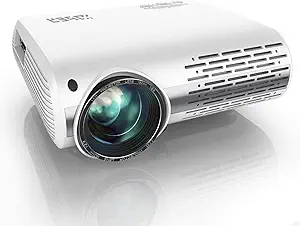
YABER vs WiMiUS: Overview
Comparing YABER and WiMiUS helps you determine which brand is best suited for your needs in Projectors. Both brands offer strong choices depending on your budget and key feature requirements.
Key Features & Comparison
Evaluate factors such as build quality, warranty, customer satisfaction, and total value before making your final purchase choice between YABER and WiMiUS.
Product Selection
When evaluating product selection, YABER and WiMiUS both compete fiercely in the budget-to-midrange projector segment, but their catalog strategies diverge slightly. YABER offers a more diverse portfolio that spans ultra-portable lifestyle units, traditional home theater LCD projectors, and higher-end smart models with integrated streaming operating systems, such as their Ace and K series. YABER has increasingly pushed into design-forward products, including modern outdoor projectors with integrated handles and advanced autofocus sensors, signaling a conscious effort to challenge premium lifestyle brands with a versatile ecosystem of compact to high-lumen devices.
WiMiUS maintains a more focused lineup predominantly centered on utilitarian, high-value LCD projectors optimized for home entertainment and casual gaming. Their product naming convention (e.g., P and K series) concentrates on delivering standard 1080p native resolution across various brightness tiers, frequently bundling units with dedicated carrying bags and portable screens. While WiMiUS does offer compact, battery-powered mini projectors, their catalog does not expand as aggressively into premium cosmetic designs or hybrid high-brightness categories as YABER's does. Consequently, consumers seeking unique form factors or smart-lifestyle designs will find more breadth with YABER, whereas those prioritizing classic tabletop home theater units will find WiMiUS's streamlined selection easier to navigate.
Affordability
Affordability is the foundational pillar for both brands, making them popular alternatives to legacy home cinema manufacturers. YABER positions its entry-level units at very accessible sub-$100 price points, while scaling its mid-tier and flagship smart projectors upward into the $300 to $500 bracket. This pricing architecture reflects YABER's inclusion of modern conveniences such as automated keystone correction, autofocus, and premium audio collaborations (like JBL sound systems in select models). While still exceptionally affordable compared to traditional lamp or laser DLP units, YABER's higher-tier models require a slightly larger financial commitment to acquire their advanced convenience features.
WiMiUS, on the other hand, frequently edges out YABER on pure cost-to-spec value. WiMiUS regularly positions its native 1080p projectors at aggressive discounts, often competing directly on Amazon and third-party marketplaces with substantial coupons that place high-lumen models in the $150 to $250 range. Additionally, WiMiUS frequently bundles essential accessories—such as custom-fit carrying cases, high-gain portable screens, or cleaning kits—directly in the retail box, reducing total out-of-pocket costs for first-time buyers. For value-driven shoppers aiming to maximize screen size and lumen output per dollar spent, WiMiUS generally holds a slight advantage in direct affordability.
Quality/Durability
In terms of build quality and mechanical durability, both manufacturers rely heavily on single-panel LCD light engines paired with LED light sources, a cost-effective design that demands careful thermal management. YABER has made significant strides in recent hardware generations by engineering sealed optical engines in models like the K2s. This sealed architecture drastically reduces the risk of dust ingress, which is the primary cause of yellowing panels and burnt-in dark spots typical of budget LCD projectors. Furthermore, YABER incorporates sturdier polycarbonate housings and more refined internal cooling channels, resulting in a lower acoustic noise profile and a longer operational lifespan under regular use.
WiMiUS constructs durable, lightweight chassis that hold up well for casual household handling, though their cooling solutions often run noticeably louder under full power. While WiMiUS has progressively introduced semi-sealed and sealed optical designs on newer iterations, many of their budget-friendly models still feature conventional filtered vents that require periodic cleaning to maintain adequate airflow. Mechanically, WiMiUS components—such as manual focus dials and tilt feet—function reliably, but fit and finish feel distinctly utilitarian compared to the sleeker, more robust manufacturing standards of modern YABER hardware. For prolonged, daily heavy usage, YABER's advancements in dust-sealed optics give it an edge in sustained durability.
Customer Support & Warranty
Customer support for both YABER and WiMiUS operates predominantly through direct-to-consumer digital channels rather than dedicated local service centers. YABER provides a standard one-year warranty on most hardware, often extending up to three years upon product registration through their official website. Their customer service team is accessible via email, social media, and integrated support portals on their smart operating systems. Response times are generally respectable, and YABER has demonstrated a willingness to issue full replacements for catastrophic hardware defects or firmware-related bootloader issues within the active warranty window.
WiMiUS has cultivated a surprisingly strong reputation in the budget electronics sphere for aggressive, highly accommodating customer service. Standard WiMiUS warranties typically cover three years, and the brand is well known for offering rapid, no-hassle replacements or partial refunds when users encounter panel burn-in, dead pixels, or power supply failures. While neither brand offers the enterprise-grade turnaround or extensive certified repair networks of brands like Epson or BenQ, WiMiUS often outpaces YABER in customer goodwill by actively resolving customer inquiries with minimal bureaucratic friction, making the post-purchase experience feel lower-risk for cost-conscious consumers.
Picture Quality
Picture quality represents the most critical performance benchmark for both brands, with both utilizing native 1080p LCD panels that support 4K input downscaling. YABER units generally stand out in terms of color fidelity, contrast optimization, and image uniformity. Models featuring advanced auto-calibration software deliver sharper corner-to-corner focus, minimizing the peripheral chromatic aberration and soft edges common in budget projector optics. Furthermore, YABER tends to calibrate its color profiles with warmer, more cinematic tones, resulting in more natural skin tones and reduced clipping in high-brightness scenes, although maximum black levels remain limited by the inherent constraints of transmissive LCD technology.
WiMiUS projectors focus heavily on raw luminous output and high perceived sharpness, which works well in environments with moderate ambient light or for casual outdoor movie nights. However, this push for higher brightness often yields a cooler, blue-shifted color temperature out of the box, requiring manual calibration in the picture settings to achieve a balanced image. WiMiUS also exhibits slightly less uniform focus across the frame compared to YABER's premium optics, with center sharpness occasionally coming at the expense of soft outer corners. While WiMiUS delivers bright, punchy, and vibrant imagery that impresses in casual settings, YABER provides a more refined, color-accurate, and uniformly sharp visual performance for critical movie watching.