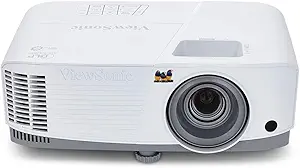








ViewSonic vs WiMiUS: Overview
Comparing ViewSonic and WiMiUS helps you determine which brand is best suited for your needs in Projectors. Both brands offer strong choices depending on your budget and key feature requirements.
Key Features & Comparison
Evaluate factors such as build quality, warranty, customer satisfaction, and total value before making your final purchase choice between ViewSonic and WiMiUS.
Product Selection
ViewSonic boasts an expansive, enterprise-grade catalog that caters to virtually every tier of projection technology and user demographic. As an established AV giant, their portfolio spans ultra-portable LED lifestyle projectors, high-brightness classroom and boardroom lamp units, advanced 4K UHD home theater systems, and ultra-short-throw (UST) laser models. Furthermore, ViewSonic develops specialized high-end installation projectors engineered for large venues, offering interchangeable lenses, motorized zoom, and advanced geometric correction. This technological diversity—spanning DLP, laser, and modern LED light engines—ensures that buyers can source an optimized optical solution tailored to specific ambient lighting conditions and architectural demands.
In stark contrast, WiMiUS operates strictly within the direct-to-consumer budget consumer market, focusing primarily on compact lifestyle and entry-level home entertainment projectors. Their product lineup is largely composed of single-panel LCD projectors augmented with LED light sources, designed with integrated smart operating systems, autofocus, and built-in screen mirroring capabilities. While WiMiUS continuously iterates upon its selection by offering different chassis form factors, outdoor-focused portable models, and varied brightness claims, their selection lacks the architectural, commercial, and high-performance variety seen in ViewSonic's catalog. Buyers looking for ultra-short throw laser projection, native 4K imaging, or high-lumens professional hardware will not find those options within WiMiUS's targeted portfolio.
Affordability
WiMiUS holds an undeniable advantage when it comes to raw consumer affordability, targeting the sub-$500 and frequently sub-$250 market space. By leveraging cost-effective single-panel LCD technology, off-the-shelf LED modules, and integrated system-on-chip streaming architectures, WiMiUS provides casual consumers with functional big-screen entertainment at a fraction of the cost of legacy brands. For users seeking a low-risk entry into projection—such as for occasional backyard movie nights, dorm rooms, or secondary children's playrooms—WiMiUS delivers remarkable initial value per dollar spent, lowering the barrier to large-format display adoption significantly.
ViewSonic operates across a much higher price spectrum, with its entry-level consumer models often starting where WiMiUS's most premium offerings top out. While ViewSonic provides budget-friendly business and education projectors, the cost of DLP chipsets, high-grade glass optical assemblies, and high-wattage lamp or laser components drives their baseline pricing upward into the hundreds and thousands of dollars. However, ViewSonic's affordability must be evaluated through the lens of long-term total cost of ownership (TCO) and certified performance metrics; their products adhere to internationally recognized ANSI lumens standards, ensuring consumers receive calibrated, verifiable optical output rather than inflated marketing figures.
Quality/Durability
ViewSonic's engineering demonstrates rigorous industrial standards, relying heavily on Texas Instruments DLP chipsets, sealed optical engines, and precision-molded glass lenses. This mechanical and thermal sophistication prevents common optical degradation issues, such as dust intrusion, internal panel burning, and optical alignment drift. Their high-end lamp and laser units incorporate advanced cooling systems with low fan noise profiles and robust heat dissipation, ensuring operational longevity that regularly spans tens of thousands of hours in commercial, educational, and dedicated home theater environments.
WiMiUS designs its projectors for consumer convenience and lower production costs, which inherently introduces structural and optical compromises. While their modern chassis designs are compact and visually appealing, the reliance on single-panel LCD architecture makes them susceptible to internal heat accumulation, which over extended use can cause panel discoloration, dead pixels, or premature LED burn-in. Although WiMiUS incorporates dust-prevention filters and solid-state LED illumination rated for long theoretical lifetimes, the overall mechanical durability, internal thermal management, and long-term optical fidelity remain well below the robust engineering standards established by ViewSonic.
Customer Support & Warranty
ViewSonic provides an enterprise-class support infrastructure backed by decades of regional operations across North America, Europe, and Asia. Most ViewSonic projectors include a standard three-year limited parts and labor warranty, complemented by a one-year lamp warranty or extended coverage on solid-state laser light sources. Consumers and corporate clients benefit from dedicated technical call centers, localized repair and return hubs, and accessible firmware updates hosted on robust, long-term web portals. This structured corporate support framework provides significant security for institutional and serious home theater buyers.
WiMiUS relies on a consumer-direct support strategy primarily operated through e-commerce portals, social channels, and responsive online customer service email desks. Although WiMiUS customer service is frequently praised for its rapid response times, generosity in issuing hassle-free replacements, and offering extended warranties upon product registration, it lacks the formal institutional backing of a global hardware manufacturer. There are no certified physical repair depots or long-term component inventory lines, meaning hardware defects outside of warranty replacement periods typically render a projector non-repairable, leaving users reliant on full-unit swaps rather than component-level servicing.
Picture Quality
ViewSonic dominates the visual fidelity category, offering superior color accuracy, contrast dynamic range, and authentic lumen outputs. Utilizing proprietary Cinema SuperColor+ technology, high Rec.709 and DCI-P3 color gamut coverage, and advanced DLP micro-mirror arrays, ViewSonic delivers razor-sharp text, fluid motion handling, and nuanced shadow details. Whether projecting calibrated SDR content or 4K HDR mastering profiles, their optical blocks achieve deep black levels and crisp edge-to-edge focus without the chromatic aberration, severe vignetting, or digital edge-enhancement artifacts common in lower-tier consumer displays.
WiMiUS provides adequate, vibrant imagery suited for casual viewing in strictly light-controlled, dark rooms, but falls short under critical analysis. Most of their models offer native 1080p resolution and process 4K inputs, delivering pleasant center-image clarity for standard streaming content. However, due to single-LCD panel limitations and inexpensive plastic lens elements, WiMiUS projectors struggle with noticeable corner softness, elevated black levels that veer toward cloudy gray, and limited dynamic range. Furthermore, their brightness ratings cannot compete with ambient light, meaning the picture quickly washes out unless viewed in pitch-black conditions.