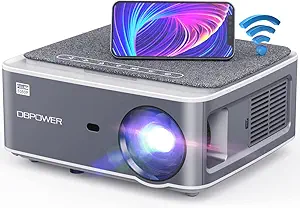
Optoma vs DBPOWER: Overview
Comparing Optoma and DBPOWER helps you determine which brand is best suited for your needs in Projectors. Both brands offer strong choices depending on your budget and key feature requirements.
Key Features & Comparison
Evaluate factors such as build quality, warranty, customer satisfaction, and total value before making your final purchase choice between Optoma and DBPOWER.
Product Selection
Optoma maintains an expansive, enterprise-grade catalog that caters to almost every niche within the projection market. Their product lines span entry-level 1080p home theater units, specialized ultra-short-throw (UST) laser systems, high-framerate competitive gaming displays, and high-lumen commercial installation projectors designed for auditoriums and corporate boardrooms. By employing a diverse mix of light engines—including traditional metal-halide lamps, solid-state LEDs, and DuraCore phosphor lasers—Optoma ensures that consumers and AV professionals can select an exact chassis, throw ratio, and optical configuration that suits their specific physical environment and ambient light conditions.
Conversely, DBPOWER operates with a focused, consumer-centric catalog engineered primarily for the ultra-budget and portable entertainment tiers. Rather than offering specialized optics or commercial hardware, DBPOWER concentrates on compact, single-panel LCD projectors designed for informal indoor movie nights, children's bedrooms, and outdoor backyard setups. Their portfolio frequently consolidates basic connectivity features like integrated dual-band Wi-Fi, Bluetooth transmitters, and bundled tripod mounts into a handful of core iterations. While this streamlined selection makes entry-level purchasing straightforward for casual users, DBPOWER completely lacks the technical breadth, specialized optical designs, and high-performance commercial tiers present in Optoma's portfolio.
Affordability
When evaluated strictly on upfront hardware acquisition costs, DBPOWER holds a dominant position in the budget consumer segment. The brand specializes in sub-$300 units, frequently retailing functional native 720p and 1080p projectors for less than the price of a standard replacement lamp from legacy AV brands. This aggressive price-to-performance ratio democratizes large-format projection for students, casual viewers, and budget-conscious families who want a 100-inch display footprint without committing to complex AV installations or costly surround sound systems. However, this immediate affordability comes with compromises in optical uniformity, color fidelity, and thermal efficiency.
Optoma occupies the mid-range to premium professional pricing brackets, with mainstream consumer projectors generally starting around $500 and their high-end 4K laser or professional installation units easily exceeding $2,000 to $5,000. While the upfront investment is substantially higher, Optoma's pricing structure reflects precision optical components, superior DLP processing chips, advanced dynamic iris mechanisms, and high-grade cooling systems. For serious home theater enthusiasts and commercial entities, the cost of an Optoma unit is justified by true long-term value, sustained color calibration, higher resale value, and durable solid-state light engines rated for up to 30,000 hours of continuous use.
Quality/Durability
Optoma's engineering benchmarks prioritize rigorous thermal management, optical stability, and structural longevity. Most Optoma models integrate Texas Instruments DLP (Digital Light Processing) technology coupled with hermetically sealed optical engines rated up to IP5X or IP6X for dust resistance. This sealed construction prevents ambient dust from settling on internal light pathways, eliminating the common projector plague of permanent 'dust blobs' on the projected image. Backed by solid internal heatsinks, quiet variable-speed cooling fans, and high-grade circuit boards, Optoma projectors are engineered to withstand extensive daily duty cycles without significant lumen decay or thermal warping.
DBPOWER builds its projectors around entry-level single-LCD transmissive panels illuminated by high-output white LEDs. While this architecture allows for extremely lightweight chassis designs and low power draw, single-LCD panels are inherently susceptible to thermal stress and light pathway contamination. Over extended periods of continuous usage, the heat generated by the LED array can cause optical polarization degradation, often resulting in yellowing or burned patches near the center of the image. Furthermore, because these budget units rarely utilize fully sealed optical engines, particulate matter can bypass basic intake filters, requiring manual cleaning to maintain an artifact-free image over time.
Customer Support & Warranty
Optoma offers a traditional corporate AV support infrastructure that includes dedicated regional service centers, technical ticketing systems, and comprehensive warranty coverage. Standard consumer units generally ship with a one- to two-year limited parts and labor warranty, with enterprise models and laser light engines frequently covered for up to three to five years or a specific operational hour threshold. Furthermore, Optoma stocks replacement internal components, power supplies, and authorized lamp modules, giving institutional and high-end residential users a reliable path for maintenance, repair, and legacy technical documentation well beyond the retail return window.
DBPOWER relies primarily on direct-to-consumer e-commerce customer service channels, utilizing direct email support, messaging via third-party retail platforms, and social channels. While the brand is known for offering rapid, no-hassle replacements or partial refunds during the initial 30-to-90-day return window, it lacks physical domestic repair centers and certified technician networks. Long-term post-warranty repairs are generally impractical, as DBPOWER does not supply individual internal component replacements like logic boards or replacement LCD ribbons. Instead, their customer support is optimized for rapid replacement cycles during the warranty timeframe rather than component-level maintenance.
Picture Quality
Optoma delivers reference-grade visual performance through high-precision glass lenses, advanced color wheels, and modern DLP projection tech. Their home theater and gaming models routinely feature true 4K UHD pixel-shifting resolution, wide color gamuts meeting DCI-P3 standards, and robust HDR10/HLG tone mapping. Optoma models also provide native 24p cinema playback, exceptionally low input lag (down to 4ms on specific gaming models), and true dynamic contrast ratios that produce deep, ink-like blacks and exceptional shadow detail. Because Optoma uses dedicated optical glass rather than molded resin, the focus uniformity remains sharp from the center of the image out to the extreme corners without chromatic aberration.
DBPOWER delivers acceptable, colorful imagery suitable for darkened rooms, but its picture quality is constrained by single-LCD optical mechanics and plastic lens assemblies. While many current models accept 4K input signals and natively resolve 1080p, the real-world brightness is significantly lower—often measuring between 150 to 350 ANSI lumens despite inflated marketing claims. Contrast is predominantly flat with elevated black levels that appear dark gray, washing out nuanced shadow details in low-key cinematic scenes. Edge-to-edge sharpness is also a compromise; focusing the center of a DBPOWER image typically results in softened focus and mild geometric distortion around the outer perimeters of the frame.