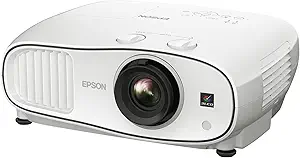






Epson vs Sony: Overview
Comparing Epson and Sony helps you determine which brand is best suited for your needs in Projectors. Both brands offer strong choices depending on your budget and key feature requirements.
Key Features & Comparison
Evaluate factors such as build quality, warranty, customer satisfaction, and total value before making your final purchase choice between Epson and Sony.
Product Selection
Epson dominates the market in terms of sheer portfolio breadth, catering to virtually every display need imaginable. Their product line spans portable ultra-compact units, budget classroom fixtures, enterprise-grade meeting room installations, and dedicated home cinema devices ranging from entry-level 1080p to high-end 4K pixel-shifting laser units. This extensive catalog includes ultra-short-throw (UST) living room models like the EpiqVision series, traditional lamp-based value projectors, and high-lumen commercial installation projectors capable of complex multi-unit stacking and edge blending, ensuring that consumers and professionals can find a bespoke device tailored to their exact spatial and environmental constraints.
In contrast, Sony maintains a tightly curated, highly focused selection of projectors that primarily targets high-end dedicated home theaters, commercial cinema venues, and specialized simulation environments. Sony famously exited the low-cost and consumer business projector space, choosing instead to focus almost exclusively on native 4K SXRD (Silicon X-tal Reflective Display) technology and high-output laser light engines. While this strategic focus results in an exceptionally premium lineup with uncompromising engineering, it leaves significant gaps in Sony's offerings for buyers seeking entry-level home theater displays, ultra-short-throw lifestyle units, or highly portable business projectors, where Epson holds a major competitive advantage.
Affordability
When analyzing affordability, Epson stands out as the undisputed leader in providing high price-to-performance value across consumer and commercial tiers. Epson makes big-screen projection accessible through affordable 3LCD lamp models starting under a thousand dollars, as well as competitively priced mid-tier 4K PRO-UHD laser projectors that provide cinematic experiences without exorbitant financial outlays. Furthermore, total cost of ownership remains low thanks to relatively inexpensive replacement lamps, accessible filter parts, and high energy efficiency, enabling buyers on variable budgets to deploy immersive displays without substantial upfront capital.
Sony operates almost strictly at the luxury tier of the projector market, where their introductory native 4K laser models often command prices equivalent to Epson's flagship consumer hardware. Sony's utilization of bespoke SXRD chips, precision motorized glass optics, and advanced X1 processor architecture inherently inflates production costs, which is reflected in their substantial MSRPs. While cinephiles and custom installers justify the significant investment by pointing to unmatched uncompressed 4K clarity and reference-grade contrast, Sony simply does not compete in the value-oriented or budget segments, positioning itself purely as a premium, capital-intensive alternative.
Quality/Durability
Epson constructs robust, reliable projection systems utilizing proprietary 3LCD optical blocks that effectively eliminate the color-wheel mechanical failure risks common in single-chip DLP competitors. In recent years, Epson's transition toward solid-state laser phosphor light engines has dramatically improved durability, offering up to 20,000 to 30,000 hours of maintenance-free operation without lamp degradations. While chassis designs on entry-level models feature functional plastics that prioritize cooling airflow over luxury aesthetics, Epson's thermal management, sealed optical engines in high-end units, and comprehensive dust filtration yield devices capable of enduring years of rigorous daily use.
Sony's build quality reflects reference-class, industrial-grade luxury engineering characterized by heavy, acoustically dampened chassis and precision-machined motorized glass lens assemblies. The integration of Sony's Z-Phosphor laser light sources provides exceptional longevity, delivering stable luminance and consistent color tracking over tens of thousands of hours without maintenance. Early-generation SXRD panels occasionally faced criticism from enthusiasts regarding micro-polarizer optical degradation in humid environments, but modern Sony laser models feature heavily fortified, hermetically sealed optical architectures that deliver structural durability and acoustic performance commensurate with their luxury price points.
Customer Support & Warranty
Epson has established one of the most respected customer support structures in the consumer display industry, recognized for its accessibility and favorable warranty terms. Most mid-tier and high-end Epson projectors include multi-year warranties—often extending to two or three years—bolstered by their standout 'Extra Care Road Service' program, which offers overnight replacement unit swaps if hardware failure occurs during the covered period. Furthermore, Epson's ubiquitous presence across global consumer retail ensures that replacement parts, operational documentation, and certified local technicians are easily accessible to end-users.
Sony's support ecosystem is uniquely bifurcated, catering heavily to custom integration (CI) channels and commercial AV integrators through their Sony Professional Support division. High-end consumer SXRD projectors typically come backed by a robust three-year limited warranty, accompanied by specialized technical concierge services designed to interface directly with professional installers rather than DIY consumers. While individual consumers may encounter slower turnaround times through standard direct consumer channels compared to Epson's immediate exchange services, high-end buyers working through authorized custom AV dealers experience white-glove warranty and calibration assistance tailored to high-end home theater installations.
Picture Quality
Epson delivers exceptional visual impact primarily through vibrant color brightness, driven by its 3LCD architecture which outputs equal white and color lumens without the dreaded 'rainbow effect' artifacting inherent to single-chip DLP. While Epson's consumer units often rely on sophisticated pixel-shifting technology (4K PRO-UHD) to achieve UHD resolutions rather than utilizing native 4K micro-displays, the resulting image is remarkably sharp, dynamic, and radiant even in ambient light conditions. Flagship models featuring laser engines and UltraBlack technology achieve deep, cinematic black levels, though they inherently face physical limits in absolute native contrast compared to reflective liquid crystal designs.
Sony is widely celebrated as the gold standard in picture quality, powered by true native 4K SXRD micro-displays paired with cinema-grade image processing derived from their professional broadcast monitors. The inclusion of the 'X1 for Projector' processor facilitates real-time, frame-by-frame HDR tone mapping, object-based super resolution, and Digital Focus Optimizers that preserve micro-details and texture across the entire canvas. Sony's native intra-scene black levels, depth perception, and motion handling are virtually peerless, resulting in a three-dimensional, filmic presentation that surpasses pixel-shifted alternatives and satisfies the most demanding home theater purists.