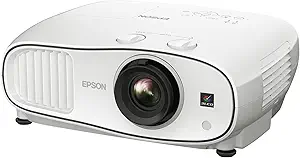






Epson vs Nebula: Overview
Comparing Epson and Nebula helps you determine which brand is best suited for your needs in Projectors. Both brands offer strong choices depending on your budget and key feature requirements.
Key Features & Comparison
Evaluate factors such as build quality, warranty, customer satisfaction, and total value before making your final purchase choice between Epson and Nebula.
Product Selection
Epson operates as an industry titan with an exceptionally broad and diversified catalog that spans virtually every commercial and residential projection niche. Their portfolio encompasses high-end, dedicated home theater projectors like the Pro Cinema series, ultra-short-throw living room laser displays such as the EpiqVision line, heavy-duty commercial venue installations, and cost-effective classroom units. By designing hardware tailored to everything from dedicated subterranean darkrooms requiring motorized lenses to sunlit corporate boardrooms needing high-lumen output, Epson provides deep configuration options across traditional chassis designs and cutting-edge solid-state laser systems.
Nebula, an Anker sub-brand, takes a sharply focused, lifestyle-centric approach, prioritizing portability, smart software integration, and compact footprints. Their product line is divided cleanly between ultra-portable cylindrical models like the Capsule series, rugged outdoor units like the Mars line, and premium smart laser projectors such as the Cosmos Laser 4K. While Nebula completely lacks high-end enterprise hardware, ultra-long-throw installation gear, and true dedicated home theater components, their laser-targeted selection resonates strongly with modern mobile users, cord-cutters, and casual backyard movie enthusiasts seeking all-in-one smart entertainment Hubs.
Affordability
When analyzing entry barriers and absolute value across price tiers, Nebula consistently targets consumer-friendly price brackets. Their lineup begins with remarkably affordable sub-$300 pocket projectors, scaling up to the $1,500 to $2,000 range for their flagship 4K laser units. Nebula maximizes value out of the box by integrating Android TV or Google TV, high-fidelity internal speakers, and onboard batteries into their hardware, eliminating the need to purchase separate streaming dongles, external soundbars, or outdoor power packs, which substantially lowers total cost of ownership for casual users.
Epson spans a much broader fiscal spectrum, from accessible sub-$600 home entertainment projectors to ultra-premium custom installation models that cost upwards of $5,000. While entry-level Epson units deliver a markedly superior lumens-per-dollar ratio compared to Nebula's compact models, they frequently require downstream investments in external audio solutions, dedicated streaming devices, and mounting hardware. However, at the mid-to-high tier, Epson offers unmatched price-to-performance longevity, as their optical engines and high-lumen capabilities deliver a genuine theater-grade experience that compact lifestyle brands like Nebula cannot replicate at equivalent price points.
Quality/Durability
Epson’s engineering ethos reflects decades of Japanese manufacturing refinement, prioritizing robust thermal management, long-term operational resilience, and mechanical durability. Their traditional lamp-based chassis feature heavy-duty cooling channels and easily serviceable air filters, while their modern laser phosphor engines (such as those in the Pro Cinema and EpiqVision lines) are rated for 20,000 to 30,000 hours of maintenance-free performance. Epson's optical assemblies use high-grade glass lenses with advanced coatings that resist thermal warping and dust degradation, ensuring the unit operates reliably over years of heavy daily use.
Nebula benefits from Anker’s pedigree in consumer hardware manufacturing, utilizing durable unibody designs, rugged rubberized finishes, and integrated lens covers on outdoor models like the Mars series. Their solid-state LED and laser light sources offer an impressive 25,000 to 30,000-hour lifespan without the need for bulb replacements. However, because Nebula prioritizes hyper-compact enclosures, thermal management relies on densely packed micro-fans and tight heatsinks, which can suffer from thermal throttling under high ambient temperatures. Furthermore, portable models feature internal lithium-ion batteries that naturally degrade over several years, setting a structural limit on overall product lifespan compared to Epson's AC-only hardware.
Customer Support & Warranty
Epson sets a gold standard within the projection industry for customer service and after-purchase protection. Many of their mid-tier and high-end projectors come standard with a robust two- to three-year limited warranty that includes dedicated toll-free phone support and the widely praised Epson Road Service Program, which ships replacement units within one to two business days if hardware failure occurs. Furthermore, because Epson maintains a global network of authorized repair centers, users can easily access replacement parts, professional recalibration, and official repair services long after the initial warranty period expires.
Nebula offers a standard direct-to-consumer warranty model, typically providing a 12-month limited warranty on their portable projectors. Customer service is handled primarily via digital ticketing systems, email support, and community forums inherited from parent company Anker. While Nebula is known for swift email responses and straightforward warranty exchanges for defective devices, they lack enterprise-level rapid replacement logistics, localized physical repair depots, and long-term part inventory for post-warranty repairs, meaning malfunctioning out-of-warranty units are rarely economically repairable.
Picture Quality
Picture quality is the domain where Epson displays profound technical superiority, powered by proprietary 3LCD technology. By utilizing three dedicated liquid crystal chips to process red, green, and blue light continuously, Epson achieves equal white and color brightness (measured in ISO lumens), completely eliminating the distracting "rainbow effect" (color breakup) inherent to single-chip systems. Epson's high-end models offer extraordinary native contrast, deep black levels, motorized lens shift, and advanced pixel-shifting (4K PRO-UHD) technology, producing a cinematic, color-accurate image that can effortlessly illuminate vast projection screens up to 150 inches and beyond even in spaces with ambient light.
Nebula relies predominantly on single-chip DLP (Digital Light Processing) technology paired with LED or ALPD laser light sources. While their 4K laser models provide sharp imagery and impressive micro-contrast with punchy colors, their overall light output is significantly lower than Epson’s, making Nebula units best suited for pitch-black environments or moderate screen sizes up to 100 inches. Additionally, single-chip DLP architecture can trigger rainbow artifacts for sensitive viewers, and Nebula's consumer-grade internal processing lacks the nuanced gamma calibration, color management systems (CMS), and frame interpolation depth found standard on Epson’s cinematic home theater displays.