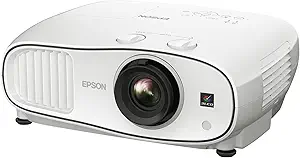
Epson vs LG: Overview
Comparing Epson and LG helps you determine which brand is best suited for your needs in Projectors. Both brands offer strong choices depending on your budget and key feature requirements.
Key Features & Comparison
Evaluate factors such as build quality, warranty, customer satisfaction, and total value before making your final purchase choice between Epson and LG.
Product Selection
When examining product selection, Epson exhibits one of the most comprehensive and deeply segmented catalogs in the projection industry, spanning entry-level portable units to high-end home cinema and multi-thousand-lumen commercial installations. Epson's lineup relies heavily on proprietary 3LCD technology, offering consumers granular choices across throw ratios, including standard throw, long throw, and dedicated ultra-short-throw (UST) models such as the EpiqVision series. Moreover, Epson caters heavily to professional environments, education, and high-ambient-light spaces with specialized business projectors alongside their dedicated theatrical home theater lines like the Home Cinema and Pro Cinema series, ensuring virtually every installation scenario is supported.
LG approaches the projection market with a strong emphasis on modern lifestyle, smart connectivity, and solid-state illumination technologies. Rather than maintaining vast fleets of traditional lamp-based commercial units, LG focuses its CineBeam and ProBeam series on compact portables, sleek lifestyle projectors, and high-performance ultra-short-throw models. LG's portfolio is distinguished by its seamless integration of smart TV ecosystems, often packaging 4K DLP laser or LED engines into minimalist, aesthetic chassis suited for contemporary living rooms. While LG lacks the sheer volume of niche commercial and high-end dedicated dark-room hardware that Epson offers, it provides a curated selection optimized for cord-cutters, smart home enthusiasts, and modern residential spaces.
Affordability
Epson offers a distinctly accessible entry point for traditional projection, particularly because it continues to manufacture and support affordable lamp-based systems alongside its newer laser projectors. Buyers working with strict budget constraints can access high-lumen Full HD and 4K-enhanced projection through Epson’s entry-level Home Cinema models at pricing tiers that solid-state competitors struggle to match. However, prospective buyers must factor in the ongoing total cost of ownership associated with lamp replacements and optical filter cleanings, which can narrow the initial price advantage over several years of frequent operation.
LG skews slightly higher in initial acquisition cost because the brand has largely abandoned conventional UHP lamps in favor of maintenance-free LED and laser light sources across its entire CineBeam lineup. While this raises the baseline floor for budget-conscious buyers, LG’s pricing structure provides substantial value over the product's lifespan by eliminating lamp replacement costs and incorporating built-in webOS smart platforms that negate the need for external streaming hardware. In the premium ultra-short-throw space, both brands compete closely on price-to-performance, but LG generally delivers a more turnkey, appliance-like value proposition compared to Epson's optics-first approach.
Quality/Durability
Epson’s build quality and durability are anchored in proven mechanical engineering and mature 3LCD manufacturing standards. Because Epson uses three separate inorganic LCD panels to process red, green, and blue light continuously, their optical blocks are robust and free from moving mechanical parts like color wheels. The structural integrity of Epson chassis is consistently high, designed to facilitate efficient thermal management via intake fans and replaceable dust filters. While traditional bulb-based models require periodic maintenance to preserve internal longevity, Epson’s transition into high-durability solid-state laser engines in lines like the LS series guarantees up to 20,000 hours of near-maintenance-free operational stability.
LG leverages cutting-edge solid-state physics, relying exclusively on multi-channel laser and LED optical engines designed to withstand tens of thousands of hours without degradation in luminous flux or color balance. By utilizing sealed optical engines, LG effectively mitigates the risk of internal dust contamination, eliminating the user chore of filter maintenance entirely. DLP technology at the heart of LG's projection eliminates the risk of panel misalignment over time, ensuring edge-to-edge sharpness throughout the unit's lifespan. Furthermore, LG’s industrial designs feature premium tactile materials, compact structural footprints, and sophisticated passive cooling techniques that reflect consumer electronics excellence.
Customer Support & Warranty
Epson sets an industry benchmark for customer support and post-purchase service, particularly within the projection sector where technical installation assistance is often required. Many of Epson's mid-tier to high-end home cinema and Pro Cinema models include robust two- to three-year standard warranties that feature dedicated overnight unit replacement programs (such as the Epson PrivateLine service). This rapid-turnaround support minimizes downtime significantly, making Epson an exceptionally safe choice for both home theater integrators and corporate clients who prioritize immediate resolution of hardware faults.
LG provides standard consumer electronics warranty coverage, typically granting a one-year parts and labor warranty for its CineBeam consumer projection units, with extended two-to-three-year commercial terms reserved for the enterprise ProBeam series. While LG maintains an expansive global service network and intuitive digital support via its web portal, warranty resolution frequently requires depot repair service rather than expedited white-glove replacement. For typical consumer troubleshooting, LG's support representatives are well-versed in software, webOS, and wireless networking issues, but advanced optical calibration inquiries are generally better supported within Epson's enthusiast-oriented infrastructure.
Picture Quality
Picture quality represents the most significant philosophical divergence between the two brands, characterized by Epson's 3LCD architecture versus LG's precision DLP technology. Epson projectors deliver identical color brightness and white brightness (equal CLO), resulting in remarkably vibrant, saturated images that do not suffer from the rainbow artifacts (color breakup) inherent to single-chip color wheel designs. Higher-end Epson units utilize proprietary 4K PRO-UHD pixel-shifting technologies alongside advanced motorized iris mechanisms, generating outstanding native black levels, deep contrast, and remarkable shadow detail that excel in dedicated, light-controlled home theater environments.
LG counters with exceptional pixel-level sharpness, native 4K UHD micro-mirror resolution via Texas Instruments DLP chips, and advanced digital image processing. Because DLP mirrors switch at microsecond speeds, LG projectors provide inherently crisp motion handling and razor-sharp edge definition that pixel-shifting 3LCD panels often struggle to match. Furthermore, LG draws from its award-winning television division by incorporating dynamic tone mapping algorithms for HDR10 and HLG content, automatically optimizing frame-by-frame brightness. While DLP-based black levels in entry-to-mid models may skew slightly grayish compared to Epson’s dynamically irised engines, LG delivers superior daylight clarity, smart image optimization, and hyper-crisp computational image fidelity.