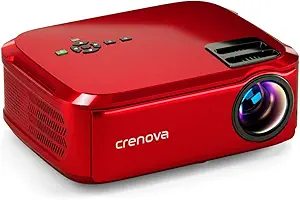
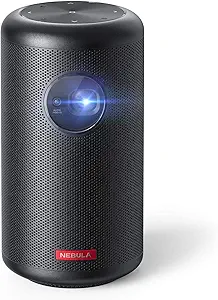
Crenova vs Nebula: Overview
Comparing Crenova and Nebula helps you determine which brand is best suited for your needs in Projectors. Both brands offer strong choices depending on your budget and key feature requirements.
Key Features & Comparison
Evaluate factors such as build quality, warranty, customer satisfaction, and total value before making your final purchase choice between Crenova and Nebula.
Product Selection
When examining product selection, Nebula and Crenova target vastly different tiers of the projection market, reflecting their respective design philosophies. Nebula, a sub-brand of Anker Innovations, curates a diverse ecosystem of portable, lifestyle, and home theater projectors. Their catalog ranges from the ultra-compact, soda-can-sized Capsule series to mid-tier portables like the Mars series, all the way up to high-end home cinema devices like the Cosmos Laser 4K. Nebula heavily integrates smart streaming platforms (Android TV or Google TV), autofocus sensors, and built-in battery configurations into their designs, offering specialized solutions tailored to outdoor camping, minimalist living rooms, and upscale home theaters alike.
In contrast, Crenova concentrates primarily on the budget entry-level segment, with a lineup composed almost entirely of affordable LED multimedia projectors. Rather than maintaining a distinct tier of specialized categories, Crenova’s catalog consists of incrementally upgraded variations of tabletop projectors (such as the XPE and baseline native 1080p series). These devices rely primarily on traditional HDMI, USB, and screen-mirroring connectivity rather than deep smart-OS ecosystems. Consequently, consumers seeking advanced options like battery-operated travel units, hybrid smart speakers, or ultra-short-throw 4K systems will find Crenova's selection narrow, while Nebula provides a structured, multi-tier spectrum that accommodates wide-ranging projection use cases.
Affordability
Affordability represents Crenova’s principal competitive advantage and the bedrock of its market positioning. Crenova targets budget-conscious buyers, students, and casual entertainment seekers who want a large-screen experience without committing to a significant financial investment. Most Crenova projectors are priced aggressively under $150, and often dip below the $100 threshold during promotional events. For this low price point, users receive a fully functional projection unit equipped with baseline manual adjustments and necessary audiovisual ports, making the barrier to entry exceptionally low for makeshift backyard movie nights or secondary display setups.
Nebula operates at a distinctly premium price bracket, spanning from several hundred dollars for their entry-level portable units to well over a thousand dollars for their flagship laser models. While this substantially higher initial cost diminishes their pure value-to-cost proposition on paper, the pricing reflects significant underlying hardware investments. Nebula packages premium DLP light engines, autofocus cameras, sophisticated time-of-flight sensors, proprietary sound systems, and licensed streaming operating systems directly into their units. For consumers strictly assessing upfront expenditure, Crenova wins decisively, but Nebula justifies its cost through feature integration and engineering sophistication.
Quality/Durability
From an engineering and build quality perspective, Nebula demonstrates the high manufacturing tolerances typical of Anker hardware. Nebula devices feature solid metallic or high-grade polycarbonate enclosures, well-engineered thermal pathways, and robust internal components designed to survive transit and mobile use. Their reliance on advanced Digital Light Processing (DLP) display chips paired with enclosed optical engines offers superior resistance to internal dust accumulation—a common failure mode in lower-end systems. Furthermore, their solid-state LED and laser light sources boast extended lifespans upwards of 25,000 to 30,000 hours, retaining uniform brightness and color balance without early degradation.
Crenova relies heavily on single-panel LCD technology encased in lightweight plastic housings. While serviceable for stationary indoor use, these optical engines are often semi-sealed or open-cooled, making them inherently vulnerable to dust specks that cause noticeable brown burns or black spots on the LCD panel over prolonged heat exposure. The thermal management systems in Crenova units are louder, requiring aggressive fan profiles to prevent thermal throttling, and the adjustment dials often exhibit mechanical play. While durable enough for infrequent or careful indoor operation, Crenova's physical build and component longevity reflect cost-cutting trade-offs compared to Nebula's refined industrial engineering.
Customer Support & Warranty
Nebula benefits directly from the mature global infrastructure of its parent company, Anker, offering a structured, dependable customer service and warranty framework. Nebula typically provides a comprehensive 12-month limited warranty on its projectors, backed by transparent warranty claim procedures, direct phone support, live chat, and automated ticketing systems. Furthermore, their products receive periodic over-the-air (OTA) firmware updates that fix software bugs, improve keystone algorithms, and update Android TV security patches, demonstrating a post-purchase commitment to device upkeep and user satisfaction.
Crenova operates primarily through third-party e-commerce marketplaces, which shapes a more fragmented customer support experience. While the brand does offer warranties (often matching the standard 12-month duration) and replacement policies for defective units upon arrival, communication generally occurs via email or platform messaging channels with varying response turnaround times. Firmware updates for Crenova projectors are virtually nonexistent once a model launches, leaving software quirks or media codec incompatibilities permanently unaddressed. For consumers prioritizing straightforward direct communication, reliable warranty fulfillment, and ongoing software maintenance, Nebula presents a notably lower ownership risk.
Picture Quality
Picture quality highlights the stark technical divide between modern DLP projection and budget single-LCD projection. Nebula employs advanced DLP technology driven by Texas Instruments DMD chips, paired with either high-efficiency RGB LEDs or ALPD laser light engines. This architecture yields sharp native resolutions (ranging from 720p on entry models to 4K on high-end units), rich dynamic contrast ratios, and exceptional color fidelity covering wide color gamuts such as DCI-P3. Combined with real-time autofocus, intelligent obstacle avoidance, and automatic keystone correction, Nebula units project balanced, vivid images with high uniformity and minimal edge distortion even in ambient lighting conditions.
Crenova models, in contrast, utilize single LCD panels illuminated by standard white LED arrays. While modern Crenova projectors claim native 1080p resolution and high lumen outputs, their real-world optical clarity suffers from low contrast, washed-out black levels, and noticeable center-to-corner brightness falloff (vignetting). Keystone adjustments on Crenova devices are typically manual and optical, which frequently causes the edges of the projected image to lose sharp focus. While Crenova can produce a satisfactory, watchable image for casual viewing in pitch-black rooms, Nebula delivers far superior color accuracy, contrast depth, and overall optical sharpness.