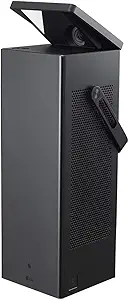
BenQ vs LG: Overview
Comparing BenQ and LG helps you determine which brand is best suited for your needs in Projectors. Both brands offer strong choices depending on your budget and key feature requirements.
Key Features & Comparison
Evaluate factors such as build quality, warranty, customer satisfaction, and total value before making your final purchase choice between BenQ and LG.
Product Selection
LG and BenQ approach their projector lineups with distinct strategic focuses, reflecting their broader brand identities. LG primarily concentrates on lifestyle, smart entertainment, and premium ultra-short-throw (UST) laser projectors under its CineBeam moniker. Their catalog is heavily weighted toward modern domestic environments, offering ultra-portable LED projectors, sleek lifestyle units with built-in battery options, and high-end living room laser models. LG effectively integrates its consumer electronics DNA into its projector range, prioritizing all-in-one smart functionality driven by webOS. However, LG offers relatively limited options for traditional ceiling-mounted, dedicated dark-room home theaters or competitive gaming setups that require high refresh rates and ultra-low input lag.
Conversely, BenQ boasts a vastly wider and more versatile product selection that spans almost every segment of the projection market. BenQ categorizes its offerings into dedicated home cinema, high-refresh-rate console and PC gaming, mobile lifestyle, classroom education, and commercial installation projectors. While LG excels in self-contained smart lifestyle devices, BenQ dominates specialized niches, providing consumers with options ranging from budget-friendly DLP lamp models to high-end 4K HDR home theater units equipped with motorized lens shift and factory color calibration. Furthermore, BenQ's purpose-built gaming lines, such as the X-series, demonstrate a targeted engineering effort that addresses specific enthusiast demands far beyond LG's more lifestyle-centric catalog.
Affordability
When analyzing pricing and value propositions, the two brands occupy different economic tiers. BenQ has long established itself as a benchmark for accessible home projection, offering some of the most competitively priced entry-level and mid-range 1080p and 4K projectors on the market. By continuing to leverage traditional high-pressure mercury lamp systems alongside newer solid-state LED and laser engines, BenQ keeps introductory costs remarkably low for budget-conscious consumers. This dual-engine approach allows enthusiasts to achieve genuine 4K projection and cinematic performance at price points significantly lower than pure laser alternatives, delivering exceptional performance-per-dollar.
LG, on the other hand, positions its projection hardware largely in the premium and mid-to-high lifestyle tiers, resulting in higher average entry barriers. Because LG has almost entirely migrated away from conventional lamps in favor of solid-state LED, single-laser, and multi-laser light sources, their base manufacturing costs are higher. While this eliminates the recurring cost of replacement bulbs, it makes LG models pricier out of the gate compared to equivalent-brightness traditional lamp models from BenQ. Consumers seeking budget-friendly solutions under the $800 mark will find substantial options from BenQ, whereas LG’s most compelling offerings typically reside in the multi-thousand-dollar category, especially within their flagship CineBeam ultra-short-throw lines.
Quality/Durability
The mechanical and optical construction of both manufacturers highlights contrasting engineering philosophies. LG projectors prioritize sleek aesthetics, compact chassis design, and modern consumer tech finishes that blend seamlessly into interior living spaces. Because LG heavily favors solid-state laser and LED light engines, their projectors boast lifespans typically rated at 20,000 to 30,000 hours of maintenance-free operation. This solid-state architecture significantly reduces thermal degradation over time and eliminates the fragility associated with high-pressure gas bulbs. However, the compact, stylish enclosures can sometimes run hotter and rely heavily on internal thermal management systems, which can result in noticeable fan noise under heavy HDR loads.
BenQ emphasizes robust, industrial-grade durability and optical integrity. A hallmark of BenQ's higher-tier models is the use of high-grade, multi-element all-glass lens assemblies housed in durable, dust-resistant chassis—often certified with IP5X ingress protection. This optical engineering reduces chromatic aberration and prevents thermal focus drift, a common issue in projectors where optical elements expand as the unit heats up. While BenQ's traditional lamp models require bulb replacements every 4,000 to 15,000 hours depending on usage modes, the physical housings, cooling channels, and optical engines are engineered for heavy-duty longevity, making them resilient workhorses in both home theater and commercial installations.
Customer Support & Warranty
Customer support infrastructure differs markedly due to the organizational structure of both companies. LG functions as a massive, multi-category consumer electronics conglomerate. While this ensures a vast global presence and accessible initial support channels, projector-specific customer service can sometimes feel impersonal and bureaucratic. Projectors represent a relatively small portion of LG's overall business, meaning frontline support representatives may lack deep, technical knowledge regarding advanced projection issues such as color wheel timing, DLP chip degradation, or specific optical anomalies. LG typically provides a standard one- to two-year limited warranty depending on the region and model tier, with repair fulfillment often routing through generalized regional electronics service depots.
BenQ, by contrast, treats projection as a core pillar of its corporate identity, which translates into more specialized, knowledgeable customer support. Enthusiasts and commercial integrators generally report a higher level of technical competency from BenQ's support staff, who are specifically trained on projection nuances, firmware updates, and calibration issues. BenQ frequently offers generous warranty terms, commonly providing three-year limited warranties on many of their home cinema projectors (though replacement lamp coverage is typically restricted to 90 to 180 days or 500 hours). This dedicated support ecosystem, paired with streamlined RMA procedures tailored to display technology, gives BenQ a decisive edge in post-purchase consumer confidence.
Picture Quality
Picture quality reveals the most significant divergence in tuning, color science, and optical philosophy between LG and BenQ. LG leverages sophisticated image processing algorithms inherited from its world-class OLED division, including advanced dynamic tone mapping for HDR content. In ambient-light conditions, LG’s bright multi-laser UST engines project punchy, vivid images with high perceived contrast and modern digital sharpness. However, LG models frequently favor oversaturated, consumer-pleasing color profiles out of the box that deviate from cinematic standards, and lower-to-mid-tier models can struggle with native contrast and black levels, occasionally showing speckle artifacts inherent to RGB laser light sources.
BenQ relies on a traditional cinematic pedigree, anchored by its proprietary CinematicColor technology and strict adherence to Rec. 709 and DCI-P3 color spaces. BenQ frequently includes factory color-calibration reports in the box for its cinema-grade units, ensuring delta E color accuracy of less than 3 right from initial setup. Furthermore, BenQ’s superior glass optics yield exceptional edge-to-edge sharpness and uniform focus, avoiding the soft corners sometimes seen in lifestyle units. While BenQ's native contrast varies by chip size, their implementation of dynamic irises and optimized color wheels results in natural skin tones, smooth motion cadence, and an authentic, director-intended image that film purists consistently favor over LG’s hyper-vibrant presentation.