BenQ vs DBPOWER: Overview
Comparing BenQ and DBPOWER helps you determine which brand is best suited for your needs in Projectors. Both brands offer strong choices depending on your budget and key feature requirements.
Key Features & Comparison
Evaluate factors such as build quality, warranty, customer satisfaction, and total value before making your final purchase choice between BenQ and DBPOWER.
Product Selection
BenQ boasts a comprehensive and specialized catalog spanning virtually every segment of the projection market, catering to cinephiles, corporate professionals, competitive gamers, and classroom environments. Their portfolio includes dedicated 4K home theater installations, ultra-short-throw (UST) living room laser displays, portable outdoor projectors, and high-brightness business units. Engineered with specialized technologies like proprietary CinematicColor, low-input-lag gaming modes, and swappable lens options on commercial units, BenQ’s selection reflects deep research and development tailored to precise optical and environmental demands.
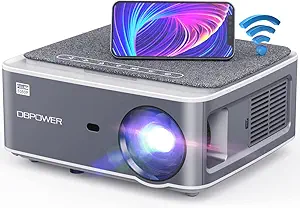
In stark contrast, DBPOWER maintains a narrowly focused catalog primarily concentrated on budget-friendly consumer entertainment and entry-level portable projection. Their lineup predominantly features compact, LED-driven lifestyle units designed for casual backyard movie nights, dorm rooms, or secondary bedrooms. Rather than offering specialized tiered tiers for high-end home theaters or commercial auditoriums, DBPOWER emphasizes plug-and-play simplicity, lightweight plastic chassis, and integrated basic streaming or mirroring capabilities, resulting in a streamlined catalog tailored almost entirely to cost-conscious buyers.
Affordability
Affordability represents the defining competitive advantage for DBPOWER, with the vast majority of their projectors priced well under the $200 threshold, and frequently even below $100. By utilizing economical single-panel LCD technology paired with commodity LED light sources, DBPOWER democratizes the large-screen projection experience for students, families on tight budgets, and hobbyists. While these models require users to accept significant trade-offs in optical performance, brightness uniformity, and physical engineering, their barrier to entry is among the lowest in the display electronics industry.
BenQ commands a significantly higher price point, positioning its catalog from upper-midrange to premium commercial tiers, often ranging from $500 for entry-level 1080p gaming units to several thousand dollars for native 4K laser projectors. This pricing structure reflects substantial investments in high-grade multi-element optical glass, precision-engineered DLP chipsets, advanced color management systems, and robust thermal cooling. Consequently, while BenQ cannot compete with DBPOWER on purely bottom-dollar pricing, it offers vastly superior value retention, optical efficiency, and overall performance-per-dollar for discerning consumers.
Quality/Durability
BenQ projectors are built to rigorous industrial standards, featuring heavy-duty, heat-resistant chassis, advanced heat-pipe thermal dynamics, and dust-resistant optical engines designed to withstand continuous operation. Utilizing Texas Instruments DLP technology, BenQ units inherently resist the optical degradation known as 'panel burn-in' or optical yellowing over time. Their lens assemblies are composed of high-grade, multi-coated glass elements that preserve geometric alignment, resist thermal warping, and maintain edge-to-edge optical sharpness over thousands of hours of playback.
DBPOWER constructs its units primarily with lightweight, injection-molded plastics and budget single-panel LCD engines that are much more susceptible to the stressors of heat and dust accumulation. Without sealed optical engines, DBPOWER units commonly suffer from internal dust spots that appear on the projected image and are difficult to clean. Furthermore, budget single-LCD panels often experience premature degradation, such as polarizing film burn or localized discoloration when subjected to long viewing sessions, making DBPOWER units better suited for intermittent, casual use rather than heavy daily operation.
Customer Support & Warranty
BenQ provides enterprise-grade customer support backed by a global corporate presence, offering established regional service hubs, direct phone and web ticketing, and extensive downloadable firmware and documentation. Most consumer and professional BenQ projectors are covered by a reassuring three-year limited hardware warranty (with separate terms for traditional lamps), providing extensive coverage against manufacturing defects, optical alignment flaws, and component failures through certified repair facilities.
DBPOWER operates on a direct-to-consumer online retail model, relying primarily on email correspondence, Amazon message centers, and website contact forms for customer interactions. While their support team is generally responsive regarding initial troubleshooting and fast replacements for units that arrive defective, long-term support infrastructure is minimal. Warranty periods are typically limited to one year with limited technical service options, often resulting in a full unit replacement or refund rather than component-level diagnosis or professional recalibration.
Picture Quality
Picture quality is an arena where BenQ exhibits overwhelming technical superiority, consistently delivering reference-grade color accuracy, exceptional contrast, and superior image processing. Utilizing refined DLP micro-mirror arrays paired with RGBRGB color wheels or solid-state LED/laser illumination, BenQ delivers true Rec.709 and wide DCI-P3 color gamuts with factory-calibrated Delta E < 3. Their projectors deliver crisp native resolutions (ranging from true 1080p to pixel-shifted 4K), high ANSI lumen brightness ratings that overcome ambient light, and sophisticated HDR tone mapping that preserves shadow detail without blowing out highlights.
DBPOWER offers modest visual performance that performs adequately in completely dark rooms but suffers substantially in moderate ambient light. While many modern DBPOWER models support 1080p input decoding or feature native 1080p LCD panels, their real-world light output is limited to lower ANSI lumen levels that frequently fall short of marketing claims. The single-LCD architecture introduces noticeable chromatic aberration, significant focus drop-off at the image corners, elevated input lag, and weak native contrast with greyish black levels, rendering it suitable for casual cartoons and videos rather than nuanced cinematic content.
Compare current retail pricing, active promotions, and verified stock availability directly from authorized stores: