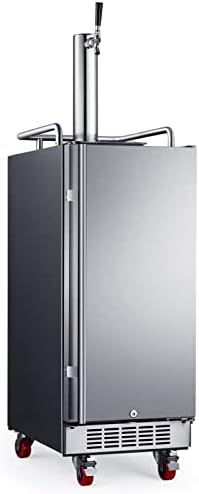
Frigidaire vs EdgeStar: Overview & Brand Philosophy
When investing in a draft beer dispensing system for the home or office, prospective buyers often find themselves torn between legacy appliance giants and specialized beverage refrigeration manufacturers. Frigidaire, a century-old American staple owned by Electrolux, approaches the kegerator market through the lens of traditional kitchen appliances. Their design philosophy relies on accessibility, mass-market volume pricing, and standard upright refrigeration platforms adapted for dispensing. Frigidaire focuses on straightforward, entry-level consumer units that serve the occasional entertainer who wants a reliable, familiar brand name backed by widespread parts distribution.
Conversely, EdgeStar is a dedicated brand under the Ferguson Enterprises umbrella, built from the ground up to dominate specialty niches like wine coolers, beverage centers, and draft equipment. Rather than treating draft beer as an afterthought, EdgeStar approaches the market from a homebrewer and beer enthusiast perspective. Their brand philosophy centers on modularity, thermal precision, and diverse configuration options—offering commercial-grade stainless steel towers, dual-gauge regulators, and systems engineered to eliminate "first-pour foam." While Frigidaire aims to make draft beer simple and cheap, EdgeStar strives to bring a professional, taproom-grade experience into the residential space.
Key Differences & Technological Comparison
The core differences between Frigidaire and EdgeStar become immediately apparent when evaluating their cooling architecture, component quality, and interior configurations:
- Cooling Technology and Temperature Ranges: EdgeStar units consistently outperform Frigidaire in thermal low-end capability. Most EdgeStar models can reliably reach deep chill temperatures in the lower 30s (°F), a critical threshold for domestic lagers. Frigidaire units typically bottom out around 36°F to 38°F, which can fluctuate into the 40s during warmer ambient conditions, leading to unwanted foaming. Furthermore, higher-end EdgeStar units feature integrated air-cooled draft towers, circulating cold air up into the tap shank, whereas Frigidaire towers are passively cooled and rely on insulated sleeves that can allow beer lines to warm between pours.
- Dispensing Hardware Quality: Frigidaire predominantly bundles generic, chrome-plated brass components that are prone to surface pitting and flavor transfer over prolonged usage with acidic beers. EdgeStar provides higher-spec hardware options, including forward-sealing faucets (such as Perlick or flow-control upgrades) and 304-grade stainless steel contact points. EdgeStar also ships superior dual-gauge CO2 regulators, allowing users to independently monitor both tank volume and output PSI, compared to the rudimentary single-gauge setups often seen on base Frigidaire units.
- Keg Capacity & Modularity: Frigidaire generally designs for single half-barrel (full-size standard) kegs or single quarter-barrels. EdgeStar optimizes internal floorplans, frequently accommodating multiple sixth-barrel (torpedo) kegs or Cornelius homebrew kegs within the same footprint. This allows EdgeStar to offer native dual-tap and triple-tap towers right out of the box, offering far superior versatility for consumers who want variety on tap.
- Build Formats: Frigidaire exclusively manufactures freestanding units with rear-mounted heat dissipation coils, requiring several inches of clearance on all sides. EdgeStar manufactures both budget-friendly freestanding units and built-in, front-venting models engineered with forced-air front exhausts that can slide directly flush into custom cabinetry and outdoor kitchens.
Pros & Cons Comparison
Frigidaire Kegerators
- Pros:
- Significantly lower upfront cost, making draft beer accessible on a budget.
- Widespread brand recognition with a dependable baseline compressor design.
- Easy-to-find replacement exterior hardware, casters, and standard appliance parts.
- Straightforward, no-frills setup suitable for first-time kegerator owners.
- Cons:
- Limited to freestanding placement only; lacks front-venting architecture.
- Passive tower cooling frequently causes "first-pour foam" issues.
- Included draft hardware consists of cheaper chrome-plated brass prone to wear.
- Few multi-tap options; mostly limited to single-keg, single-tap operations.
EdgeStar Kegerators
- Pros:
- Wide variety of configurations, including built-in, freestanding, and outdoor-rated models.
- Deep temperature pull-down capabilities (reaching down to 32°F-34°F).
- Advanced tower cooling technology preserves proper dispensing temperature to the faucet.
- Superior multi-tap options capable of holding up to three slim kegs simultaneously.
- Commercial-grade components, including dual-gauge regulators and stainless steel lines.
- Cons:
- Higher price ceiling, especially for built-in or multi-tap variants.
- Compressors on base models can run louder than standard kitchen refrigerators.
- Requires more assembly and mechanical aptitude during initial setup.
Performance, Durability & Value Analysis
From an engineering and long-term durability standpoint, the performance gap between these two brands comes down to duty cycle and component degradation. Frigidaire provides solid value if viewed purely as a modified mini-fridge. The core refrigeration loop is robust enough to last for years without refrigerant leaks, but the dispensing side suffers. Because Frigidaire utilizes lower-cost tap components, users often find themselves replacing faucets, dry-rotted rubber gaskets, and basic regulators within two to three years. Consequently, what appeared to be an initial $200–$300 savings on the purchase price is gradually eroded by aftermarket upgrades necessary to eliminate foam and keep the beer pouring smoothly.
EdgeStar commands a higher price point, but the investment is reflected directly in systemic efficiency and pour quality. Their draft hardware lasts significantly longer without corroding, and the interior floorboards are reinforced with steel plates to withstand the repeated physical trauma of heavy steel kegs being dropped into the chamber. Thermally, EdgeStar’s digital thermostats and forced-air fan systems maintain tighter temperature deltas, protecting the beverage from thermal degradation. For serious draft consumers, EdgeStar delivers vastly superior dollar-for-dollar lifetime value because it requires virtually no out-of-the-box retrofitting to achieve professional-tier pours.
Final Verdict: Which Brand Should You Choose?
The choice between Frigidaire and EdgeStar ultimately hinges on your budget, installation constraints, and standard of beer consumption.
Choose Frigidaire if: You are shopping on a strict budget, want an entry-level freestanding unit for a garage or basement "man cave," and primarily plan to dispense standard domestic lagers (like Bud Light, Coors, or Miller) from a single commercial half-barrel keg. If you do not mind pouring off an initial ounce or two of foam after the unit sits idle, Frigidaire provides an affordable, functional gateway into home draft systems.
Choose EdgeStar if: You care deeply about craft beer, temperature precision, or need a customized setup. EdgeStar is the definitive choice if you want multiple taps (dual or triple dispense), intend to install the unit flush under kitchen or bar counters, or need a fully outdoor-rated weatherized refrigerator. For homebrewers, craft beer enthusiasts, and those looking for an authentic commercial tavern experience without hardware headaches, EdgeStar is overwhelmingly worth the premium.
Features
From a feature and hardware standpoint, EdgeStar substantially outpaces Frigidaire by delivering commercial-grade components tailored for serious draft performance. EdgeStar kegerators frequently ship with forward-sealing faucets (such as Perlick or intermediate brass/stainless options), dual-gauge regulators that simultaneously monitor both tank pressure and keg volume, and heavy-duty commercial couplers. Furthermore, EdgeStar's digital control panels offer pinpoint temperature selection down to the single degree, alongside deep-chill modes and internal air blower tubes specifically designed to push chilled air directly up into the draft tower to prevent foamy first pours. The brand also caters heavily to multi-keg versatility, effortlessly accommodating multiple 1/6th barrels or corny kegs with dual or triple-tap configurations.
Frigidaire, meanwhile, opts for a simplified, low-barrier feature set that prioritizes essential functionality over granular customization. Most Frigidaire models utilize manual analog thermostats, standard rear-sealing chrome faucets that are prone to sticking over time if left uncleaned, and single-gauge regulators that only reflect output pressure. Although these components are fully functional for standard American domestic half-barrels, they lack the refinement demanded by specialty beer styles. Frigidaire does, however, provide solid everyday conveniences, such as integrated heavy-duty casters, removable drip trays, and wire shelving that allows users to quickly convert the unit into a standard beverage cooler. For consumers seeking straightforward utility without the complexity of balancing advanced draft lines, Frigidaire offers adequate basics, whereas EdgeStar supplies high-utility engineering.
Performance
Thermal dynamics and draft line stability represent the critical performance benchmarks where EdgeStar generally demonstrates technical superiority. The brand employs forced-air cooling systems that continuously circulate chilled air throughout the cabinet interior and into the dispense tower. This uniform airflow minimizes thermal stratification, ensuring beer stays consistently cold from the bottom of the keg up through the faucet shank, which virtually eliminates initial-pour breakout and excess foaming. EdgeStar compressors are optimized to pull internal temperatures down into the mid-to-low 30s Fahrenheit, making them highly effective at maintaining the precise temperatures necessary to keep commercial and craft carbonation levels in steady equilibrium even in warm ambient environments.
Frigidaire provides respectable chilling performance rooted in its conventional cold-wall refrigeration technology, but it exhibits minor operational trade-offs during heavy usage. Because Frigidaire units typically rely on passive internal convection without a dedicated tower-cooling fan, the dispensing tower remains susceptible to ambient heat transfer, frequently resulting in warm first pours that generate excessive head. The analog temperature controls can also lead to broader temperature swings of 4 to 6 degrees Fahrenheit between compressor cycles, which can slightly affect carbonation solubility over extended periods. Nonetheless, for standard domestic lagers poured over a weekend gathering, Frigidaire offers quiet, energy-efficient operation and dependable base-level cooling that reliably prevents spoilage.
Design
Design philosophies between the two manufacturers reflect their respective market orientations, with Frigidaire focusing on modern household integration and EdgeStar emphasizing utilitarian durability and commercial modularity. Frigidaire models showcase a polished, consumer-friendly aesthetic, featuring sleek fingerprint-resistant stainless steel doors, clean rounded corners, and integrated top guard rails that blend effortlessly into modern basements, dens, or home kitchens. Their chassis design is specifically tailored for freestanding installation, featuring rear-facing ventilation coils that necessitate generous perimeter clearance. The interior layout is clean and minimalist, engineered to maximize spatial efficiency so that users can transition seamlessly between keg storage and general refrigerated can or bottle containment.
EdgeStar designs its draft equipment with robust materials suited for both residential entertainment centers and demanding back-bar environments. EdgeStar models frequently feature front-venting kickplates, allowing them to be fully integrated flush into cabinetry as built-in appliances—a critical design advantage completely absent from Frigidaire’s lineup. The industrial-grade stainless steel door skins, reinforced stainless steel floor plates designed to handle the abrasion of heavy steel kegs, and insulated stainless towers give EdgeStar a commanding, professional presence. While EdgeStar may possess a more functional, commercial appearance that looks less like a traditional kitchen appliance, its structural integrity, front-venting flexibility, and heavy-duty chassis engineering make it markedly more durable over years of continuous keg exchanges.