EdgeStar vs Nostalgia: Overview
Comparing EdgeStar and Nostalgia helps you determine which brand is best suited for your needs in Kegerators. Both brands offer strong choices depending on your budget and key feature requirements.
Key Features & Comparison
Evaluate factors such as build quality, warranty, customer satisfaction, and total value before making your final purchase choice between EdgeStar and Nostalgia.
Features
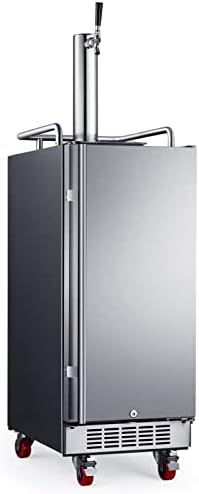
From a feature and hardware integration perspective, EdgeStar outpaces Nostalgia through its focus on industry-standard draft specifications. EdgeStar models routinely incorporate domestic D-system couplers, commercial-grade dual-gauge regulators, and forward-sealing or high-grade brass faucets that prevent oxidation and sticking. Crucially, EdgeStar provides integrated digital thermostat displays, rolling casters, and deep drip trays, with higher-end units offering internal circulation fans that run cold air straight up into the draft tower. This tower-cooling capability is critical for eliminating warm-beer foamy first pours, a common pain point for home draft systems that cheaper units fail to address.
Nostalgia, while including the basic starter accessories—such as a standard CO2 tank, single-gauge or basic dual-gauge regulators, and draft tower—tends to utilize more plastic-heavy and entry-grade components. The temperature management in most Nostalgia units relies on a manual mechanical dial located in the rear or interior rather than a precise exterior digital controller, making pinpoint temperature setting a matter of trial and error. Furthermore, Nostalgia units often lack forced-air tower cooling and use basic stamped metal or plastic drip trays. However, Nostalgia does excel in delivering turnkey consumer-friendly setups that require minimal technical calibration, allowing a complete novice to tap their first standard half-barrel with minimal assembly confusion.
Performance
Thermal dynamics and pour equilibrium are where EdgeStar decisively separates itself from Nostalgia. EdgeStar kegerators utilize robust, high-BTU compressors engineered to reach temperatures deep into the mid-30s Fahrenheit, which is essential for maintaining optimal carbonation levels and suppressing CO2 breakout inside the keg. Their internal fan systems promote uniform cold air distribution, preventing the thermal stratification where the bottom of the keg freezes while the top stays warm. As a result, EdgeStar systems deliver consistent, balanced pours with minimal foam wastage, even during periods of heavy draw at social gatherings.
Nostalgia models often struggle with thermal recovery times and overall cooling depth, sometimes plateauing in the upper 30s to lower 40s Fahrenheit, especially in warmer ambient conditions like non-climate-controlled garages. Because their draft towers typically lack dedicated internal insulation and active blower cooling, the first few ounces of beer in the beer line inevitably warm up, resulting in excessive foam on the first pour after idling. While Nostalgia provides adequate baseline cooling for commercial macro-lagers that tolerate a slightly warmer serving temperature, it lacks the refrigeration overhead and fluid-dynamic precision needed to handle delicate, highly carbonated craft ales without frequent regulator adjustments and line balancing.
Design
In terms of industrial design, EdgeStar emphasizes utilitarian durability, modern aesthetics, and architectural versatility. Their units are finished in brushed stainless steel, clean black coatings, or integrated custom panel-ready options that blend seamlessly into modern kitchens, home bars, or covered outdoor entertainment areas. The cabinet construction utilizes thicker sheet metal, dense polyurethane foam insulation, and reinforced stainless steel floor plates designed to handle the heavy impact of dropping a 160-pound full keg. EdgeStar also engineers many of its models with front-breathing vents, allowing for true under-counter built-in installation that preserves cabinet flushness.
Nostalgia embraces an eye-catching design language, frequently utilizing stylized retro elements, chrome accents, and vibrant color palettes that evoke a 1950s diner or classic American taproom. While these units serve as delightful conversation pieces in casual spaces, the underlying construction relies more heavily on lightweight plastics, thinner insulation walls, and standard freestanding-only rear-exhaust ventilation. This mechanical design prevents Nostalgia units from being installed beneath counters without risking compressor overheating. While visually charming and undeniably fun, Nostalgia’s design is optimized for standalone casual display rather than rugged, heavy-use structural integrity.