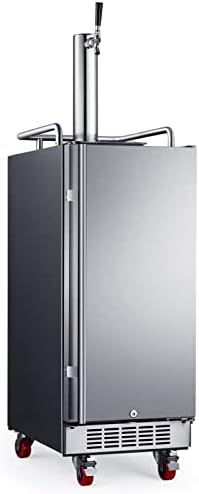
EdgeStar vs Kegco: Overview & Brand Philosophy
When it comes to home draft dispensing, EdgeStar and Kegco stand as two of the most recognizable titans in the industry. EdgeStar, a core brand under the Living Direct (and ultimately Ferguson) umbrella, made its name by bringing draft beer out of the commercial tavern and into the residential suburban home. Their brand philosophy revolves around accessibility, streamlined manufacturing, and plug-and-play simplicity. EdgeStar aims to deliver dependable, attractively priced draft systems designed primarily for basement bars, mancaves, and occasional party hosts who want the luxury of cold draft beer without a steep learning curve or prohibitive upfront cost.
Conversely, Kegco approaches draft beverage systems with a background firmly anchored in commercial beverage hardware and specialized draft expertise. While they offer consumer models, their overall design philosophy borrows heavily from industrial standards, emphasizing modular upgradability, wider thermal capabilities, and commercial-grade componentry. Kegco does not merely sell home appliances; they cater heavily to craft beer enthusiasts, commercial establishments, and homebrewers who demand precision temperature stability, custom gas configurations, and commercial NSF-certified components.
Key Differences & Technological Comparison
While both brands appear to offer similar aesthetic choices on the surface, beneath the chassis lie several engineering and structural distinctions that define their respective performance tiers:
- Refrigeration Technology and Temperature Pull-Down: Kegco units frequently feature digital temperature controls with exceptionally wide operational ranges (often reaching as low as 32°F and extending up to 75°F on select dual-purpose fermentation models). Kegco also utilizes fan-forced cooling systems with cold air redirected straight up into the draft tower, mitigating the common issue of foamy "first pours." EdgeStar typically utilizes traditional rear-wall cold-plate evaporation on entry-level models, which can result in temperature gradients between the floor and the tower unless paired with an aftermarket blower fan.
- Interior Capacity & Keg Flexibility: Internal layout is a critical differentiator. EdgeStar units comfortably accommodate standard half-barrel kegs, quarter-barrels, and slim quarters, but can occasionally become cramped when attempting to fit multiple commercial sixth-barrel (sixtel) kegs or rubber-bottom Cornelius kegs simultaneously. Kegco cabinets are widely celebrated for having slightly wider interior profiles, designed explicitly to hold up to three 5-gallon kegs or a full-size commercial keg alongside an internal CO2 canister.
- Dispense Componentry: Base EdgeStar kits frequently ship with chrome-plated brass draft towers and generic standard couplers, which perform adequately for casual domestic lagers but wear down over time against continuous acidic beer lines. Kegco tends to standardize on higher-specification dispense gear earlier in their lineups, offering 100% stainless steel contact surfaces, robust dual-gauge commercial regulators, and options for premium Perlick or forward-sealing faucets.
- Versatility & Lineup Breadth: EdgeStar focuses heavily on residential freestanding units and built-in under-counter options. Kegco offers a far wider spectrum of products, spanning from straightforward residential boxes to heavy-duty, outdoor-rated, ETL/NSF-sanitation-certified commercial units with reinforced steel interior floors designed to withstand the physical impact of heavy commercial keg changes.
Pros & Cons Comparison
EdgeStar: Pros & Cons
- Pros:
- Highly competitive entry price point offering exceptional value.
- Compact exterior footprints suitable for tight residential spaces.
- Intuitive, low-maintenance setups ideal for non-technical users.
- Extensive catalog of integrated under-counter residential models.
- Cons:
- Stock models often lack integrated tower cooling fans, increasing potential for warm-tower foam.
- Base configurations utilize plated brass dispense components rather than all-stainless steel.
- Tighter internal clearances limit triple-keg setups.
Kegco: Pros & Cons
- Pros:
- Superior digital thermostat technology with wider thermal operating ranges.
- Fan-forced tower cooling comes standard or readily supported on most models.
- Spacious internal cavities engineered to hold up to three homebrew or sixtel kegs.
- Commercial-grade build quality with durable stainless steel interior flooring options.
- Cons:
- Noticeably higher price point across comparable multi-tap configurations.
- Units often feature heavier curb weights, making delivery and positioning more labor-intensive.
- Advanced features and regulator configurations may overwhelm novice consumers.
Performance, Durability & Value Analysis
From a performance and durability perspective, the gulf between EdgeStar and Kegco centers primarily around duty cycle and build materials. EdgeStar units perform reliably under typical home conditions—maintaining solid serving temperatures for casual domestic beer drinkers. However, because standard EdgeStar compressors rely heavily on static convective cooling, they must work harder in high-ambient heat environments, which can translate to increased compressor fatigue over years of operation. For standard indoor use serving a single commercial half-barrel keg, EdgeStar delivers tremendous cost-per-pour value, leaving more money in your pocket for the beer itself.
Kegco justifies its premium price through long-term structural resilience and precision control. Their commercial-grade compressors achieve rapid temperature pull-down, which is essential after swapping in a warm keg, and their blower systems maintain uniform cold air from the bottom plate to the faucet shank. The inclusion of heavy-gauge stainless steel contact points prevents flavor taint and resists the harsh chemical cleansers used to sanitize draft lines. While the initial financial investment is steeper, Kegco equipment provides lower long-term cost of ownership for high-frequency users, homebrewers requiring stable fermentation temperatures, and small taprooms needing commercial reliability.
Final Verdict: Which Brand Should You Choose?
Selecting between EdgeStar and Kegco ultimately comes down to your technical requirements, your frequency of use, and your budget.
Choose EdgeStar if: You are setting up your first home draft system on a sensible budget, plan to keep the unit indoors (such as a kitchen, basement, or finished entertainment room), and primarily intend to tap a single half-barrel or two slim kegs for weekend entertaining. EdgeStar gives you everything you need to pour brewery-fresh beer at home without overpaying for heavy commercial engineering you might never use.
Choose Kegco if: You are a craft beer purist, a serious homebrewer, or require an outdoor/commercial installation. If you require absolute zero-foam precision right from the first ounce, plan to run a multi-tap setup (such as three homebrew cornelius kegs simultaneously), or want a unit that doubles as a precision temperature-controlled fermentation chamber, Kegco's superior airflow dynamics, wide temperature thresholds, and commercial-grade components make it the undisputed technical winner.
Features
When evaluating the feature ecosystems of EdgeStar and Kegco, the comparison largely centers on consumer-focused functionality versus commercial-grade versatility. EdgeStar designs its kegerators with intuitive, home-centric features aimed at seamless operation right out of the box. Most modern EdgeStar units boast intuitive digital control panels that allow users to precisely dial in serving temperatures, often accompanied by a "Deep Chill" mode that quickly pulls down the temperature of a newly loaded, warm keg. Their draft kits typically include standard domestic D-system couplers, integrated drip trays, and rolling casters for mobility. However, EdgeStar often leans toward lighter-duty components in their baseline packages, such as chrome-plated brass faucets and standard aluminum CO2 tanks, which satisfy the casual entertainer but may necessitate aftermarket upgrades for purists seeking superior draft hygiene and longevity.
Kegco, by contrast, targets homebrewers, craft beer enthusiasts, and light commercial venues by packing its units with superior technical hardware and robust customization features. While Kegco also provides digital temperature regulation, its standout engineering lies in the breadth of its draft components and specialized cooling technology. Many Kegco models feature fan-forced cooling that directs chilled air straight into the draft tower, eliminating the dreaded "first-pour foam" common in less specialized units. Furthermore, Kegco regularly equips its units with premium draft kits directly from the factory, frequently incorporating 100% stainless steel contact surfaces, commercial-grade dual-gauge regulators, and forward-sealing Perlick or Kegco faucets that prevent stickiness and mold buildup. Their cabinets also feature broader interior footprints with reinforced steel floorboards that more readily accommodate diverse keg configurations, such as multiple homebrew Cornelius kegs alongside oversized half-barrels.
The practical trade-offs regarding features boil down to convenience versus technical execution. EdgeStar presents an attractive, user-friendly feature set that prioritizes simplicity and quick deployment, making it ideal for the casual drinker who wants dependable temperature control without getting bogged down by commercial draft mechanics. Kegco delivers a more sophisticated, enthusiast-grade platform; while it may require a marginally more involved initial assembly and carry a higher price point, the inclusion of tower-cooling blowers, high-end dispense hardware, and versatile multi-keg interior engineering provides a demonstrably better long-term dispensing experience with minimal need for immediate component upgrades.
Performance
When evaluating performance, thermal consistency and recovery speed are paramount, and this is where the engineering differences between EdgeStar and Kegco become starkly evident. Kegco consistently outperforms EdgeStar in heavy-use environments due to its robust commercial-grade compressor systems and interior fan-forced cooling. Premium Kegco models, particularly their HBK and VSP series, integrate digital temperature controls with exceptionally wide ranges (often chilling down to a crisp 32°F) and utilize fan-driven cooling to eliminate thermal stratification inside the cabinet. Crucially, Kegco frequently includes blower-driven tower cooling pipes, which direct cold air straight up into the draft tower. This virtually eliminates "first-pour foam," a common performance issue caused by warm beer lingering in an uncooled tower. In contrast, standard EdgeStar units, while reliable, generally rely on static cooling or less aggressive circulation systems, resulting in minor temperature gradients between the bottom and top of the keg, and making their baseline units slightly more prone to foaming on the initial pour if an aftermarket tower cooler is not installed.
EdgeStar shines, however, in everyday residential duty cycles and low-vibration, energy-efficient performance. Engineered predominantly for the home consumer rather than the busy pub, EdgeStar kegerators feature compressors that cycle quietly and smoothly, minimizing the agitation of sediment in unpasteurized or bottle-conditioned craft beers. While EdgeStar units take longer to bring an ambient-temperature keg down to serving temperature compared to Kegco’s rapid pulldown capability, EdgeStar’s deep-chill technology—especially on models equipped with the "Super Chill" mode—efficiently locks in a steady 34°F to 38°F range once equilibrium is reached. The practical trade-off is that EdgeStar’s temperature stability is more sensitive to ambient room conditions; they struggle more than Kegco when placed in non-temperature-controlled environments like hot garages or outdoor patios.
Ultimately, from a pure performance standpoint, Kegco earns the advantage for high-volume entertaining, outdoor versatility, and draft system mechanics. The combination of Kegco's high-BTU displacement compressors, standard air-cooled towers, and digital thermostats capable of handling extreme cold-crash temperatures for homebrewers makes it the technically superior performer. EdgeStar represents a balanced, consumer-friendly tier of performance: it is quiet, electrically efficient, and thoroughly capable of pouring great pints in a climate-controlled living room or home bar, but it lacks the thermal headroom, rapid recovery times, and robust draft engineering that define Kegco’s output.
Design
When evaluating the design philosophy of kegerators, EdgeStar and Kegco represent two distinct approaches to residential and commercial draft beverage engineering. EdgeStar generally focuses on streamlined, consumer-friendly aesthetics with a strong emphasis on space optimization and contemporary home bar integration. Their units often feature sleek stainless steel doors, integrated towel bar handles, and intuitive electronic control panels cleanly nestled into the top threshold. Engineering-wise, EdgeStar excels in modular internal layouts, utilizing reversible doors and low-profile casters to maximize installation versatility in tight entertainment areas. However, this focus on compact, living-space-friendly footprints sometimes results in tighter internal tolerances, making the simultaneous loading of multiple oversized kegs or bulky secondary CO2 regulators slightly more challenging for advanced homebrewers.
Kegco, by contrast, leans into a more industrial, commercial-grade design ethos that prioritizes rugged utility and maximum internal volume. Built with heavier-gauge stainless steel and reinforced stainless steel floor plates to withstand the repeated physical trauma of heavy metal keg transitions, Kegco models exude durability. The brand places higher value on functional engineering enhancements, such as built-in blower hoses that channel refrigerated air directly up into the draft tower to eliminate "first-pour foam"—a thoughtful fluid dynamics feature less consistently implemented across standard EdgeStar units. Furthermore, Kegco’s draft towers and external hardware typically exhibit a heavier, commercial draft house build quality, featuring larger interior cavern space that easily accommodates multiple sixth-barrels, commercial half-barrels, or homebrew cornelius kegs without requiring awkward angling.
The practical trade-offs in design ultimately align with different user requirements and deployment environments. EdgeStar is thoughtfully engineered for the casual to mid-tier host who values quiet operation, clean lines, and an appliance that harmonizes seamlessly with modern kitchen cabinetry and stainless steel decors. Kegco appeals more directly to the craft beer aficionado and heavy entertainer who favors technical thermal management, expandability, and heavy-duty structural components over sheer minimalist elegance. While EdgeStar delivers a more refined, plug-and-play visual presence ideal for finished living spaces, Kegco’s robust architectural integrity and superior air circulation engineering make it the structurally superior choice for rigorous, high-volume performance.