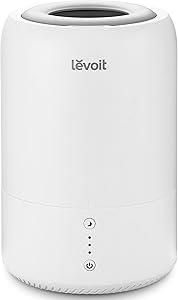
Levoit vs Honeywell: Overview
Comparing Levoit and Honeywell helps you determine which brand is best suited for your needs in Humidifiers. Both brands offer strong choices depending on your budget and key feature requirements.
Key Features & Comparison
Evaluate factors such as build quality, warranty, customer satisfaction, and total value before making your final purchase choice between Levoit and Honeywell.
Features
Levoit distinguishes itself through an advanced suite of smart features, proprietary app ecosystems, and hyper-responsive digital sensing. Most modern Levoit ultrasonic models come equipped with integrated hygrostat modules that deliver real-time environmental readouts, smart automated run modes, and compatibility with voice assistants such as Amazon Alexa and Google Assistant via the VeSync application. Additionally, Levoit frequently incorporates dual-temp misting capabilities—allowing users to alternate between warm mist to combat winter chills and cool mist for energy efficiency—alongside integrated aroma diffusion trays and programmable night-light ambient settings designed for sleep enhancement.
Honeywell takes a decidedly functional and utilitarian approach to its feature architecture, generally eschewing wireless connectivity in favor of durable physical dials, illuminated manual displays, and robust internal safety protocols. While Honeywell lacks the automated scheduling and app-driven tracking of Levoit, it compensates with specialized functional capabilities, such as patented evaporative technology utilizing antimicrobial-treated wicking filters that naturally self-regulate room humidity. Furthermore, several Honeywell units feature integrated UV germicidal treatment chambers that actively neutralize waterborne pathogens before moisture is expelled into the ambient atmosphere, prioritizing basic hygiene over algorithmic convenience.
Performance
In terms of raw output and operational acoustics, Levoit’s ultrasonic transducer technology delivers immediate, dense moisture plumes with exceptionally low noise floor metrics, frequently dipping below 28 decibels. This near-silent operation makes Levoit units the preferred choice for nursery environments and light sleepers. However, because ultrasonic technology nebulizes mineral content directly along with the water molecules, Levoit requires the use of distilled water, demineralization cartridges, or frequent descaling maintenance to prevent the settling of white dust in homes supplied with municipal hard water.
Honeywell models, primarily leveraging evaporative cooling fans and wicking matrices, offer a fundamentally different performance profile marked by self-regulating physics. As the relative humidity in a room rises, Honeywell’s evaporative wick naturally evaporates less water, preventing accidental over-saturation and the condensation pooling occasionally observed with ultrasonic misters. Furthermore, the evaporative process completely traps minerals and sediments inside the disposable filter rather than aerosolizing them into the air. The trade-off is mechanical noise: Honeywell units produce a noticeable fan whir across medium-to-high speeds, which acts effectively as soothing white noise for some users, but may disrupt environments requiring absolute silence.
Design
From an industrial design standpoint, Levoit adopts a sleek, minimalist aesthetic marked by smooth matte finishes, rounded edges, and compact footprints that integrate harmoniously into modern Scandinavian or contemporary interior decor. A standout design victory for Levoit is its widespread implementation of top-fill water reservoirs, which eliminate the clumsy, inverted-tank refilling process that historically plagued the humidifier category. The transparent water-level indicators and intuitive, capacitive-touch interfaces present on Levoit devices elevate the user experience, transforming an otherwise mundane appliance into an unobtrusive home accessory.
Honeywell prioritizes physical ruggedness, serviceability, and mechanical stability over sleek exterior lines. Their humidifiers frequently feature robust, shatter-resistant plastics, wide bases engineered to prevent accidental tip-overs, and substantial, molded carrying handles designed to transport heavy, full reservoirs safely. While Honeywell’s aesthetics lean toward functional, medical, or appliance-grade styling that rarely acts as a decorative centerpiece, their internal component layout is thoroughly optimized for easy component disassembly, deep cleaning, and straightforward filter replacements, appealing directly to users who prioritize physical longevity over contemporary visual appeal.