RCA vs EdgeStar: Overview
Comparing RCA and EdgeStar helps you determine which brand is best suited for your needs in Freezers. Both brands offer strong choices depending on your budget and key feature requirements.
Key Features & Comparison
Evaluate factors such as build quality, warranty, customer satisfaction, and total value before making your final purchase choice between RCA and EdgeStar.
Features
RCA’s feature set is defined by minimalist utility, offering fundamental mechanisms that keep manufacturing costs low and operation uncomplicated. Most RCA chest and upright freezers feature simple mechanical dial thermostats, removable wire storage baskets, and basic manual defrost drain ports. While these features are adequate for general food preservation, they lack modern technological refinement; you will rarely find internal digital controls, dynamic interior LED arrays, or high-temperature alert systems on standard RCA models, meaning users must actively monitor freezer performance manually.
Conversely, EdgeStar equips its freezers with sophisticated functionality aimed at thermal precision and versatile installation. EdgeStar models frequently incorporate external digital control panels with precise degree-by-degree temperature adjustments, rapid-freeze modes to quickly preserve bulk groceries, and integrated door locks for security. Furthermore, several EdgeStar upright models feature front-venting compressor systems, enabling seamless undercounter installation alongside cabinetry, as well as field-reversible doors with advanced gasket seals that RCA simply does not engineer into its standard freestanding catalog.
Performance
Performance benchmarks reveal notable distinctions in temperature uniformity, recovery speed, and operational efficiency between the two brands. RCA freezers utilize traditional static cooling and standard reciprocating compressors, which maintain safe sub-zero environments but are susceptible to vertical temperature stratification and slower thermal recovery cycles after the door is opened. Moreover, heavy ice accumulation is common over time in RCA manual defrost models, demanding regular maintenance to prevent compressor strain and inconsistent internal temperatures.
EdgeStar demonstrates superior thermodynamic performance by employing robust cooling systems capable of reaching ultra-low temperatures, often dipping well below standard zero-degree thresholds. Their compact and undercounter units frequently utilize forced-air circulation systems to eliminate cold and warm spots, ensuring even distribution across all shelving tiers. Additionally, EdgeStar compressors exhibit better duty-cycle management and quieter decibel ratings under heavy ambient loads, providing stable performance in variable climates such as garages, workshops, or outdoor kitchens where RCA units tend to struggle.
Design
From an aesthetic and architectural standpoint, RCA adheres strictly to conventional, utilitarian appliance design. Its freezers are clad in basic textured sheet metal—predominantly in standard white or matte black—with exposed plastic handles or recessed pocket pulls. While these designs are functional and fit neatly into utility rooms or basements, they do not attempt to elevate a modern living space. The interior finishes rely on lightweight plastic liners and sparse wire framing that can bend under the strain of heavy frozen bulk items.
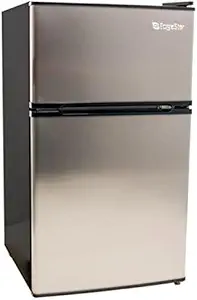
EdgeStar prioritizes premium build materials, commercial styling, and space-conscious ergonomics. Many of their freezers showcase commercial-grade stainless steel door wraps, heavy-duty towel-bar handles, and professional matching trim that integrates flawlessly into modern kitchens, wet bars, or offices. Internally, EdgeStar uses reinforced wire or tempered glass shelves supported by durable molded brackets. The overall structural rigidity, tighter panel seams, and refined fit-and-finish give EdgeStar a distinctly high-end appearance that far outclasses the purely functional aesthetic of RCA.