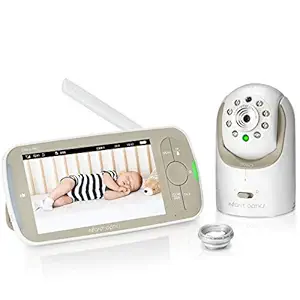
Infant Optics vs Motorola: Overview & Brand Philosophy
When shopping for a baby monitor, parents quickly encounter two titan brands that embody completely different manufacturing philosophies: Infant Optics and Motorola. Infant Optics is a hyper-focused brand dedicated solely to pediatric monitoring technology. Rather than spreading its engineering bandwidth across consumer electronics, the company made its reputation on a single, legendary premise: building an ultra-reliable, closed-loop (non-Wi-Fi) video monitor that prioritizes zero latency, zero hacking risk, and user-swappable hardware. Their flagship DXR line revolutionized the industry by introducing interchangeable optical lenses, cementing Infant Optics as the darling of pediatricians, sleep consultants, and privacy-conscious parents.
Motorola, by contrast, operates under the stewardship of consumer telecommunications licensing (primarily through Binatone and now Hubble Connected/Meian). Motorola leverages its century-long legacy in radio frequencies and enterprise communications to deliver a broad, diverse lineup of baby monitors. Motorola’s catalog ranges from basic budget audio monitors to advanced "Connected" smart monitors that bridge localized handheld units with Wi-Fi-enabled smartphone apps. Their design philosophy centers on feature ubiquity, offering high-resolution streaming, digital pan-tilt-zoom, ambient room tracking, and integrated lifestyle features like preloaded lullabies and smart assistant compatibility.
Choosing between these two brands is not merely a matter of comparing spec sheets; it is an ideological choice regarding infant privacy and domestic workflow. While Infant Optics treats the baby monitor as a specialized, foolproof nursery appliance that works entirely off-grid, Motorola treats the nursery monitor as an integrated node within the wider smart-home ecosystem.
Key Differences & Technological Comparison
The core technological divide between Infant Optics and Motorola lies in transmission security and infrastructure. Infant Optics operates exclusively via localized, encrypted 2.4GHz FHSS (Frequency-Hopping Spread Spectrum) technology. This means your video and audio data never touches a cloud server, eliminating the vulnerability of IP-camera hacks and Wi-Fi outages. Motorola offers standard FHSS monitors as well, but their primary market advantage is their "Dual Mode" hybrid technology found in lines like the Motorola Nursery series. This allows parents to use a dedicated parent console at home while simultaneously streaming the nursery feed via secure Wi-Fi to a smartphone app, accommodating working parents and traveling partners.
Another major technological differentiator is optical engineering versus digital processing. Infant Optics famously champions optical zoom and field-of-view modification. Instead of using lossy digital magnification that pixelates the image, the Infant Optics DXR-8 and DXR-8 PRO use physical lens attachments (standard, wide-angle, and optical telephoto zoom). The DXR-8 PRO takes hardware processing further with its proprietary Active Noise Reduction (ANR) chipset, which actively filters out low-frequency ambient sounds like air conditioners, white noise machines, and purifiers so parents only hear their child’s vocalizations. Motorola relies heavily on digital signal processing (DSP), high-resolution sensors (up to 1080p and 2K feeds on mobile devices), motorized pan-tilt assemblies, and software-side video analytics like motion sensing, sleep zone tracking, and automated diary logs.
Regarding user interface and hardware ergonomics, the brands target different usage patterns. Infant Optics designs utilitarian, heavy-duty parent units with physical tactile buttons, instant-access brightness/volume dials, and modular, easily replaceable lithium-ion batteries. Motorola monitors lean toward consumer-grade sleekness, featuring larger, high-definition displays, capacitive touch interfaces, and integrated software menus that incorporate temperature monitoring, intercoms, and multi-camera split-screen viewing.
Pros & Cons Comparison
Infant Optics: Pros
- Uncompromised Privacy: Completely closed-loop 2.4GHz FHSS systems ensure feeds cannot be intercepted over the internet.
- Active Noise Reduction (ANR): Hardware-level filtering isolates infant vocalizations from ambient white noise and fans.
- Interchangeable Optical Lenses: Real optical zoom and wide-angle hardware preserves true image quality without digital degradation.
- Modular Maintenance: User-replaceable batteries significantly prolong the operational lifespan of the parent unit.
- Instant Setup & Zero Lag: True plug-and-play operation with virtually instantaneous audio/video feedback.
Infant Optics: Cons
- No Remote Monitoring: Lack of Wi-Fi or mobile app functionality means you cannot check the nursery when away from home.
- Limited Screen Sizes: Parent console displays (typically 3.5 to 5 inches) are modest compared to newer smart competitors.
- Smaller Product Portfolio: Highly limited range of models, providing fewer tiered price points for tight budgets.
Motorola: Pros
- Hybrid Connectivity: Dual-mode systems let you monitor via a dedicated local parent unit or remotely via iOS/Android apps.
- Comprehensive Product Catalog: Offers hardware across all budgets, from ultra-affordable audio-only units to luxury motorized smart monitors.
- Smart Home Integration: High compatibility with Amazon Alexa and Google Assistant for hands-free viewing on smart screens.
- Crisp Digital Resolutions: Supports up to 1080p Full HD rendering, particularly useful when viewing over smartphones or large consoles.
- Pre-Loaded Environmental Features: Includes robust suites of lullabies, ambient nature tracks, and programmable night lights.
Motorola: Cons
- Inconsistent App Experience: Companion apps (such as Hubble Connected / Motorola Nursery) can be plagued by subscription paywalls, bugs, and connectivity latency.
- Lower Long-Term Hardware Durability: Parent units and charging ports historically experience higher failure rates over multi-year use.
- Digital Zoom Pixelation: Relies on digital cropping rather than true optical magnification, resulting in grainier zoomed images in low light.
Performance, Durability & Value Analysis
From an operational durability perspective, Infant Optics demonstrates superior engineering resilience. Infant monitors endure significant physical abuse—parent units are frequently dropped on nightstands, subjected to toddler handling, and cycled through charge states endlessly. Infant Optics accommodates this reality by manufacturing rugged chassis plastics and, critically, designing their parent consoles around swappable battery packs. When a lithium battery inevitably degrades after 18 to 24 months of heavy cycling, an Infant Optics user can replace the battery for minimal cost rather than discarding the entire unit. Their FHSS signal is exceptionally robust, slicing through drywall and household structural elements with remarkably low signal drop and virtually non-existent video latency.
Motorola offers exceptional on-paper value and technological versatility, but its real-world performance depends heavily on the model tier and your household network infrastructure. Motorola’s low-to-mid-range consoles often suffer from shorter battery cycle life, and non-replaceable internal cells can render units tethered to AC power within two years. When using Motorola's Wi-Fi-enabled cameras, parent satisfaction is bound to network bandwidth; users in concrete or heavily insulated homes may experience signal dropouts, buffering, or app disconnections. However, for parents who demand remote check-ins from the workplace or want smart assistant compatibility without buying an enterprise security camera, Motorola delivers far more functionality per dollar spent than Infant Optics.
Final Verdict: Which Brand Should You Choose?
The decision between Infant Optics and Motorola hinges on your stance regarding remote accessibility versus off-grid reliability.
Choose Infant Optics if: You prioritize data privacy, operational simplicity, and localized reliability. Infant Optics is the undisputed gold standard for parents who want a secure, zero-latency monitor that never touches the internet, ignores background white noise machines, and uses interchangeable optical lenses. It is the premier choice for master bedrooms, nursery sleep training, and multi-year durability spanning multiple children.
Choose Motorola if: You need remote viewing flexibility, smart home functionality, or are shopping on a specific budget. If you are a working parent who wants to check in on the baby during your commute, rely heavily on Amazon Alexa or Google Home displays, or require a hybrid setup that functions both on a dedicated nightstand monitor and on your smartphone, Motorola provides the feature-dense, interconnected ecosystem you need.
Features
When evaluating the feature ecosystems of Infant Optics and Motorola, parents are presented with fundamentally divergent engineering philosophies: dedicated closed-loop hardware versus modern dual-mode versatility. Infant Optics, anchored by its flagship DXR-8 PRO, focuses its technical strength on local-only, RF-based reliability. Its most distinguished physical feature is the proprietary Optical Lens system, which allows users to physically swap between standard, wide-angle, and optical zoom lenses without degrading digital resolution. Furthermore, Infant Optics leads in specialized auditory processing through its Active Noise Reduction (ANR) chipset, an embedded DSP feature that dynamically filters out static background noise such as humidifiers and air purifiers, passing only the infant's vocalizations through to the parent unit. While its feature list eschews modern smart integrations, every onboard capability—such as real-time temperature sensing, pan/tilt/zoom mechanics, and two-way talk—is engineered with low-latency responsiveness and absolute data privacy at the forefront.
Conversely, Motorola leverages its legacy in telecommunications to provide feature-rich, connected ecosystems, most notably through its "Connected" smart hybrid models that utilize the Hubble/Motorola Nursery app. Motorola’s technical strength lies in remote connectivity and multi-device interoperability, offering true 1080p Wi-Fi streaming directly to smartphones alongside a standard handheld monitor. The brand excels in software-driven amenities, boasting extensive suites of pre-loaded soothing features including multi-track lullabies, white noise, customized ambient nature sounds, and interactive multi-color nightlights. Higher-end Motorola units integrate advanced analytics like sleep tracking, baby journal logging, and motion-activated snapshot/recording alerts sent straight to cloud storage. These smart diagnostics provide a level of quantitative data on infant sleep architecture that Infant Optics simply does not attempt to offer.
The practical trade-offs regarding features center on the user's operational preferences and risk tolerance regarding connectivity. Infant Optics limits its feature set strictly to the home perimeter, meaning there are no automated video archives, smart home integrations (like Alexa or Google Assistant), or remote checking while away from home; however, this eliminates Wi-Fi dropouts, app latency, and subscription paywalls. Motorola offers an expansive, modern feature matrix perfect for travel and working parents, but this versatility comes at the cost of software complexity. Users frequently report that Motorola’s app-reliant features can suffer from push-notification delays, cloud subscription upsells, and firmware instability. Ultimately, Infant Optics delivers superior tactile and auditory feature execution for dedicated in-home monitoring, whereas Motorola is the superior choice for tech-forward parents prioritizing cloud connectivity, comprehensive smart metrics, and remote access.
Performance
When evaluating core performance in the baby monitor category, Infant Optics and Motorola showcase divergent engineering philosophies that yield markedly different user experiences. Infant Optics, heralded by its flagship DXR-8 series, prioritizes closed-loop reliability and real-time execution. Operating strictly over an unhackable 2.4GHz FHSS wireless connection, Infant Optics models deliver near-zero latency, exceptionally stable audio feeds, and an immediate visual response that critical monitoring requires. The brand's optical engineering is uniquely physical; rather than relying on digital zoom that degrades image clarity, Infant Optics employs an interchangeable optical lens system. This mechanical approach provides sharp, true-to-life focal adjustments and robust infrared night vision, ensuring parents receive a crisp, artifact-free image without signal degradation or buffering delays.
Conversely, Motorola leverages hybrid digital performance, often combining dedicated local parent units with Wi-Fi-enabled companion apps for smart-device integration. In optimal network conditions, Motorola monitors achieve superior video resolution, frequently transmitting 1080p Full HD streams compared to the standard definition limits common to Infant Optics. Motorola’s technical strength lies in its ecosystem features: multi-camera split-screen streaming, cloud-based sound and motion recording, and flexible pan-tilt-zoom (PTZ) controls accessible from anywhere in the world. However, this complex digital pipeline introduces latency trade-offs. Wi-Fi-dependent handshakes occasionally lead to frame-rate drops, slow connection establishment, and sensitivity to residential bandwidth congestion, contrasting with Infant Optics' ironclad, standalone signal path.
Ultimately, the performance trade-off between the two brands boils down to instantaneous reliability versus extended functional versatility. Infant Optics excels in the fundamentals: its transmission range is resilient through thick walls, audio detection is hyper-calibrated to eliminate ambient white noise while catching subtle infant sounds, and its physical lens versatility prevents digital pixelation. Motorola, while occasionally hampered by the unpredictable nature of network connectivity and app stability, offers far greater analytical performance for parents wanting expansive screen real estate, sharp digital definitions, and remote monitoring capabilities. For absolute zero-latency dependability, Infant Optics holds the technical edge, whereas Motorola wins for families demanding high-resolution versatility and remote reach.
Design
When evaluating the design paradigms of Infant Optics and Motorola in the baby monitor space, the fundamental divergence lies in specialized, modular utility versus modern, smart-home integration. Infant Optics—exemplified by its flagship DXR-8 PRO series—champions an engineering philosophy built on utilitarian durability, tactile control, and physical customization. Its most celebrated design achievement is the interchangeable optical lens system, an analog-inspired hardware solution that allows parents to physically swap between normal, wide-angle, and zoom lenses without sacrificing digital resolution. The parent units favor dedicated physical buttons, raised volume rocker switches, and robust kickstands, purposefully engineered for one-handed operation in pitch-black nurseries. The materials, predominantly high-density matte polymers, are resilient against inevitable tabletop drops, emphasizing functional longevity over sleek aesthetics. While this mechanical-heavy design can feel slightly retro compared to contemporary electronics, it eliminates software latency and offers unmatched tactile dependability.
Conversely, Motorola leverages its consumer electronics heritage to deliver a sleek, contemporary aesthetic that blends effortlessly into modern nursery decor. Motorola’s units, such as the VM series and PIP line, feature minimalist camera enclosures—often sporting glossy finishes, teardrop or orb silhouettes, and smooth motorized pan-tilt-zoom (PTZ) assemblies integrated cleanly into the base. Rather than relying on physical lens swaps, Motorola embraces internal digital engineering with expansive focal lengths and motorized articulation handled directly from the monitor or smartphone. The parent units are distinctly modern, often featuring edge-to-edge glass profiles, slimmer chassis, and larger widescreen displays that mimic compact tablets or smartphones. However, this aesthetic refinement introduces practical trade-offs: the glossier plastics are prone to micro-scratches and fingerprint smudges, and the integration of touch-sensitive or flush buttons makes no-look adjustments significantly more challenging in darkened rooms compared to the tactile feedback of Infant Optics.
From an architectural and ergonomics perspective, the two brands cater to distinct operational workflows. Infant Optics embraces a closed-loop RF architecture, which dictates a bulkier camera base housing dedicated transceivers, robust passive heat dissipation, and an active noise-reduction chip, resulting in an exceptionally reliable, hack-proof physical design. Motorola often integrates "Connected" dual-mode designs (combining local 2.4GHz FHSS with Wi-Fi connectivity), requiring internal antennas and multi-band chipsets that can cause the units to run warmer, occasionally necessitating more delicate thermal venting. Furthermore, while Motorola's minimalist multi-surface mounting designs offer greater aesthetic versatility on walls and crib rails, Infant Optics provides superior mechanical articulation limits and intuitive, rugged parent-unit ergonomics. Ultimately, Infant Optics leads in mission-critical industrial design focused on tactile resilience and modular optics, whereas Motorola excels in delivering an elegant, stream-lined consumer product that appeals to design-conscious parents seeking modern nursery integration.