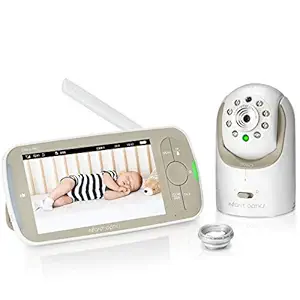
Infant Optics and HelloBaby are two reputable brands in the baby monitor market, both offering a variety of models with different features to cater to the needs of parents. The Infant Optics DXR-8, for instance, is renowned for its interchangeable lens technology that allows parents to customize the viewing angle and zoom. This feature is quite unique to Infant Optics and gives it an edge over many other brands, including HelloBaby. On the other hand, HelloBaby monitors, such as the HB32 model, are well-regarded for their long-range connectivity of up to 960 feet and two-way, talk-back intercom system, allowing parents to comfort their baby from a distance. When it comes to the latest technologies, both brands are on par. Infant Optics monitors come with an invisible IR night vision feature that allows clear monitoring in complete darkness. HelloBaby, too, offers a similar feature in its monitors. However, HelloBaby goes a step further with its temperature monitoring feature, which alerts parents if the room's temperature is too high or low. In terms of battery life, Infant Optics DXR-8 leads with a 10-hour life in power-saving mode and 6 hours with the display screen constantly on. HelloBaby, in contrast, offers a decent 8 hours with the display screen always on. Both brands have their strengths and weaknesses, and the choice between the two would largely depend on the specific needs and preferences of the parents.
Features
When evaluating the feature ecosystems of HelloBaby and Infant Optics, the fundamental difference lies in Infant Optics' emphasis on specialized hardware innovation versus HelloBaby’s focus on high-density digital functionality at an accessible price point. Infant Optics fundamentally distinguished itself through physical engineering, most notably with its patented interchangeable optical lens system on the DXR-8 series. This allows parents to physically swap between standard, optical zoom, and wide-angle lenses, providing true optical magnification without the pixelation and visual artifacting typical of digital zoom. HelloBaby, by contrast, relies entirely on digital zoom and software-driven pan-tilt-zoom (PTZ) mechanics across models like the HB65 and HB6550. While HelloBaby lacks modular optics, it compensates with versatile automated patrol modes, rapid remote tracking, and larger display consoles that deliver expansive coverage, making it a turnkey solution that does not require manual lens swaps.
The divergence in technical refinement is equally pronounced in audio architecture and nursery environmental controls. Infant Optics holds a decisive technological advantage with its proprietary Active Noise Reduction (ANR) chipsets, especially prominent in the DXR-8 PRO. This feature isolates baby vocalizations by actively filtering out constant low-frequency ambient sounds—such as white noise machines, air purifiers, and oscillating fans—yielding an exceptionally clean audio feed. HelloBaby implements standard VOX (Voice Operated Exchange) trigger-to-wake modes and two-way talkback systems, which perform reliably for basic threshold alerting but lack advanced acoustic filtration, frequently transmitting surrounding room hum to the parent unit. However, HelloBaby edges ahead in ambient conveniences, integrating an array of multi-track digital lullabies, customizable feeding/medication alert schedules, and more flexible multi-camera split-screen viewing options directly out of the box.
Ultimately, the practical trade-off between the two brands centers on acoustic and optical precision versus all-inclusive operational value. Both manufacturers wisely eschew vulnerability-prone Wi-Fi in favor of secure, zero-latency 2.4GHz FHSS closed-loop transmission with remote temperature sensing. Infant Optics engineers a focused, distraction-free monitoring tool with superior build quality, targeted audio isolation, and optical integrity designed for parents who prioritize pure sensory fidelity. HelloBaby delivers a feature-packed digital utility belt—combining multi-room split-screen monitoring, digital alerts, and robust automated motor functions—providing roughly 85% of the practical utility of premium units at a fraction of the cost, making it the more comprehensively equipped option for budget-conscious households.
Performance
In the non-Wi-Fi baby monitor ecosystem, core performance hinges on transmission stability, signal latency, and environmental resilience, where Infant Optics maintains a distinct engineering advantage over HelloBaby. Operating primarily on closed-loop 2.4GHz FHSS (Frequency-Hopping Spread Spectrum) protocols, Infant Optics—particularly exemplified by the flagship DXR-8 PRO—deploys superior internal transceivers and dedicated hardware-level signal processing. This architecture yields exceptional wall penetration, a near-zero latency video stream, and virtually zero packet dropouts across multi-story homes. HelloBaby models (such as the HB65 and HB6550 series) offer remarkably stable connectivity relative to their accessible price bracket, sustaining dependable connections up to typical suburban distances. However, HelloBaby units exhibit higher vulnerability to structural interference from thick masonry and dense 2.4GHz consumer radio environments, which can translate into intermittent frame stuttering or sluggish re-pairing sequences when pushing the boundary of its rated operational range.
Visual and sensor performance reveals contrasting approaches to optical engineering and image processing. Infant Optics differentiates itself by prioritizing optical purity over digital manipulation; its hardware features interchangeable physical optical lenses and a calibrated, high-definition camera module that resists the chromatic distortion and digital noise common in budget sensors. Its infrared night vision dynamically balances high-contrast exposure, preventing close-up facial features from blowing out into stark white silhouettes. In contrast, HelloBaby relies predominantly on software-based digital zoom and automated gain amplification. While HelloBaby displays deliver vivid, punchy daylight color and respectable daytime clarity on their large parent units, their infrared night mode frequently suffers from aggressive sharpening and blooming artifacts around near-field objects, diminishing overall diagnostic clarity when monitoring a child's minute movements in low-light environments.
Acoustic rendering and power management define the practical operational threshold, where the performance divide is most pronounced in ambient sound handling. Infant Optics revolutionized nursery acoustics with its proprietary Active Noise Reduction (ANR) chipset, an engineering milestone that systematically isolates and filters out constant background hums—such as sound machines, humidifiers, and fans—while instantly transmitting genuine infant vocalizations with razor-sharp fidelity. HelloBaby utilizes conventional microphone capsules coupled with standard threshold-based VOX (voice-activated) triggers; while functional and responsive to crying, it invariably transmits unfiltered room hiss and static alongside baby vocalizations. Nevertheless, HelloBaby demonstrates commendable electrical efficiency, often providing extended battery life on continuous display modes due to lower processor overhead. Infant Optics trades a fraction of raw battery longevity to run its demanding ANR chip and high-bitrate data stream, representing an elite performance profile tailored for parents who prioritize clinical acoustic precision and rock-solid transmission integrity.
Design
When evaluating industrial engineering and build quality, HelloBaby and Infant Optics approach nursery monitor design from fundamentally distinct philosophies. Infant Optics, best exemplified by its flagship DXR-8 and DXR-8 PRO models, utilizes a purposeful, clinical-grade design language that prioritizes rugged utility and longevity. Its parent units are constructed from thick, high-grade matte polymers engineered to endure frequent drops and continuous handling, complete with heavily reinforced kickstands, robust antenna hinges, and tactile physical controls. In contrast, HelloBaby adopts a sleeker, consumer-electronics aesthetic across its portfolio, often incorporating lightweight chassis and glossy finishes that mirror modern entry-level smartphones. While HelloBaby units are commendably compact, lightweight, and modern in visual appeal, the plastic housing feels perceptibly thinner and less shock-absorbent than Infant Optics' dense, utilitarian frameworks, presenting a trade-off between modern desktop minimalism and heavy-duty nursery survivability.
The mechanical and optical engineering of the camera units further delineates the two brands in functional sophistication. Infant Optics gained industry acclaim through its patented interchangeable optical lens system, an innovative hardware solution allowing parents to physically swap between normal, optical zoom, and wide-angle lenses without sacrificing digital resolution. Paired with whisper-quiet brushless pan-and-tilt motors and specialized thermal dissipation grilles to prevent overheating during 24/7 operation, Infant Optics' cameras reflect superior mechanical refinement. HelloBaby counters with integrated all-in-one camera units that favor digital pan-tilt-zoom (PTZ) mechanisms. While HelloBaby successfully eliminates loose accessories and simplifies the setup process through motorized enclosures capable of vast 355-degree rotation, their reliance on digital cropping over true optical reconfiguration introduces edge distortion and compromises image sharpness at maximum magnification, demonstrating a design priority focused on cost efficiency and simplicity over optical excellence.
From an ergonomic and interface design perspective, each brand caters to different user workflows. Infant Optics excels in blind-touch operation, featuring intuitively placed physical volume bars, distinct rubberized shortcut buttons, and dedicated Active Noise Reduction toggle switches that allow parents to adjust essential settings in dark rooms without looking at the screen. HelloBaby, however, leans into expansive screen-to-body ratios, often delivering larger 5-inch and 6-inch displays with vibrant color profiles and modernized on-screen display (OSD) menus. The trade-off is operational: HelloBaby frequently forces critical functions—such as zoom depth and sensitivity alerts—into multi-step software submenus managed by plastic multi-directional directional pads. Ultimately, Infant Optics delivers an engineered-for-purpose masterclass in ergonomic tactility and optical modularity, whereas HelloBaby presents an accessible, visually expansive design that maximizes display real estate and compact convenience at a far more approachable price point.
Conclusion
Infant Optics and HelloBaby are two renowned brands in the baby monitor category, each offering a unique set of features and technologies. The Infant Optics DXR-8 baby monitor is known for its interchangeable lens technology which allows parents to customize the viewing angle and zoom. It offers a real-time video feed on a 3.5” color display, infrared night vision, and a sound-activated LED display. However, some users have reported issues with battery life and signal range. On the other hand, HelloBaby monitors, such as the HB32 model, come with a 3.2” color TFT screen and use 2.4GHz wireless technology for a secure and interference-free connection. It also offers infrared night vision, two-way audio, and a temperature monitoring feature. A notable advantage of the HelloBaby monitor is its long battery life, with up to 12 hours in power-saving mode. However, some users have reported a lack of durability and issues with the monitor's speaker quality. In comparison to other brands, both Infant Optics and HelloBaby offer competitive features and are generally well-received by users, although each has its own strengths and weaknesses.