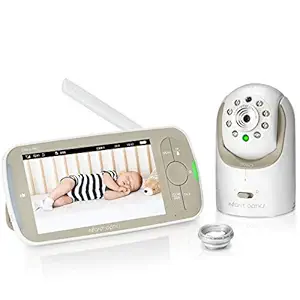
Infant Optics vs Anmeate: Overview & Brand Philosophy
When selecting a dedicated baby monitor, parents consistently grapple with the balance between technological sophistication, daily reliability, and overall security. Infant Optics entered the nursery technology sector with a singular, resolute objective: to build closed-loop, hack-proof monitoring systems engineered specifically around real-world parenting needs. Rather than diversifying into broad consumer electronics, Infant Optics established its reputation almost entirely on the success of its flagship DXR series, emphasizing modular hardware like interchangeable optical lenses and uncompressed local transmission that eschews potentially vulnerable Wi-Fi networks.
In contrast, Anmeate operates within the hyper-value direct-to-consumer segment, targeting budget-conscious families who demand essential digital monitoring tools without a premium price tag. Anmeate focuses on providing turnkey functionality straight out of the box, integrating standard features such as thermal monitoring, two-way audio, and infrared night vision into ultra-affordable packages. While Infant Optics positions itself as an industry benchmark built for multi-child nursery expansion, Anmeate serves as an entry-level powerhouse that maximizes feature count per dollar spent.
Key Differences & Technological Comparison
The technological divide between Infant Optics and Anmeate centers largely on optics, transmission protocol, and hardware flexibility:
- Optical Engineering & Customization: Infant Optics distinguishes itself through hardware-level optical innovation. Its flagship units feature interchangeable lens systems, allowing parents to switch between standard, wide-angle, and optical zoom lenses without degrading digital resolution. Anmeate, by contrast, relies on fixed standard lenses paired with basic digital zoom, which inherently crops the sensor image and reduces visual clarity when zooming in on a crib.
- Wireless Protocol and Latency: Both brands deliberately bypass Wi-Fi in favor of secure 2.4GHz FHSS (Frequency-Hopping Spread Spectrum) wireless technology to ensure zero risk of internet interception. However, Infant Optics employs more robust signal-processing hardware and noise reduction algorithms, offering greater wall-penetrating performance and lower audio latency than Anmeate's simpler transceiver modules.
- Display Quality and Interface: Infant Optics displays (notably on the DXR-8 PRO) feature high-definition screens with active background noise-reduction technology that filters out ambient sounds like fans or air purifiers. Anmeate units generally offer smaller, standard-definition LCD screens (typically 2.4 to 3.5 inches) that, while adequate for tracking movement, lack the advanced color grading, sharpness, and audio-filtering capabilities of Infant Optics.
- Camera Articulation and Build: Infant Optics cameras provide motorized remote pan, tilt, and optical focus controlled directly from the parent handheld monitor. Most entry-level Anmeate models require manual repositioning by hand, though higher-tier Anmeate variations provide basic mechanical pan/tilt with slightly louder motor noise during quiet nighttime operation.
Pros & Cons Comparison
Infant Optics
- Pros:
- Groundbreaking interchangeable optical lens system for customized field-of-view.
- Advanced Active Noise Reduction (ANR) isolates baby sounds from ambient room noise.
- Superior physical build quality and high-res monitor panels.
- Fully motorized, silent remote pan and tilt functionality.
- Easily replaceable, modular lithium-ion batteries.
- Cons:
- Significantly higher initial investment cost.
- Accessory lenses must be purchased separately on certain baseline trims.
- Handheld parent unit is somewhat bulkier than basic competitors.
Anmeate
- Pros:
- Extremely competitive price-to-feature ratio.
- Simple, zero-learning-curve setup straight out of the packaging.
- Compact, lightweight parent unit suitable for easy pocket transport.
- Reliable FHSS connection without reliance on unstable home internet.
- Standard inclusion of nursery temperature sensors and lullaby modes.
- Cons:
- Relies on digital zoom, resulting in pixelated close-up monitoring.
- Smaller display screen sizes with lower resolution and narrower viewing angles.
- More plastic-heavy, lightweight construction prone to drop damage.
- Shorter operational battery longevity over sustained daily duty cycles.
Performance, Durability & Value Analysis
From a performance and durability standpoint, Infant Optics justifies its higher pricing tier through exceptional component resilience and engineering foresight. The modularity of its hardware—particularly the user-replaceable battery pack—solves the single most common failure point in modern handheld monitors, which typically suffer battery degradation after 12 to 18 months of continuous cycling. Infant Optics' structural casing and mechanical gears in the motorized camera assembly are built to withstand years of active nursery duty, surviving toddler drops and multiple room transitions across successive children.
Anmeate presents undeniable upfront value for secondary use cases, such as travel, grandparents' homes, or families operating within strict financial parameters. While the unit performs its core duties of night-vision monitoring and temperature monitoring reliably in the short term, its internal lithium cells are generally non-serviceable, and the lightweight chassis shows wear more rapidly. If calculated over a single year of infancy, Anmeate provides unbeatable cost efficiency; however, when amortized across multiple years or consecutive children, Infant Optics often represents the more sustainable, lower-headache hardware investment.
Final Verdict: Which Brand Should You Choose?
Choose Infant Optics if your priority is pristine audio/video clarity, zero-compromise physical durability, and mechanical adaptability. It remains the gold standard for parents who want to zoom closely into a swaddle without pixelation, actively filter out white noise machines, and invest in an ecosystem capable of scaling across multiple children and room layouts.
Choose Anmeate if you need an affordable, dependable, and no-nonsense monitoring solution right out of the box. It is the premier choice for budget-conscious families, secondary travel kits, or caregivers who simply need a secure, closed-circuit peek into the nursery without paying for high-end optical glass and digital signal processors.
Features
When evaluating the feature ecosystems of Infant Optics and Anmeate, the distinction lies primarily between modular, high-end optical versatility and budget-conscious, integrated utility. Infant Optics, heralded by its flagship DXR-8 and DXR-8 PRO models, builds its engineering identity around premium optical customization. Its hallmark feature is the interchangeable optical lens system, which permits parents to physically switch between normal, zoom, and wide-angle lenses without suffering the pixelation inherent to digital manipulation. The brand also leans heavily into proprietary acoustic engineering, featuring Active Noise Reduction (ANR) chipsets that dynamically filter out background white noise—such as humidifiers and air purifiers—so caregivers only hear the infant’s vocalizations. Coupled with seamless motorized pan, tilt, and digital zoom (PTZ) executed with whisper-quiet brushless motors, Infant Optics delivers a tactile, technically superior feature suite tailored for maximum nursery visibility and acoustic clarity.
Conversely, Anmeate targets the practical essentials of infant monitoring, prioritizing cost-effective automation over mechanical versatility. Instead of physical lens swapping, Anmeate units rely entirely on high-magnification digital zoom, accompanied by manual mechanical tilting on the camera base alongside remote digital pan/tilt controls on select models. Where Anmeate shines is its robust suite of standardized convenience features embedded directly into the software. Anmeate monitors frequently incorporate pre-programmed polyphonic lullabies, multi-stage eco-mode (VOX) voice activation with high sensitivity thresholds, and built-in infrared night vision that transitions automatically with ambient light shifts. Furthermore, Anmeate cameras feature integrated ambient temperature sensors with programmable high/low alert thresholds, alerting parents via audible alarms on the parent unit if the nursery breaches optimal sleeping temperatures—a feature implemented with intuitive simplicity.
The practical trade-off between these two brands comes down to specialized optical and audio refinement versus out-of-the-box convenience. Infant Optics requires a steeper financial investment, but it rewards the user with superior hardware longevity, a larger high-definition parent screen (up to 5 inches on the PRO), localized signal security via 2.4GHz FHSS with advanced hopping, and an audio-filtering capability that competitors struggle to match. Anmeate, on the other hand, delivers high functional density at a fraction of the cost, making it immensely practical for travel or secondary setups. While Anmeate lacks the sophisticated optical precision, active acoustic filtering, and modular upgrades of Infant Optics, its reliable execution of essential monitoring metrics—temperature tracking, battery-saving VOX responsiveness, and sound-activated visual LED bars—makes it a formidable, high-value alternative for parents seeking comprehensive core utility without premium modular mechanics.
Performance
When evaluating core performance in the non-Wi-Fi baby monitor space, Infant Optics establishes a clear advantage in signal integrity, hardware-level responsiveness, and video fluidity. Anchored by their flagship DXR-8 PRO, Infant Optics leverages an upgraded 2.4GHz FHSS digital transmission channel engineered with patent-pending Active Noise Reduction (ANR) technology. This specialized audio processing chipset actively filters out ambient environmental soundscapes—such as white noise machines, air purifiers, and humidifiers—to isolate and amplify the baby's actual vocalizations. In terms of wireless stability, Infant Optics monitors deliver exceptional latency-free video feed with superior wall-penetration capabilities up to a reliable 700 to 1,000 feet, virtually eliminating the frame dropping, screen tearing, and micro-stuttering that frequently compromise consumer-grade radio frequency monitors.
Conversely, Anmeate targets the budget-conscious performance tier, offering a dependable yet fundamentally basic operational profile. Operating on standard 2.4GHz digital encryption, Anmeate units provide adequate coverage for smaller to medium-sized single-story homes, typically remaining stable within an unobstructed 960-foot line of sight. However, in real-world environments dense with structural obstacles and competing radio bands, Anmeate exhibits noticeable frame-rate degradation and a higher susceptibility to connection dropouts. While its infrared night vision sensor triggers promptly in low-light conditions, the resulting image lacks the dynamic range and high-definition clarity found in Infant Optics, often resulting in washed-out focal points or heavy digital noise around the periphery. Furthermore, Anmeate’s audio channel lacks active filtering, which means constant white noise from the nursery is transmitted directly to the parent unit, leading to listener fatigue over extended night shifts.
The definitive operational trade-off between the two brands centers on optical flexibility and component endurance. Infant Optics utilizes interchangeable and motorized pan-tilt-zoom (PTZ) optical lens mechanisms that maintain visual acuity without relying on aggressive, pixelated digital zoom. The mechanical pan and tilt functions operate smoothly and almost silently, preventing camera noise from disturbing light sleepers. In contrast, Anmeate models frequently rely on manual mechanical positioning paired with basic digital zoom capabilities, restricting parents' remote control over nursery viewing angles. While Anmeate delivers competent baseline functionality for close-quarters monitoring at an accessible price, Infant Optics comprehensively outperforms it in optical precision, transmission resilience, and intelligent audio processing, making it the superior performer for rigorous, long-term nursery surveillance.
Design
In the landscape of dedicated, non-Wi-Fi baby monitors, Infant Optics and Anmeate present two distinct design philosophies that directly reflect their respective market tiers. Infant Optics, heralded by its flagship DXR-8 PRO, emphasizes a refined, user-centric industrial design rooted in modular versatility. The brand's signature design innovation—an interchangeable optical lens system—allows parents to physically swap between normal, wide-angle, and zoom lenses without sacrificing optical clarity for digital interpolation. Both the camera and parent handheld unit feature ergonomic contours, smooth matte finishes, and premium mechanical hinge designs. The parent unit is engineered with high-density tactile controls, an external antenna integrated flush into the frame, and a vibrant 5-inch LCD display. Conversely, Anmeate favors a minimalist, budget-friendly design paradigm. Its hardware relies on utilitarian ABS plastics with lighter internal weighting, resulting in a chassis that feels less substantial in hand. Instead of optical modularity, Anmeate integrates fixed-focus, wide-aperture lenses with automated digital pan-tilt-zoom (PTZ), prioritizing straightforward, unencumbered manufacturing over modular engineering.
From an operational and feature-set perspective, the technical trade-offs between the two form factors are substantial. Infant Optics prioritizes active nursery interaction: the camera module features high-torque, silent internal brushless motors that pan 330 degrees and tilt 110 degrees smoothly without waking a sleeping infant. Furthermore, its parent unit integrates a patented Active Noise Reduction (ANR) chipset, managed via intuitive side-mounted toggle buttons rather than buried digital menus. Anmeate, meanwhile, adopts a more static architectural footprint. Many of its standard models require manual physical adjustment at the camera base during installation, limiting dynamic remote panning from the smaller 2.4-inch to 3.5-inch parent unit screen. However, Anmeate's design excels in compactness and thermal dissipation; its smaller footprint allows it to sit unobtrusively on narrow shelves or mount securely to headboards using simplified wall-anchor plates, making it exceptionally portable for travel.
Ultimately, the design divergence impacts longevity, tactile satisfaction, and real-world utility. Infant Optics’ engineering is tailored for demanding, multi-year nursery environments, featuring a modular, user-replaceable lithium-ion battery cavity, a robust rear kickstand, and a heavy, low-center-of-gravity camera base that prevents accidental cord tugs from toppling the unit. This high-grade build quality demands a steeper investment and adds pocket bulk to the parent receiver. Anmeate provides a streamlined, lightweight alternative that strips away complex moving parts and interchangeable components in favor of a low-profile, plug-and-play design. While Anmeate delivers commendable durability for its price bracket, Infant Optics establishes a clear superiority in refined industrial execution, materials science, and adaptable mechanical design.