Arlo vs Infant Optics: Overview
Comparing Arlo and Infant Optics helps you determine which brand is best suited for your needs in Baby Monitors. Both brands offer strong choices depending on your budget and key feature requirements.
Key Features & Comparison
Evaluate factors such as build quality, warranty, customer satisfaction, and total value before making your final purchase choice between Arlo and Infant Optics.
Features
From a feature architecture perspective, Arlo and Infant Optics cater to sharply contrasting user workflows. Arlo leverages modern software engineering, incorporating artificial intelligence to deliver sophisticated package- and person-detection, customizable smart motion zones, ambient air quality tracking (VOC, temperature, and humidity sensors on dedicated models), and automated multi-color nightlights. It integrates seamlessly with broad smart home platforms, allowing parents to automate routines—such as triggering white noise or adjusting nursery smart bulbs when crying is detected. Furthermore, Arlo enables two-way audio directly through mobile apps, supports multi-user remote access for grandparents or babysitters, and archives video history to the cloud, though unlocking the full breadth of these AI-driven features frequently requires an ongoing Arlo Secure subscription.
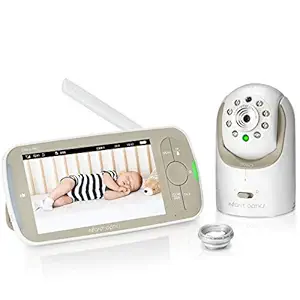
Infant Optics eschews app-based software ecosystems entirely, focusing its feature set on rapid hardware utility and localized physical controls. Its standout engineering feat is the proprietary optical lens system, which allows users to physically swap between normal, wide-angle, and telephoto zoom lenses to adjust the field of view without inducing digital pixel degradation. Modern iterations, like the DXR-8 PRO, feature Active Noise Reduction (ANR), a dedicated hardware chipset that actively filters out repetitive background ambient hums—such as HEPA air purifiers, humidifiers, and fans—to ensure parents hear only vocalizations and distress cries. While Infant Optics lacks cloud storage, sleep tracking metrics, and smart assistant voice commands, it provides high-utility hardware features like remote mechanical pan/tilt/zoom, real-time localized temperature readouts, and sound-activated visual LED bar meters that operate with zero internet dependency.
Performance
In real-world performance metrics, Arlo leads in baseline resolution, color rendering, and daytime dynamic range, streaming crisp 1080p up to 2K HDR video that captures micro-movements in the crib with exceptional clarity. However, because Arlo routes its feed through local Wi-Fi and outbound cloud infrastructure, performance is inextricably linked to home network health and ISP bandwidth. Users often encounter a latency buffer of 1 to 3 seconds, occasional stream buffering, and potential service drops during routine router reboots or external server outages. Night vision performance is generally strong due to high-power infrared LEDs, but the compression artifacts native to streamed cloud video can occasionally blur rapid movements or obscure fine breathing motions in low-light conditions.
Infant Optics trades pure pixel density for rock-solid consistency, zero latency, and absolute transmission reliability. While its physical parent monitors utilize lower resolutions (such as 720p on the DXR-8 PRO), the feed operates with virtually imperceptible input lag, offering instantaneous auditory and visual feedback the millisecond a child makes a sound. Because it utilizes closed-circuit FHSS wireless technology rather than home Wi-Fi, the connection is impervious to network congestion, bandwidth throttles, or external internet outages. The battery life on the parent handheld unit delivers reliable overnight endurance with power-saving screen-timeout modes, and the hardware-driven Active Noise Reduction provides far cleaner, clearer audio monitoring than the basic noise-gating software algorithms found in mobile app-dependent streams.
Design
The aesthetic and physical design language of Arlo reflects modern minimalist consumer electronics. Arlo cameras feature smooth, rounded curves, glossy weather-resistant polycarbonates, and clean contemporary silhouettes that blend effortlessly into modern home decor or nursery shelving. Because Arlo is designed to use your smartphone, tablet, or smart display as the monitor, the physical footprint is strictly limited to the camera unit and its mounting hardware. The cameras frequently feature integrated magnetic bases or multi-directional ball-and-socket mounts that facilitate quick, precise adjustments toward the crib. However, this design philosophy requires parents to commit their primary personal devices to baby monitor duty, which can lead to rapid smartphone battery depletion, interruptions from incoming phone calls, and screen-management fatigue.
Infant Optics takes a purely utilitarian, purpose-built approach to physical design, creating two distinct matching components: the motorized nursery camera and a dedicated, ruggedized parent handheld monitor. The camera unit is engineered around a robust mechanical base providing ultra-smooth, whisper-quiet motorized pan and tilt functionality, flanked by the threaded interchangeable optical lens housing. The parent monitor is ergonomically shaped with textured grips, tactile navigation buttons, a retractable external antenna for extended range, and a heavy-duty kickstand for bedside tables. While the handheld unit has a decidedly utilitarian, gadget-like appearance with a noticeably bulkier profile compared to a smartphone, its dedicated nature ensures parents have an always-on, glanceable screen that does not drain personal device batteries or require unlocking a phone screen in the middle of the night.
Compare current retail pricing, active promotions, and verified stock availability directly from authorized stores:
Compare current retail pricing, active promotions, and verified stock availability directly from authorized stores: