Winix vs Medify: Overview
Comparing Winix and Medify helps you determine which brand is best suited for your needs in Air Purifiers. Both brands offer strong choices depending on your budget and key feature requirements.
Key Features & Comparison
Evaluate factors such as build quality, warranty, customer satisfaction, and total value before making your final purchase choice between Winix and Medify.
Features
Winix purifiers excel in smart automation and auxiliary air treatment technologies. Most Winix models, such as the 5500-2 and AM90, feature the brand's proprietary PlasmaWave technology, an advanced bipolar ionization system that breaks down odors, chemical vapors, and biological contaminants at a molecular level without generating harmful ozone. Furthermore, Winix incorporates responsive dual-sensor suites (detecting both ambient light and airborne particulates) that drive an intelligent Auto Mode, seamlessly shifting fan speeds and dimming display LEDs for undisturbed sleep without requiring manual user intervention.
Medify Air avoids ionization entirely, focusing its feature architecture around physical filtration enhancements, ultra-high air volume, and intuitive touch interfaces. Medify's primary selling point is its use of True HEPA H13 (and in some models H14) medical-grade filters, which capture 99.9% of particles down to 0.1 microns—a tighter threshold than the standard True HEPA H11 or H12 grade often found in entry-to-mid consumer units. Medify also equips its devices with multi-speed operational timers, child locks, filter replacement indicators, and, on select units, optional UV-C light sanitation, catering to users who want measurable mechanical efficacy rather than passive electronic air-cleaning features.
Performance
In terms of outright particulate removal, Medify Air holds a technical edge due to its superior filtration density and exceptionally high Clean Air Delivery Rates (CADR). By deploying dense H13/H14 HEPA media alongside robust, high-RPM centrifugal fan assemblies, Medify units cycle large air volumes rapidly, achieving exceptional Air Changes per Hour (ACH). This high throughput makes Medify remarkably effective in environments laden with heavy wildfire smoke, pet dander, or commercial foot traffic. However, this high static pressure requires significant motor effort, resulting in noticeable acoustic output at maximum speeds.
Winix counters with superior acoustic tuning and chemical odor mitigation. While its baseline True HEPA captures 99.97% of particles down to 0.3 microns—sufficient for nearly all residential needs—Winix models typically feature high-grade activated carbon filters (often pelletized rather than coated carbon sheets) that outperform Medify in adsorbing household VOCs, cooking odors, and pet smells. Additionally, Winix engineers their units for residential soundscapes; even on medium-to-high settings, Winix purifiers maintain low decibel levels and a non-intrusive sound frequency, providing superior continuous, long-term living room and bedroom performance.
Design
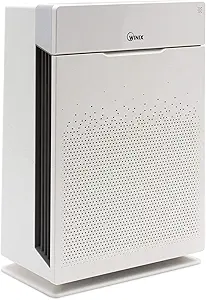
From a design and aesthetic perspective, Winix adopts a sleek, consumer-friendly approach that blends effortlessly into contemporary home decor. Their units typically feature clean plastic housings, subtle vertical intake grilles, and organic curved profiles with minimalist control panels. Winix also thoughtfully integrates ergonomic recessed handles and lightweight chassis architectures, facilitating easy movement between rooms. The internal layout is modular and user-friendly, allowing rapid access to the pre-filter, carbon cassette, and main HEPA block without specialized tools.
Medify embraces a more utilitarian, commercial-grade aesthetic defined by angular geometry, robust composite plastics, and cylindrical or tower form factors. Many Medify units, like the MA-40 or MA-112, employ 360-degree cylindrical or dual-sided intake arrays to maximize intake surface area and reduce airflow resistance across the dense H13 media. While Medify’s tempered glass control panels and industrial finishes impart a sense of durability and institutional hygiene, they are often bulkier, heavier, and distinctly more clinical in appearance compared to the softer, domestic lines of Winix appliances.