Dyson vs Winix: Overview
Comparing Dyson and Winix helps you determine which brand is best suited for your needs in Air Purifiers. Both brands offer strong choices depending on your budget and key feature requirements.
Key Features & Comparison
Evaluate factors such as build quality, warranty, customer satisfaction, and total value before making your final purchase choice between Dyson and Winix.
Features
Dyson distinguishes itself through an exhaustive suite of digital intelligence and multifunctional convenience features. Most modern Dyson purifiers serve as either cooling fans or combo fan-heaters, drastically reducing year-round appliance clutter. Technologically, Dyson units are equipped with advanced onboard sensor arrays that measure particulate matter (PM2.5, PM10), volatile organic compounds (VOCs), and nitrogen dioxide (NO2) in real time, projecting these metrics onto a built-in LCD screen and the MyDyson companion app. Extensive oscillation controls—ranging up to 350 degrees—voice assistant compatibility, and backward airflow modes underscore Dyson's emphasis on user experience.
Winix purifiers prioritize functional air treatment capabilities over connected luxury, centered heavily around their proprietary PlasmaWave technology. This bipolar ionization feature creates positive and negative ions that combine with water vapor to neutralize airborne bacteria, viruses, and odors without generating harmful levels of ozone. While higher-end Winix models include Wi-Fi connectivity and basic auto-modes driven by onboard light and particle sensors, their interface remains predominantly utilitarian with physical tactile buttons and LED air quality indicators. The brand sacrifices deep smart-home automation to ensure seamless, intuitive, and distraction-free operation.
Performance
In terms of raw air cleaning efficacy, Winix holds a commanding lead in air exchange rates and high-volume particle capture. Leveraging thick, high-surface-area True HEPA filters paired with robust internal centrifugal fans, Winix models such as the 5500-2 deliver significantly higher CADR numbers across smoke, dust, and pollen compared to Dyson units of similar footprint. Winix’s deep pellet-based activated carbon filters provide superior adsorption of heavy odors and chemical vapors compared to thin carbon sheets, making them substantially more effective for rapid air clearing in homes with pets, smokers, or heavy culinary activity.
Dyson operates on a different performance paradigm focused on room-wide circulation rather than localized air exchange speed. Dyson purifiers rely on Air Multiplier technology to project purified air across the entirety of a room, creating continuous airflow loops that draw distant pollutants back into the unit. Furthermore, Dyson’s newer models feature fully sealed HEPA H13-standard enclosures, ensuring that what goes inside stays trapped with zero air bypass. While Dyson cleans rooms at a noticeably slower rate due to lower airflow velocity, its high-filtration standard ensures extremely low particulate leakage once the air has been cycled.
Design
From an aesthetic and structural design standpoint, Dyson represents the gold standard of modern industrial engineering. Characterized by their iconic bladeless loop amplifiers, metallic finishes, and minimalist silhouettes, Dyson purifiers are engineered to be showcased rather than concealed. The absence of spinning blades enhances household safety for children and pets while simplifying exterior cleaning. Dyson's internal architecture reflects a compact, vertical integration that maximizes airflow physics, and the magnetic remote control that docks seamlessly onto the curved top of the unit epitomizes their meticulous attention to detail.
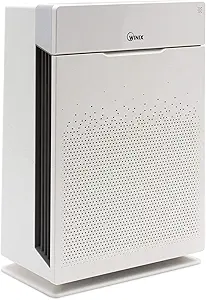
Winix opts for a conventional, functional appliance aesthetic that favors utilitarian practicality over modern luxury. Built with durable matte plastic chassis, Winix purifiers feature standard front-grille intake designs and top-mounted exhaust vents, blending discreetly against walls or within room corners. While less visually striking than Dyson, this classic boxy architecture permits a direct, low-resistance airflow pathway that accommodates significantly thicker filter media. The trade-off is a bulkier presence and a more industrial look, but one that is optimized for acoustic dampening, easy filter access, and long-term mechanical reliability.