Crane vs Winix: Overview
Comparing Crane and Winix helps you determine which brand is best suited for your needs in Air Purifiers. Both brands offer strong choices depending on your budget and key feature requirements.
Key Features & Comparison
Evaluate factors such as build quality, warranty, customer satisfaction, and total value before making your final purchase choice between Crane and Winix.
Features
Crane’s feature portfolio reflects a child-centric, lifestyle-driven approach that prioritizes simplicity and multifunctional utility. Many Crane purifiers incorporate integrated features such as multi-color nightlights, aroma trays for essential oils, and basic sleep timers. Some models even feature integrated ultrasonic humidifiers. However, Crane units generally lean on fundamental manual controls, featuring three-speed rotary or push-button interfaces with relatively rudimentary filter replacement indicators that rely on internal operational timers rather than dynamic particulate measurement.
Winix takes a significantly more advanced, automated approach by outfitting its machines with high-precision airborne pollutant monitoring. Most Winix models come equipped with onboard infrared or optical particulate smart sensors that continuously sample ambient air, automatically adjusting fan velocity via an intelligent Auto Mode. A signature hallmark is Winix's proprietary PlasmaWave technology, which utilizes an active electrical discharge to neutralize molecular contaminants and airborne odors without emitting harmful ozone levels. Coupled with expansive scheduling, light sensors for automated Sleep Mode, and select Wi-Fi app connectivity, Winix delivers a drastically more intelligent and autonomous user experience.
Performance
From a raw performance standpoint, Winix substantially outperforms Crane across virtually every standard metric, including Clean Air Delivery Rate (CADR) and square footage coverage. Winix units leverage True HEPA filtration media capable of capturing 99.99% of airborne particles down to 0.003 microns in select units, supported by dense, activated carbon filtration grids that actively adsorb volatile organic compounds (VOCs) and pet odors. The high-powered centrifugal fan assemblies in Winix purifiers allow them to cycle hundreds of cubic feet of air per minute, making them exceptionally effective at rapidly clearing smoke, dander, and microscopic allergens from living rooms and master suites.
Crane purifiers, by comparison, are engineered with smaller blowers and less dense filter cartridges, translating to modest CADR values best suited for small spaces typically under 200 square feet. While many Crane units feature HEPA-type or genuine True HEPA filters with integrated carbon layers, the carbon is often an impregnated thin sheet that saturates relatively quickly compared to Winix’s granulated or thicker activated carbon setups. Consequently, Crane handles localized dust and light dander adequately in small bedrooms, but it lacks the static pressure and airflow throughput required to handle heavy pollutant loads or eliminate persistent household odors efficiently.
Design
Crane’s design methodology leans heavily on gentle geometries, playful motifs, and compact desk-friendly proportions. The brand frequently employs rounded edges, whimsical cylindrical shapes, and clean neutral palettes that intentionally blend into children’s nurseries, home offices, and bedside tables. Materials are primarily lightweight plastics, keeping the units portable and easy to relocate. The tactile controls are kept minimal and unobtrusive, reinforcing Crane's goal of producing approachable home appliances that do not intimidate the user or dominate the physical room aesthetic.
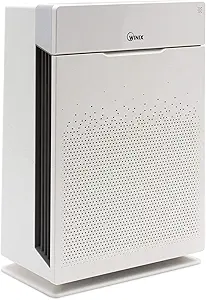
Winix embraces a more architectural, appliance-grade design language characterized by clean lines, modern perforated front-intake grilles, and contemporary gray and white finishes. Designed to handle significant air intake volume, Winix enclosures are substantially larger and feature optimized aerodynamic air ducting designed to draw pollutants from 360 degrees or through broad front panels before expelling clean air upward. While larger footprints mean Winix purifiers require dedicated floor space rather than tabletop placement, the build quality feels dense, industrial, and utilitarian, accented by informative LED air quality indicator rings that shift color to communicate environmental conditions at a glance.