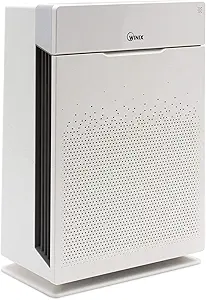
Coway vs Winix: Overview
Comparing Coway and Winix helps you determine which brand is best suited for your needs in Air Purifiers. Both brands offer strong choices depending on your budget and key feature requirements.
Key Features & Comparison
Evaluate factors such as build quality, warranty, customer satisfaction, and total value before making your final purchase choice between Coway and Winix.
Features
The technological philosophies of Coway and Winix diverge most noticeably in their secondary purification methods and connectivity options. Coway distinguishes itself through its Green True HEPA technology, which incorporates antimicrobial coatings designed to deactivate captured viruses and bacteria rather than simply trapping them. Additionally, higher-end Coway models offer sophisticated multi-stage filtration customization, including specialized filters for pet odors, smoke, or VOCs, paired with a remarkably intuitive Eco Mode that completely shuts the motor down when clean air is detected. Winix counters with its proprietary PlasmaWave technology, a hydroxyl-based ionization system that breaks down pollutants at a molecular level without producing harmful ambient ozone levels, offering an active sterilization layer alongside standard mechanical filtration.
In terms of user experience and smart controls, both manufacturers deliver competent automation, yet execute it differently. Winix purifiers typically include light sensors that automatically transition the unit into an ultra-quiet sleep mode when ambient lighting drops, an immensely practical convenience for bedroom placement. Winix also provides broad smart connectivity via the Winix Smart app across intermediate models. Coway reserves its most robust Wi-Fi capabilities and smart home integrations (such as Alexa and Google Assistant) for its flagship Airmega lines, which feature granular air quality mapping and real-time VOC tracking. While Winix provides exceptional automated utility out of the box, Coway offers deeper customization and more polished sensor responsiveness.
Performance
From a pure filtration efficacy standpoint, both brands easily capture 99.97% of airborne particulate matter down to 0.3 microns, yet their airflow dynamics reveal notable differences in real-world application. Coway's internal fluid dynamics are optimized for laminar airflow and low acoustic footprints, allowing units like the Airmega 200M and 400 to achieve rapid air turnover without the high-pitched motor whine typical of cheaper units. Coway's particle sensors, particularly their dual-sensing particulate monitors, exhibit exceptional sensitivity, instantly ramping fan speeds at the slightest introduction of aerosolized cooking grease or dust. This precision ensures that air quality rebounds swiftly while minimizing prolonged runs at high, energy-draining decibel levels.
Winix purifiers, such as the ubiquitous 5500-2 and Zero series, rely on aggressive air circulation powered by high-torque centrifugal fans. In standardized CADR benchmark testing, Winix units frequently outperform Coway models at comparable price brackets, moving substantially higher cubic feet of air per minute. The inclusion of washable AOC (Advanced Odor Control) carbon filters in mid-range Winix models provides superior initial vapor and odor absorption compared to Coway's thinner, disposable carbon sheets found on entry-level models. However, Winix units tend to operate at higher decibel thresholds on their maximum settings, sacrificing whisper-quiet sound profiles in exchange for sheer processing throughput.
Design
Design serves as the clearest differentiator between these two manufacturers, with Coway treating air purifiers as curated interior design elements. Coway's design language borrows heavily from mid-century modern and Scandinavian aesthetics, characterized by soft curves, clean matte finishes, and perforated intake grilles that resemble acoustic speakers rather than industrial appliances. Models like the Airmega 150 and Icon have received prestigious international design accolades (such as iF and Red Dot awards), fitting seamlessly into modern residential decor. Furthermore, Coway emphasizes a compact footprint, maximizing intake surface area while minimizing the visual mass of the chassis.
Winix adopts a much more utilitarian, functional design ethos. Constructed primarily from resilient, high-grade plastic with front-facing vertical intake louvers, Winix purifiers present a traditional consumer-electronics aesthetic. While exceptionally durable and easy to service, they prioritize airflow pathways over architectural minimalism, resulting in units that are visibly bulkier and more noticeable in a room. Coway features sleek, recessed touch controls and subtle ring-LED air quality indicators, whereas Winix relies on prominent top-mounted control panels with brightly lit displays. For homeowners where visual unobtrusiveness is a priority, Coway clearly holds the upper hand, while Winix prioritizes structural ruggedness and maintenance accessibility.