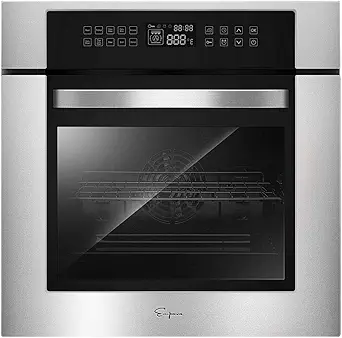
GE vs Empava: Overview
Comparing GE and Empava helps you determine which brand is best suited for your needs in Wall Ovens. Both brands offer strong choices depending on your budget and key feature requirements.
Key Features & Comparison
Evaluate factors such as build quality, warranty, customer satisfaction, and total value before making your final purchase choice between GE and Empava.
Features
From a technological and feature perspective, GE offers a deeply integrated, sophisticated ecosystem tailored to modern smart homes. Most mid-to-high-tier GE wall ovens are outfitted with the SmartHQ platform, delivering seamless Wi-Fi connectivity that supports remote preheating, precision cooking modes, and downloadable firmware upgrades such as specialized air frying algorithms. GE often incorporates advanced features like multi-point integrated meat probes, true European convection systems with dedicated heating elements, variable self-cleaning cycles (combining high-heat pyrolytic cleaning with rapid steam cleaning options), and heavy-duty, roller-bearing gliding racks that can safely remain in the oven during the clean cycle.
Empava, in contrast, focuses on executing core culinary essentials with straightforward mechanical and digital utility, deliberately omitting overly complex software stacks to maintain lower price thresholds. While select Empava models feature digital touch interfaces, pre-programmed cooking modes, and convection fans, their feature sets are more utilitarian. Smart home integration, remote diagnostics, and companion apps are largely absent, and their convection mechanisms are typically standard fan-assisted systems rather than true European third-element systems. Empava generally relies on standard porcelain cavity coatings and manual or basic steam-assisted cleanup methods rather than robust, high-temperature pyrolytic self-cleaning. For users prioritizing connected kitchen capabilities and automated precision, GE holds a distinct advantage, while Empava appeals to those who favor unpretentious, plug-and-play simplicity.
Performance
In terms of thermal dynamics and cooking performance, GE demonstrates a clear technical superiority driven by sophisticated heat distribution engineering. GE’s premium models utilize advanced true European convection systems that pair a rear heating element with a dedicated, variable-speed fan. This architecture creates an optimized, uniform airflow that drastically mitigates cold spots, allowing for multi-rack baking without the need to rotate sheet pans midway through the cycle. The precision of GE's temperature management—governed by algorithmic sensor arrays—ensures exceptionally tight temperature swings, resulting in consistent pastry rises, reliable low-temperature proofing, and high-heat broiling with uniform surface coverage.
Empava wall ovens deliver reliable, predictable thermal performance suited for everyday domestic cooking, but they exhibit narrower operating margins compared to GE. Because many Empava units utilize single-fan assist rather than dedicated third-element true convection, heat distribution can occasionally be directional, leading to subtle hot spots during high-density, multi-rack baking. Preheat times on 120V compact Empava models can also be longer compared to standard 240V hardwired GE units, which draw higher wattage to rapidly saturate the cavity with heat. While Empava effortlessly handles standard roasting, casserole baking, and daily family meals, GE provides the thermodynamic precision and recovery speed necessary for demanding baking and complex multi-stage culinary tasks.
Design
The industrial design languages of GE and Empava cater to very different aesthetic sensibilities and architectural paradigms. GE designs its wall ovens around traditional American kitchen dimensions and cabinetry, utilizing heavy-gauge stainless steel, robust tubular handles, and glass-paneled doors with oversized viewing windows. The user interfaces strike a refined balance between responsive glass capacitive-touch panels and physical rotary dials, catering to both digital-first and tactile-oriented cooks. Furthermore, GE ovens are engineered to seamlessly align flush or standard inset with standard American 27-inch and 30-inch cabinet cutouts, presenting an integrated, professional appearance that blends into high-end transitional or contemporary kitchens.
Empava, by contrast, embraces a distinctly minimalist, European-inspired aesthetic characterized by slim vertical profiles, black reflective glass surfaces, and brushed stainless trim. Empava has achieved particular design success in the 24-inch compact category, making it an ideal visual and spatial match for modern urban apartments, modular kitchen layouts, and European cabinetry. However, the physical build materials reflect its value orientation; the sheet metal gauge is often noticeably lighter, the door hinges operate with a less dampened feel, and the control panels feature more utilitarian LED displays and basic membrane or rotary controls. While Empava achieves an undeniably chic, upscale look at a distance, GE offers a more substantial, tactile, and durable physical construction that withstands heavy, long-term use.