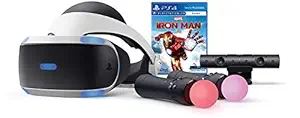
LG vs Playstation: Overview
Comparing LG and Playstation helps you determine which brand is best suited for your needs in VR Headsets. Both brands offer strong choices depending on your budget and key feature requirements.
Key Features & Comparison
Evaluate factors such as build quality, warranty, customer satisfaction, and total value before making your final purchase choice between LG and Playstation.
Features
PlayStation's feature architecture is meticulously engineered around sensory immersion and deep interactive feedback. The PSVR2 boasts inside-out tracking powered by four integrated cameras, highly responsive infrared eye-tracking that facilitates foveated rendering, and specialized Sense controllers featuring adaptive triggers and nuanced haptic feedback derived from the DualSense ecosystem. Additionally, PlayStation innovated by embedding a haptic motor directly into the headset headband, providing physical feedback during gameplay events. These hardware capabilities are tightly woven into Sony’s bespoke operating system, offering effortless boundary calibration, see-through cameras, and seamless integration with PlayStation Network services.
LG’s hardware features, derived from their advanced R&D divisions and enterprise prototypes, center primarily on supreme display fidelity and component-level integration rather than consumer software perks. LG has showcased ultra-high-density micro-OLED architectures capable of delivering extreme pixel density, wide color gamuts, and high-bandwidth processing tailored for next-generation extended reality (XR). However, LG lacks the bespoke consumer input hardware, unified storefront, and proprietary spatial audio engines that make PlayStation's feature package cohesive. While LG’s technical specifications often set theoretical high-water marks for visual clarity and sensor throughput, PlayStation wins on functional, practical utility by delivering an interconnected suite of immersion-focused features tailored for everyday use.
Performance
In real-world performance metrics, PlayStation VR2 demonstrates the immense benefits of dedicated hardware optimization. Powered by the PlayStation 5, the headset delivers smooth 90Hz to 120Hz refresh rates with minimal latency, utilizing eye-tracked foveated rendering to dynamically focus computing power precisely where the user is looking. This allows the system to push graphical boundaries that rival high-end PC setups, rendering complex physics, photorealistic lighting, and expansive draw distances without staggering frame drops. The custom OLED panels offer rich contrast, deep blacks, and full HDR support, though users do occasionally report a subtle persistence blur (mura effect) in low-light digital environments.
LG’s performance merits lie squarely within its display panel supremacy, where the company outclasses nearly all competitors in raw visual metrics. LG Display's micro-OLED technology delivers astronomical resolutions with sub-millisecond response times, virtually eliminating the screen-door effect and motion blur while delivering superior color accuracy and peak brightness. However, because LG does not manufacture a standalone, commercially optimized consumer ecosystem with dedicated compute hardware, its operational performance depends entirely on external hosts, third-party drivers, and software layers. While LG hardware can produce superior raw clarity, PlayStation achieves higher real-world performance efficiency through tightly controlled, host-level optimization.
Design
PlayStation’s design ethos prioritizes long-duration gaming ergonomics and user-friendly adjustability. The PSVR2 adopts a halo-strap configuration that distributes the unit's weight across the crown of the head rather than clamping forcefully against the user's face. This floating-visor design is complemented by an intuitive lens adjustment dial (IPD slider), plush light-blocking silicone gaskets, and integrated ventilation channels that significantly reduce lens fogging during intense physical exertion. The matching Sense controllers are sculpted into ergonomic spheres that balance naturally in the hands while protecting the infrared tracking rings from accidental collisions.
LG’s design approach reflects an emphasis on industrial minimalism, spatial computing sleekness, and compact form factors. Leveraging advanced pancake optics and micro-displays, LG’s hardware prototypes and collaborative concepts sport dramatically slimmer visors compared to the relatively bulky PSVR2. Their aesthetic prioritizes premium materials, balanced center-of-gravity profiles, and low-profile industrial silhouettes intended to blend into productivity and lifestyle environments. However, while LG excels in theoretical weight reduction and structural compactness, PlayStation’s physical design has been rigorously stress-tested across millions of diverse consumer head shapes, making it a more forgiving, practical, and durable design for sustained consumer use.
Compare current retail pricing, active promotions, and verified stock availability directly from authorized stores: