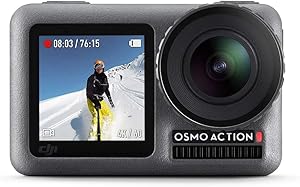
Sony vs DJI: Overview
Comparing Sony and DJI helps you determine which brand is best suited for your needs in Video Cameras. Both brands offer strong choices depending on your budget and key feature requirements.
Key Features & Comparison
Evaluate factors such as build quality, warranty, customer satisfaction, and total value before making your final purchase choice between Sony and DJI.
Features
Sony's feature architecture is deeply rooted in professional-grade camera controls, expansive signal processing, and unrivaled optical flexibility. Across both mirrorless hybrids and FX-line cinema bodies, Sony incorporates standard-setting real-time autofocus with AI subject recognition that can track human eyes, animals, and vehicles with surgical precision. Videographers benefit from robust recording formats, including 10-bit 4:2:2 internal capture, advanced color profiles like S-Cinetone and S-Log3, dedicated dual-base ISOs, and custom LUT monitoring. Additionally, Sony’s electronic variable ND filters—present in cinema models like the FX6—and multi-interface shoe integration provide an unprecedented level of granular hardware control that accommodates sophisticated third-party accessories and audio setups.
DJI approaches features through the lens of automated robotics, hardware stabilization, and intelligent software tracking. Models such as the Osmo Pocket 3 and Ronin 4D feature mechanical three-axis gimbals that render traditional optical stabilization obsolete for moving shots, paired with ActiveTrack algorithms that track subjects dynamically without human intervention. DJI also excels in workflow immediacy, integrating high-fidelity wireless microphone receivers directly into camera bodies, incorporating magnetic quick-release mounting architectures, and offering seamless smartphone ecosystem connectivity. While Sony gives professionals the deep technical manual dials and color grading flexibility required on high-end sets, DJI delivers clever, ready-to-deploy utility features that automate cinematic movements for the solo operator.
Performance
In terms of pure optical performance, dynamic range, and image fidelity, Sony remains the benchmark across the imaging industry. Utilizing massive full-frame and Super35 BSI CMOS sensors, Sony cameras deliver pristine low-light performance with minimal noise, extended dynamic ranges stretching past 15 stops, and organic depth of field that cannot be replicated on smaller optical formats. Sony’s BIONZ XR image processors handle sustained high-bitrate data pipelines with remarkable thermal efficiency, allowing extended high-frame-rate 4K 120p recording without aggressive overheating. When coupled with top-tier G Master lenses, Sony cameras yield resolving power, edge-to-edge sharpness, and nuanced color fidelity suitable for silver-screen theatrical releases.
DJI's performance metrics are optimized around spatial stabilization, mechanical agility, and rapid operational readiness. While DJI cameras generally leverage smaller sensors—ranging from 1/1.3-inch to 1-inch formats in consumer devices, with the full-frame Ronin 4D being an exception—they squeeze extraordinary dynamic range and low-light capability from these platforms using computational photography and D-Log M profiles. Where DJI outclasses Sony entirely is kinetic performance: while a Sony operator must balance hefty third-party gimbals to achieve fluid motion, a DJI device delivers buttery-smooth, shake-free tracking immediately out of the pocket. For productions prioritizing dynamic movement over ultimate sensor real estate, DJI provides flawless operational stability.
Design
Sony’s industrial design adheres to time-tested, utilitarian camera philosophy, heavily favoring tactile feedback, rugged weather sealing, and modular scalability. Constructed from rigid magnesium alloy chassis, Sony bodies feature an array of customizable physical buttons, dedicated aperture and shutter dials, dual high-speed card slots (supporting CFexpress Type A and SD), and comprehensive thermal heatsinks. The physical architecture prioritizes reliability under harsh production environments, though this traditional design inevitably results in heavier kits, complex menu hierarchies, and the requirement of external cages, handles, and balancing rigs for dynamic shooting scenarios.
DJI rethinks camera industrial design through minimalism, modularity, and mechanical innovation. Devices like the Osmo Pocket 3 feature ultra-compact vertical handles dominated by rotatable OLED touchscreens that automatically power on and adjust orientation with a simple flick of the wrist. DJI's magnetic quick-swap accessories, modular battery grips, and integrated gimbals eliminate the need for cumbersome external mounting hardware. While DJI devices are inevitably more delicate mechanically due to exposed motors and micro-gimbals—and lack the deep weather-sealing of Sony’s workhorse bodies—their industrial design sets the industry standard for packing cinema-grade stabilization into impossibly ergonomic footprints.
Compare current retail pricing, active promotions, and verified stock availability directly from authorized stores: