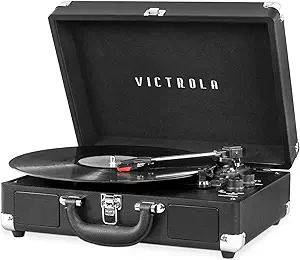







Victrola vs Audio-Technica: Overview
Comparing Victrola and Audio-Technica helps you determine which brand is best suited for your needs in Turntables. Both brands offer strong choices depending on your budget and key feature requirements.
Key Features & Comparison
Evaluate factors such as build quality, warranty, customer satisfaction, and total value before making your final purchase choice between Victrola and Audio-Technica.
Affordability
When examining initial price points, Victrola dominates the entry-level budget market by offering all-in-one suitcase players and starter decks often priced well under one hundred dollars. These low-cost units appeal heavily to casual listeners and impulse buyers who want a complete, self-contained record playing setup without purchasing external amplification or speakers. However, Victrola achieves this extreme affordability through the use of inexpensive components, such as generic ceramic cartridges, lightweight plastic platters, and cheap chassis materials. While the initial investment is exceptionally low, long-term costs can rise if users decide to replace the unit prematurely or suffer groove wear on valuable vinyl collections caused by higher tracking forces.
Audio-Technica, in contrast, targets true entry-level to mid-fi audiophile territory, generally positioning their most accessible turntables (such as the LP60X series) slightly above Victrola's cheapest novelty options. While consumers must spend more upfront for an Audio-Technica deck—frequently needing to pair it with powered speakers—the brand provides far superior value retention, repairability, and durable engineering. Audio-Technica's decks feature magnetic cartridges, aluminum platters, and precision-engineered tonearms that justify the higher price tag. Consequently, while Victrola wins purely on the metric of bottom-dollar pricing, Audio-Technica delivers greater long-term economic value through component longevity and standard, upgradeable parts.
Sound Quality
Audio-Technica holds a commanding lead in acoustic fidelity, built upon decades of experience as a premier phono cartridge manufacturer. Their turntables come equipped with high-performance Moving Magnet (MM) cartridges—such as the AT3600L or the renowned VM95 series—which extract significant dynamic detail, provide balanced frequency response, and preserve stereo separation. Additionally, Audio-Technica builds its decks with precision-machined aluminum die-cast platters, calibrated counterweights, and adjustable anti-skate systems. These mechanical tolerances minimize wow, flutter, and tracking errors, resulting in clean, resonance-free audio reproduction that honors the depth and warmth of analog recordings.
Victrola's budget line, particularly its widely recognized suitcase-style record players, struggles considerably with acoustic performance due to acoustic feedback and low-grade playback mechanics. Utilizing rudimentary ceramic cartridges and plastic tone arms with heavy tracking forces, these players produce a narrow, tinny frequency profile lacking low-end presence and dynamic headroom. The built-in speakers in popular Victrola models are small, prone to distortion at higher volumes, and introduce mechanical vibrations back into the needle. While Victrola has recently introduced higher-end models like the Stream series to combat this reputation, the vast majority of their product line falls substantially short of the clarity, fidelity, and low harmonic distortion found natively in Audio-Technica hardware.
Features & Functionality
Victrola heavily emphasizes lifestyle integration, convenience, and modern connectivity. A signature characteristic of Victrola’s ecosystem is the inclusion of built-in stereo speakers, headphone jacks, and versatile two-way Bluetooth connectivity that lets users stream music to the turntable or output audio to wireless headphones. In their higher-tier models, such as the Victrola Stream lineup, the company has integrated high-tech smart features, notably certified 'Works with Sonos' integration that streams vinyl directly across multi-room Wi-Fi networks without extra hardware. This creates a functional bridge between modern whole-home audio ecosystems and traditional physical media.
Audio-Technica approaches features from an audiophile and practical utility standpoint, prioritizing mechanical refinement over novelty. Depending on the model, Audio-Technica provides fully automatic or direct-drive manual operation, switchable integrated phono preamplifiers, USB outputs for vinyl archiving, and pitch control sliders. Their primary engineering advantage lies in modularity: headshells are frequently detachable, cartridges can be upgraded through various stylus profiles (elliptical, microlinear, Shibata), and tracking force can be dialed in accurately. While they lack the all-in-one lifestyle convenience of base-level Victrola players, Audio-Technica turntables offer superior functional longevity and audio customizability.
Ease of Use & Setup Processes
Victrola excels at offering a frictionless, out-of-the-box user experience designed specifically for beginners. Most of their mass-market offerings require virtually zero assembly: users simply unlatch the suitcase case or unbox the deck, plug it into wall power, flip the cueing lever, and start playing. Because tonearms on standard Victrola players lack counterweights or anti-skate adjustments, novice users do not have to navigate the intimidating process of tonearm balancing, tracking force calibration, or cartridge alignment. For individuals who prioritize instant gratification and minimal technical involvement, Victrola provides the simplest possible pathway to spinning records.
Audio-Technica offers a balanced approach to setup, ranging from fully plug-and-play to semi-technical calibration. The entry-level AT-LP60X is nearly as simple to use as a Victrola, requiring only the belt to be looped around the motor pulley, as the tonearm and cartridge are pre-calibrated at the factory. However, moving up to the popular AT-LP120X series introduces traditional setup procedures, including installing the headshell, setting the counterweight, zero-balancing the tonearm, and setting the anti-skate force. While this requires following an instructional guide and taking several minutes to complete, it imparts a deeper mechanical understanding to the user and guarantees optimal playback performance without damaging records.