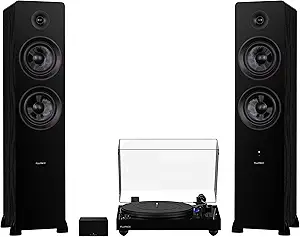
Fluance vs Sylvania: Overview
Comparing Fluance and Sylvania helps you determine which brand is best suited for your needs in Turntables. Both brands offer strong choices depending on your budget and key feature requirements.
Key Features & Comparison
Evaluate factors such as build quality, warranty, customer satisfaction, and total value before making your final purchase choice between Fluance and Sylvania.
Affordability
When examining initial acquisition costs, Sylvania occupies the absolute budget-tier segment of the turntable market, typically pricing their all-in-one units well under the one-hundred-dollar threshold. These systems are positioned as impulse purchases or casual gifts, bundling amplification, small built-in stereo speakers, and basic playback mechanics into a single self-contained housing. For buyers seeking an immediate, rock-bottom entry point into vinyl playback without the requirement to purchase external audio peripherals, Sylvania presents an undeniably low barrier to entry that requires virtually zero upfront financial commitment.
Conversely, Fluance operates within the entry-level to mid-range hi-fi category, with their popular Reference (RT series) decks commanding prices that begin several times higher than Sylvania's offerings and scale upward significantly. However, from an engineering and long-term cost-of-ownership perspective, Fluance delivers substantially superior value. While Sylvania cuts costs through molded plastic chassis, lightweight stampings, and generic ceramic cart systems that wear down records rapidly, Fluance allocates budget toward acoustically inert MDF plinths, high-grade Audio-Technica or Ortofon cartridges, and isolated motors that preserve vinyl investments for decades, justifying their premium over pure novelty hardware.
Sound Quality
Acoustic performance presents a vast gulf between the two brands due to their divergent engineering philosophies. Sylvania turntables almost universally utilize cheap ceramic cartridges combined with rudimentary, undersized plastic tonearms lacking counterweights. These systems suffer from high tracking forces, notable inner-groove distortion, and a heavy reliance on tiny built-in speakers that produce thin, tinny audio with virtually no lower-frequency extension or dynamic separation. Resonance from the internal speakers also feeds back directly into the poorly isolated needle, degrading sound clarity even further.
Fluance, on the other hand, prioritizes audiophile-grade fidelity by implementing legitimate high-fidelity components across their product range. Utilizing calibrated aluminum tonearms with adjustable counterweights, anti-skate controls, and moving magnet (MM) cartridges from acclaimed manufacturers like Ortofon (2M Red/Blue), Fluance decks deliver warm, precise frequency response, wide stereo imaging, and remarkably low total harmonic distortion. Combined with dense MDF plinths and decoupled rubber feet that neutralize ambient motor and acoustic vibrations, Fluance reproduces vinyl records with the depth, clarity, and dynamic range that genuine analog enthusiasts demand.
Features & Functionality
Sylvania targets convenience and novelty by packing their turntables with lifestyle-oriented utility features. Many Sylvania models take the form of vintage-styled consoles or portable suitcases featuring built-in AM/FM radios, CD players, cassette decks, auxiliary inputs, and Bluetooth connectivity for streaming digital audio through the integrated speakers. Furthermore, several models incorporate basic USB encoding capabilities for ripping vinyl directly to MP3 formats without a computer, catering squarely to users who value a Swiss-Army-knife approach over specialized acoustic refinement.
Fluance eschews mass-market gimmicks to focus exclusively on dedicated, high-performance analog reproduction features. Rather than cluttering the plinth with secondary media players, Fluance implements performance-oriented mechanics: speed-controlled decoupled motors for ultra-low wow and flutter (0.07% or better on higher tiers), heavy aluminum or high-density acrylic platters for rotational inertia, gold-plated RCA outputs, and precision auto-stop mechanisms that protect the stylus without adding electronic interference. Features on a Fluance deck are specifically curated to optimize record longevity, trackability, and audio purity, offering modular upgrade paths for styli and platters down the line.
Ease of Use & Setup Processes
For absolute beginners seeking instant gratification, Sylvania provides an out-of-the-box, plug-and-play workflow that requires virtually no mechanical setup. Because the tonearm tracking force and anti-skate are factory-fixed (albeit often to excessively heavy tolerances), users simply unbox the unit, remove the stylus protector, plug the power cord into a wall outlet, and drop the needle onto a spinning record. There is no need to balance counterweights, align cartridge overhangs, or configure external stereo receivers, making the physical onboarding process simple and foolproof for casual operators.
Fluance demands a more involved initial assembly procedure, which serves as an educational introduction to proper turntable calibration. Setting up a Fluance RT model requires installing the drive belt, mounting the platter, leveling the heavy chassis via adjustable isolation feet, precisely balancing the tonearm counterweight to match the specific cartridge specification, and setting the anti-skate dial. While this requires reading the manual and dedicating roughly 15 to 30 minutes before first playback, Fluance includes exceptionally clear documentation and setup guides. This slight learning curve empowers the user with standard hi-fi operation skills while ensuring both the turntable and vinyl collection operate under optimal, damage-free conditions.
Compare current retail pricing, active promotions, and verified stock availability directly from authorized stores: