





Cuisinart vs Apohalo: Overview
Comparing Cuisinart and Apohalo helps you determine which brand is best suited for your needs in Toaster Ovens. Both brands offer strong choices depending on your budget and key feature requirements.
Key Features & Comparison
Evaluate factors such as build quality, warranty, customer satisfaction, and total value before making your final purchase choice between Cuisinart and Apohalo.
Features
From a functionality perspective, Cuisinart designs its toaster ovens with deep culinary versatility, integrating specialized cooking programs such as precise dual-cook functionality, low-temperature dehydration, dedicated bagel settings, and convection-assisted frying. Higher-end Cuisinart models frequently feature multiple quartz heating elements paired with advanced microprocessor controls that dynamically adjust wattage across elements to achieve uniform heat distribution. Furthermore, Cuisinart excels in providing high-grade accessories, including heavy-gauge baking pans, nonstick interior cavities for effortless maintenance, and robust crumb trays that prevent grease accumulation and smoke generation.
Apohalo, conversely, emphasizes breadth over depth by packaging numerous multifunction presets into an economical footprint, often marketing comprehensive 8-in-1 or 10-in-1 capability sets. While these presets simplify operation for casual users via simple push-button or dial interfaces, Apohalo typically employs basic nichrome heating elements that lack the dynamic, zone-specific temperature regulation found in Cuisinart’s premium catalog. While Apohalo covers the essential bases—such as timer alerts, basic convection fans, and standard wire racks—its feature set leans heavily on simplified presets rather than the granular, precision-driven culinary controls that seasoned cooks appreciate in Cuisinart appliances.
Performance
Thermal stability and cooking precision represent the most stark performance differentiators between the two manufacturers. Cuisinart toaster ovens are engineered with dense, double-walled insulation, sealed doors, and finely calibrated internal sensors that maintain target temperatures within remarkably tight tolerances. This translates to exceptional performance across complex culinary tasks, such as evenly browned artisanal toasts, perfectly caramelized roasts, and delicate pastries that require stable convection currents. The high-velocity airflow in Cuisinart’s air-fryer hybrid units produces crisp textures rapidly without excessive moisture loss, demonstrating superior aerodynamic and thermal balance.
Apohalo machines manage daily basic tasks adequately, such as melting cheese, crisping frozen snacks, and toasting sandwich bread, but they exhibit noticeable performance compromises under high-demand scenarios. Due to thinner single-layer metal housings and less sophisticated thermal insulation, Apohalo ovens tend to suffer from greater external radiant heat loss, resulting in internal hot spots and occasional temperature swings during extended bake cycles. Consequently, users may find themselves needing to manually rotate trays halfway through cooking to achieve even browning. While Apohalo provides acceptable speed and functionality for simple meals, Cuisinart decisively leads in heat retention, programmatic accuracy, and end-to-end culinary consistency.
Design
The design philosophy behind Cuisinart appliances is steeped in timeless, professional culinary aesthetics, dominated by brushed stainless-steel housings, ergonomic handles, and solid-feeling metal knobs. Every interaction point—from the damped hinge resistance on the tempered-glass doors to the tactile feedback of the control dials—conveys high-tolerance manufacturing. Additionally, Cuisinart engineers prioritize internal volumetric efficiency, ensuring that exterior dimensions remain countertop-friendly while the internal cavity can easily accommodate standard 12-inch pizzas, six slices of bread, or small whole chickens without crowning.
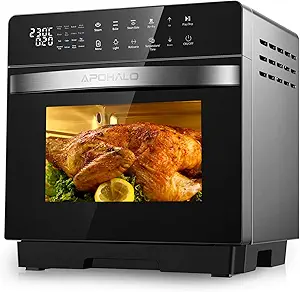
Apohalo adopts a more contemporary, lightweight design language that often incorporates compact, boxy silhouettes with glossy digital LED touch panels alongside basic dials. While visually modern and suitable for small-footprint kitchens, the physical materials feel significantly lighter, and the metal paneling is more prone to flexing under pressure than Cuisinart’s heavy-gauge shells. The exterior surfaces of Apohalo units can also become considerably hotter to the touch during peak operation due to minimal thermal baffling. However, for users with limited counter real estate who favor lightweight mobility and intuitive digital interfaces, Apohalo offers a practical, modern form factor despite its utilitarian material constraints.