






BLACK+DECKER vs Apohalo: Overview
Comparing BLACK+DECKER and Apohalo helps you determine which brand is best suited for your needs in Toaster Ovens. Both brands offer strong choices depending on your budget and key feature requirements.
Key Features & Comparison
Evaluate factors such as build quality, warranty, customer satisfaction, and total value before making your final purchase choice between BLACK+DECKER and Apohalo.
Features
The functional architecture of BLACK+DECKER toaster ovens generally revolves around tactile, electro-mechanical dial interfaces with core presets restricted to bake, broil, toast, and keep-warm. While newer digital models exist within the catalog, the brand's core engineering identity emphasizes analog simplicity with standard 30- to 60-minute stay-on timers, precision toast shades, and dual-position rack slots. Even in their air-fry-enabled units, features are kept practical and elemental, ensuring that the learning curve remains virtually non-existent for everyday meal preparation.
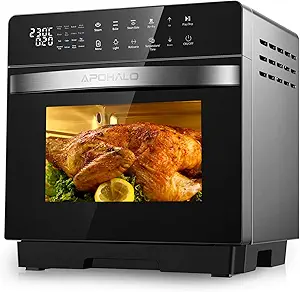
Apohalo, in contrast, significantly outpaces standard utility units by incorporating multi-mode digital sensor suites, integrated LED control clusters, and expansive 8-to-12 preset micro-programs that cover dehydrating, proofing, rotisserie, and high-velocity air frying. Their engineering integrates precision NTC thermistors for dynamic thermal tracking and automated multi-stage cooking menus that BLACK+DECKER’s budget-oriented platforms lack. For home cooks desiring automated one-touch culinary tasks and broad operational breadth, Apohalo provides a noticeably richer, more modern technological toolkit.
Performance
Thermal performance diverges sharply between the two brands due to heating element architecture and convective airflow design. BLACK+DECKER models typically utilize standard dual quartz or calrod heating elements spanning the top and bottom cavities, providing steady radiant heat well-suited for classic slicing toast, melting cheese, and baking small frozen items. However, their air circulation tends to be modest or passive, which can lead to marginal temperature gradients across the cooking plane and slower cooking cycles for moisture-dense proteins.
Apohalo addresses this thermal latency by deploying higher-wattage heating loops paired with high-RPM internal convection fans, establishing a true forced-air vortex inside the oven cavity. This translates into accelerated preheat cycles, crispier exterior textures on fried foods, and reduced overall cook times compared to standard radiant models. While BLACK+DECKER delivers predictable, uniform browning on static items like bread slices, Apohalo exhibits superior convective power, roasting efficiency, and multi-rack heat saturation.
Design
From an industrial design standpoint, BLACK+DECKER favors space-conscious, utilitarian aesthetics tailored to fit comfortably underneath standard low-hanging kitchen cabinetry. Constructed predominantly with lightweight stamped stainless steel or powder-coated black enclosures, their chassis prioritize a minimal footprint, drop-down crumb trays for rapid maintenance, and high-contrast, easy-to-read analog iconography. The structural emphasis is squarely on space efficiency and ergonomic simplicity rather than high-end aesthetic refinement.
Apohalo adopts a more contemporary, monolithic presence, frequently mirroring the commercial look of high-end countertop ovens with brushed metallic facades, tempered double-pane glass doors, and backlit touch displays. The inclusion of internal cavity lighting, cool-touch structural handles, and expansive internal cubic footage allows Apohalo units to accommodate larger quarter-sheet pans or whole poultry with ease. While this expanded footprint demands considerably more countertop real estate than a compact BLACK+DECKER, the trade-off is a modernized, centerpiece appliance aesthetic that feels premium on display.