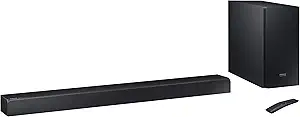
Yamaha vs Samsung: Overview
Comparing Yamaha and Samsung helps you determine which brand is best suited for your needs in Soundbars. Both brands offer strong choices depending on your budget and key feature requirements.
Key Features & Comparison
Evaluate factors such as build quality, warranty, customer satisfaction, and total value before making your final purchase choice between Yamaha and Samsung.
Product Selection
Samsung dominates the market with one of the most extensive and strategically segmented soundbar lineups in consumer audio. Their catalog spans from bare-bones, ultra-budget 2.0-channel bars to high-tier, multi-component flagship packages like the Q-Series (e.g., HW-Q990 series), which feature true 11.1.4-channel setups with wireless rear surrounds and up-firing drivers. In addition, Samsung curates specialized lifestyle ranges such as the ultra-slim 'S-Series' designed to match aesthetic-forward interiors. This vast hierarchy allows consumers to choose granular steps in channel count, discrete amplification, and spatial computing capabilities, making it remarkably easy to find a model tailored to virtually any TV size or home theater requirement.
Yamaha adopts a leaner, more focused engineering approach that prioritizes self-contained audio excellence over overwhelming variety. While Yamaha historically pioneered the digital sound projector space, their contemporary consumer catalog concentrates heavily on compact standalone bars (such as the SR-C and SR-B series) and mid-range performance bars with integrated subwoofers or wireless companion modules. Yamaha offers fewer ultra-premium multi-channel discrete satellite systems compared to Samsung, choosing instead to concentrate on high-yield, living-room-friendly bars that maximize acoustic output per square inch. While this curation reduces decision fatigue for shoppers wanting straightforward television audio enhancement, it leaves high-end custom home theater enthusiasts with fewer modular, multi-speaker configurations than Samsung's comprehensive ecosystem.
Design/Look
Samsung's design language leans modern, architectural, and technology-forward, engineered specifically to create visual synergy with modern flat-panel displays. Higher-end models favor angular, chiseled silhouettes, acoustic metal grilles, and premium matte-black polycarbonate surfaces that resist dust and reduce screen-glare reflections. Their lifestyle offerings, like the S-Series, incorporate organic textiles from Danish textile manufacturer Kvadrat, providing soft, premium furnishings that blend into contemporary living spaces. Samsung also champions extreme miniaturization with low-profile heights, ensuring the soundbar body rarely obstructs the bottom edge of modern TV screens or remote IR receivers, creating a streamlined, monolithic profile when paired with a television.
Yamaha embraces an understated, audio-traditionalist design philosophy focused on functional acoustic ergonomics. Most Yamaha soundbars are wrapped in durable, tightly woven acoustic fabric grilles rounded gracefully over the edges, exuding a warm, classic home-audio feel that integrates unobtrusively into any entertainment console. Instead of futuristic angles, Yamaha favors smooth curves and tactile status indicators that provide clear visual feedback without producing distracting light blooms in darkened rooms. While their enclosures can be slightly deeper and rounder than Samsung’s ultra-slim chassis to accommodate larger internal acoustic chambers and passive radiators, Yamaha's craftsmanship feels consistently rugged, dense, and resonance-free.
Affordability
When analyzing price-to-performance metrics, Samsung operates aggressively across every price tier through massive economies of scale. In the mid-to-high tiers, Samsung frequently undercuts traditional audiophile brands by bundling wireless subwoofers, physical surround satellites, and premium Dolby Atmos/DTS:X decoders into cost-effective turnkey packages. Consumers shopping during seasonal promotions frequently find Samsung’s premium multi-channel packages discounted significantly, lowering the barrier to entry for true room-filling spatial audio. However, their entry-level models sometimes cut corners on chassis materials to hit aggressive price targets, relying heavily on processing rather than substantial acoustic hardware.
Yamaha maintains strong value propositions predominantly in the budget to lower-midrange tiers, particularly for consumers seeking standalone solutions without the clutter or expense of external subwoofers. Units like the SR-B20A or SR-C30A offer exceptional structural and acoustic engineering at sub-$300 price points, delivering high-grade internal components, balanced crossover networks, and proprietary bass extension without forcing consumers to purchase secondary modules. While Yamaha offers fewer extreme high-ticket multi-speaker packages to compete with Samsung's $1,500+ theater setups, their offerings represent a pragmatic investment that holds long-term durability, providing balanced, premium-grade hi-fi acoustics per dollar spent.
Sound Quality
Samsung soundbars are engineered for cinematic impact, spatial immersion, and visceral excitement. Benefiting from research out of their California Audio Lab, Samsung utilizes advanced acoustic beamforming, wide-range tweeters, and sophisticated room-calibration algorithms like SpaceFit Sound to build a vast, three-dimensional acoustic bubble. In movies and gaming, Samsung delivers sharp, localized steering of Dolby Atmos overhead effects, punchy low-frequency dynamics, and crystalline dialogue extraction. However, this cinematic bias can sometimes result in an overly sculpted, slightly bright upper-frequency curve and exaggerated bass response that requires equalization tuning when listening to nuanced, uncompressed musical recordings.
Yamaha approaches sound quality from a musicality-first, high-fidelity heritage. Utilizing decades of studio and instrument engineering expertise, Yamaha excels in natural vocal reproduction, accurate mid-range timbre, and cohesive acoustic integration. Features like 'Clear Voice' enhance speech intelligibility naturally by lifting dialogue frequencies without creating the harsh sibilance or thinness seen in competing algorithms. While Yamaha's virtualized surround processing produces a wide, convincing soundstage from a single enclosure, it cannot match the physical directional steering of Samsung's discrete wireless satellite setups. Nevertheless, for users prioritizing natural musical tone, authentic instrument separation, and fatigue-free everyday listening, Yamaha offers a more neutral and refined sonic profile.
Compare current retail pricing, active promotions, and verified stock availability directly from authorized stores:
Compare current retail pricing, active promotions, and verified stock availability directly from authorized stores: