Samsung vs VIZIO Comparison
Main Features
Samsung uses a lot of features that improve the overall performance of the soundbar. Game Mode adapts the audio reproduction for gaming, making it louder and brighter. Music Mode allows hearing the music as the artist intended, with preserved quality and without any sound coloration. Thanks to that, both vocals and instruments stay crisp. Samsung also offers a lot of automatic functions, like Adaptive Sound that optimizes volume level for every scene so you can hear everything clearly. Some models even can reproduce any audio content from your smartphone after you simply touch the soundbar with your phone. Samsung also enables you to fully control your soundbar and equalize the sound just using your smartphone via the Samsung Audio Remote app (or via the SmartThings app).
VIZIO offers a poor range of features in comparison with Samsung. The soundbars from this brand are quite simple and there are no specific, unique technologies. They use DTS TruVolume as an analog of Samsung’s Adaptive Sound technology, ensuring consistently convenient volume level. Most models come with a built-in Google Cast that allows casting of tunes from 100 audio apps. Control can be performed with the help of the VIZIO SmartCast app as well.
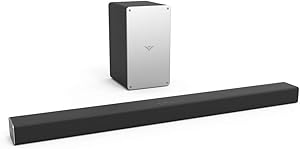
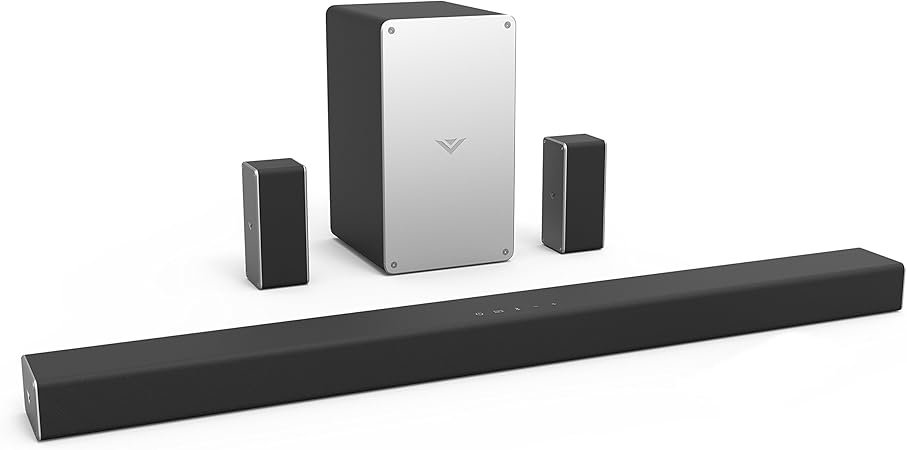
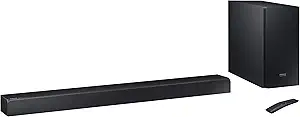
Let’s compare the VIZIO SB3821-C6 and the Samsung HW-T650. The first one has such features as built-in Bluetooth and built-in Google Cast. The model from Samsung offers built-in Bluetooth with a multi-connection option, Smart Sound, and Game Mode.
So, considering the fact that these models are sold for a similar price, it’s fair to say that you get more interesting and advanced features with the Samsung HW-T650.

- Built-in center speaker
- 3D Surround sound
- One remote control
- Dolby Digital 5.1ch
- Multi-connection
- Powerful bass
- Game Mode
Design
Most soundbars from both manufacturers have a low-profile design and standard, rectangular shape (with either rounded or sharp corners) and look simple and minimalistic. They come colored in black, white, or gray to be universal for most interiors. Some models from both brands also have a small screen on their bodies that indicates the currently used input. Both manufacturers provide a range of wireless and wall-mountable soundbars, allowing for great placement flexibility.
Samsung soundbars usually have onboard buttons for volume control, power on/off, and source button. Cheaper models go in plastic bodies. More expensive bars from Samsung feature premium fabric design. Such design allows for more natural sound reproduction. Soundbars from VIZIO are usually bigger in size. They also have more buttons on the cabinet: control buttons, an on/off button, source button, and a dedicated button for Bluetooth. Almost all the bars from VIZIO have one distinctive feature — white panels on the right and left ends. Some models also feature a hexagonal shape that gives you two ways to position the soundbar.
In general, affordable models from both brands have identical build quality. However, when it comes to the premium price tag, Samsung soundbars appear to be better. For example, the Samsung HW-S40T has a curved shape design that features Kvadrat textiles. Meanwhile, the VIZIO V51-H6 has an all-plastic body.
As a result, the Samsung HW-S40T wins in this part of the Samsung vs VIZIO soundbar comparison as it has a more thoughtful design.

- Bluetooth multiple connections
- Dolby 2ch/DTS Digital 2.0
- Room-filling sound
- Music mode
- Application
- 4 speakers
- 4.5 x 26.8 x 2.7 inches and 4.2 pounds
Sound
The main thing that should be noted when comparing VIZIO vs Samsung sound reproduction is that both brands issue soundbars with DTS and Dolby support. Such technologies as DTS Virtual X, DTS TruSurround, Dolby Digital, and others make you feel like you are inside the scene, providing cinematic experience. In terms of bass reproduction, the soundbars from both brands either come with one separate subwoofer in the kit, or incorporate one, two, or even several woofers inside of a bar. However, a dedicated subwoofer usually delivers more vibrant, rich, and powerful bass, but such models are more expensive.
Samsung soundbars usually sound louder than those from VIZIO. Q-series models offer such feature as Q-Symphony. It syncs with Samsung TV speakers providing more volumetric and more immersive sound as you have TV speakers and a soundbar work simultaneously. Samsung also has its own technology for surround sound reproduction called Surround Sound Expansion that creates an effect of sound coming from every direction, just like in a real home theater. Some models combine this technology with Dolby or DTS for even more spatial sounding.
The soundbars from VIZIO are known for providing an expansive, clear sound with a minimal level of harmonic distortion. Moreover, even affordable models from this manufacturer support at least three technologies from Dolby or DTS. This way, a deep cinematic sound is not a problem for VIZIO soundbars.
Let’s compare the sound reproduction of two 2.1-channel models from both brands. The Samsung HW-J450 has rich and dynamic sounding and features Surround Sound Expansion that adds depth to the overall sound. The VIZIO SB3821-C6 supports Dolby Digital and DTS TruSurround that provide realistic surround sound. This model also sounds very clear.
The bars from both manufacturers definitely have decent sound, but after the side-by-side comparison, I consider the Samsung HW-J450 as a model with better sound.

- Surround sound
- Plug In to sync and set up
- Wireless subwoofer
- Connect via HDMI
- Audio remote app
- Wall-mount kit with screw
- Optical cable
Channels
VIZIO issues soundbars with 5 channels max, but Samsung released a 9-channel model. However, comparing VIZIO vs. Samsung in this regard, I can’t recommend the last one. The Samsung HW-Q950T is a 9.1.4-channel soundbar, but it has poor bass and takes too much time and effort to set it up correctly. Considering the fact that it’s a very expensive, top of the line model, we can’t pick it as the best one
If you need a high-quality soundbar with a bigger quantity of channels, the VIZIO V51-H6 will be a much better option.

- Discreet volume adjustable surround speakers
- Optimized for 4K TVs with Dolby Audio 5.1
- Control with TV remote
- Wireless subwoofer
- Low-profile Design
- Easy setup
- Bluetooth
Voice Enhancement
Both manufacturers offer soundbars with a built-in center speaker that guides the sound directly where you sit, resulting in clearly hearable dialogs. Samsung usually has some additional features for voice enhancement. For example, the Smart Sound feature detects what type of content you are watching (sports, concert, movie, etc.) and automatically optimizes the sound setting for it, ensuring that you won’t lose the singer’s voice under the sound of instruments. Some soundbars from VIZIO feature an auto-calibration function that enhances the voices when it’s needed.The Samsung HW-J355 includes a Voice sound effect that provides clear voices no matter what type of content you are watching. The VIZIO SB2920-C6 gives out a transparent sound, but doesn’t have any specific features for voice enhancement.
The Samsung HW-J355 includes a Voice sound effect that provides clear voices no matter what type of content you are watching. The VIZIO SB2920-C6 gives out a transparent sound, but doesn’t have any specific features for voice enhancement.
This way, the Samsung HW-J355 can be considered as a better option in this part of VIZIO vs Samsung sound bar comparison.

- Power on and control the soundbar via Bluetooth
- Samsung Audio Remote app
- Wall-mount kit
- Optical cable
- 8-ohm impedance
- 2.1-channel system with 120 watts of total power
- 37.7 x 2.6 x 2.3 inches and 3.5 pounds
Connectivity
Both brands provide soundbars with wired and wireless connectivity options. Bluetooth can be used to connect the unit to Bluetooth-enabled devices such as TV, smartphone, or tablet without wires. More advanced models from both brands also offer Bluetooth multi-connectivity option that allows you to connect more than two devices and switch between them with ease.
VIZIO has more wired connectivity options. Let’s compare 2.1-channel models from both brands. The Samsung HW-J355 has AUX-in, a USB port, and optical input. The VIZIO SB3821-C6 is equipped with 2 AUX inputs, USB port, digital optical audio input, and digital coaxial input.
Apparently, the VIZIO SB3821-C6 is supplied with more ports.

- Premium audio with Dolby Digital decoding
- Wireless subwoofer
- Built-in Bluetooth
- DTS TruVolume
- DTS audio post-processing
- 100 dB of room filling
- 38 x 3 x 3 inches and 5.8 pounds
Voice Control
If you have a Samsung TV with a built-in voice assistant, you can use it to control your Samsung soundbar by voice. Some models are also Alexa-compatible and can be connected to any Alexa-enabled device to add voice control. VIZIO has started to issue soundbars, compatible with voice assistants, only in 2020. For example, you can control the Samsung HW-Q70T by voice via any Alexa-enabled device. Meanwhile, the VIZIO SB3821-C6 can be controlled only using an included remote control or via VIZIO SmartCast app on your phone.
If you are choosing between VIZIO vs Samsung soundbar and would like to get the one with voice control possibility, the Samsung HW-Q70T can be your choice.

- Dolby Atmos and DTS
- Q-Symphony
- True 3.1.2 sound
- Adaptive sound
- Acoustic beam
- Game Pro
- Compatible with Alexa
Price
When it comes to high-end models, units from Samsung are more expensive compared to VIZIO. However, you can buy a soundbar from any of the compared brands for under $200 (models from VIZIO start from about $70 and Samsung soundbars start from around $100).
So, if we compare two 2.1-channel bars from both brands, the VIZIO SB362An-F6B and the Samsung HW-M360, the second model will be more expensive even despite the fact that it’s 2 years older.
Thus, the VIZIO SB362An-F6B wins in the Samsung soundbar vs VIZIO sound bar price comparison as it’s more affordable.

- Built-in subwoofer
- Optical Digital Audio
- Deep Bass
- IR Sensor
- Remote controlled
- Bluetooth pairing
- 5.2 x 36 x 2.1 inches and 6.8 pounds
Samsung vs VIZIO Sound Bar: Conclusion
As you can clearly see from this VIZIO soundbar vs Samsung sound bar review, Samsung wins in most categories. It offers more features, better sound, etc. However, both manufacturers offer products that support Dolby and DTS technologies, so soundbars from VIZIO sound decently as well. VIZIO models also have more connectivity options and more affordable prices.
Product Selection
When evaluating product selection in the soundbar market, Samsung and VIZIO adopt fundamentally different portfolio strategies, resulting in distinct trade-offs for consumers. Samsung maintains an expansive, vertically integrated catalog engineered to span every market segment, from basic 2.0-channel entry units to industry-leading 11.1.4-channel spatial audio powerhouses like their flagship Q-Series. Samsung’s technical strength lies in its modularity and high-tier component engineering; higher-end models feature heavy acoustical optimization, true up-firing and side-firing neodymium drivers, and proprietary processing features such as SpaceFit Sound room calibration and Q-Symphony, which synergizes the soundbar with Samsung television speakers. Furthermore, Samsung caters to design-conscious consumers with specialized offerings like the Ultra Slim series and "The Frame"-adjacent lifestyle bars. The trade-off for this vast ecosystem is navigating a complex model taxonomy where minor generational increments and confusing naming conventions can obscure the differences between mid-range and premium options.
Conversely, VIZIO concentrates its catalog on aggressive consumer utility, deliberately streamlining its portfolio into tightly defined, high-value lines categorized primarily under the "V-Series," "M-Series," and specialized "Elevate" models. VIZIO excels at lowering the barrier of entry for immersive surround sound, offering genuine 5.1-channel systems with physical rear satellite speakers and wireless subwoofers at price points where Samsung typically offers only 2.1 or 3.1-channel virtualization. On the engineering front, VIZIO demonstrates remarkable mechanical ingenuity at the top end with the Elevate series, which features auto-rotating driver assemblies that physically pivot upward when Dolby Atmos signals are detected. However, VIZIO's catalog lacks the structural depth and luxury headroom of Samsung's lineup. They do not offer enterprise-grade or lifestyle-focused form factors, multi-room Wi-Fi-based home ecosystems, or the high-fidelity acoustic performance and expansive driver counts found at the summit of Samsung's range.
Ultimately, the choice between these manufacturers depends on the specific performance tier and architectural demands of the end user. Consumers prioritizing raw cost-to-channel efficiency and plug-and-play simplicity will find VIZIO's curated selection ideal, as it eliminates portfolio bloat while reliably democratizing multi-channel formats like Dolby Atmos and DTS:X for budget-conscious home theaters. On the other hand, Samsung offers unmatched versatility and aspirational ceiling; their product selection allows discerning buyers to systematically scale up their fidelity requirements, accommodating minimalist aesthetics, smart-home Wi-Fi streaming integration, and multi-dimensional reference audio setups that VIZIO simply does not accommodate.
Design/Look
When evaluating the physical design and aesthetic engineering of soundbars, Samsung leans heavily into a sleek, architectural minimalism that harmonizes with modern, premium home theater environments. Across both its entry-level units and flagship Q-Series systems, Samsung prioritizes cohesive lines, utilizing rigid acoustic metal grilles, angled side-firing and up-firing facets, and matte-finished dark composites that actively suppress light reflections from television screens. Flagship models, such as those in the HW-Q900 series, showcase sophisticated industrial engineering with tapered polygonal profiles designed to maximize acoustic dispersion without introducing unnecessary visual bulk. The trade-off for this high-density acoustic construction is sheer footprint; high-end Samsung bars are often substantially wide, thick, and heavy, requiring deep console placement or heavy-duty wall anchors, which can create visual imbalances when paired with displays smaller than 55 inches.
VIZIO takes an entirely different design path centered on functional, unobtrusive utilitarianism and lifestyle integration. While budget models lean on traditional, utilitarian matte plastics and wrap-around acoustic fabric grilles—which are prone to collecting dust and pet hair over time—their mid-range and higher-tier products, such as the M-Series and Elevate, introduce distinctive design innovations. The VIZIO Elevate, for instance, features brushed metal endcaps housing motorized, rotating up-firing speaker pods that pivot automatically when Dolby Atmos or DTS:X signals are detected—a striking, functional visual flourish unmatched in Samsung’s catalog. Furthermore, VIZIO excels in spatial practicality; their subwoofers are often engineered with slim, low-profile enclosures capable of sliding horizontally beneath a sofa, and their satellite speakers routinely route wiring through the subwoofer rather than requiring dedicated wall outlets, significantly streamlining cable management.
Ultimately, the choice between Samsung and VIZIO regarding design hinges on whether a consumer prioritizes architectural refinement or flexible, practical integration. Samsung provides superior build quality, uniform material finishes, and an upscale, monolithic aesthetic that seamlessly complements high-end televisions, though it demands considerable visual and physical real estate. VIZIO delivers a more casual, living-room-friendly aesthetic with compelling mechanical novelties and superior low-profile spatial ergonomics, but sacrifices the premium fit, finish, and all-metal durability found across Samsung's higher tiers.
Affordability
When evaluating affordability in the soundbar market, VIZIO and Samsung approach value from distinctly different angles. VIZIO has long built its brand identity around aggressive price-to-performance engineering, dominating the entry-to-midrange space by democratizing advanced audio features. Consumers on a strict budget can frequently acquire a complete VIZIO 5.1-channel system—including a wireless subwoofer and dedicated rear satellite speakers—for the same price Samsung charges for a standalone 2.1-channel bar. VIZIO maximizes cost efficiency through pragmatic design choices, focusing heavily on raw acoustic performance per dollar by incorporating foundational technologies like Dolby Atmos, DTS:X, and HDMI eARC without adding the overhead costs of proprietary ecosystems or premium metal chassis. For budget-conscious audiophiles seeking maximum immersion at the lowest possible cost, VIZIO consistently provides more hardware for less money.
Samsung, by contrast, operates on a tiered pricing architecture that reserves its best engineering for mid-tier and premium price brackets, making its entry-level options less competitive strictly on a hardware-per-dollar basis. Lower-cost Samsung soundbars often feature basic 2.0 or 2.1 acoustic configurations with utilitarian plastic enclosures and limited multi-channel expansion. However, Samsung’s affordability proposition shifts when viewed through the lens of long-term ecosystem integration and feature longevity. Rather than packing its budget bars with physical satellite speakers, Samsung invests in robust wireless protocols (such as Wi-Fi and Bluetooth), superior digital signal processing (DSP), and seamless synergy with Samsung displays via features like Q-Symphony and SpaceFit Sound. This engineering approach eliminates setup friction and optimizes sound processing dynamically, which translates to a more refined user experience out of the box.
The ultimate trade-off between the two brands centers on physical capability versus acoustic finesse and software integration. VIZIO is the undeniable champion of raw affordability, delivering authentic surround sound hardware that outperforms virtually anything else in the sub-$300 category, though buyers sacrifice app polish, firmware stability, and premium material quality. Samsung demands a higher initial investment for full-surround immersion, but compensates with superior build tolerances, reliable long-term software support, and a scalable product line that allows users to purchase modular wireless rear speakers later. Therefore, VIZIO represents optimal immediate value for buyers prioritizing discrete surround sound on a budget, whereas Samsung appeals to consumers willing to spend slightly more for ecosystem synergy, cleaner aesthetics, and cohesive software reliability.
Sound Quality
When evaluating sound quality, Samsung consistently leads the category through superior acoustic engineering, driven by its California-based Audio Lab. Samsung's flagship and mid-range soundbars leverage advanced technologies such as SpaceFit Sound room calibration and Q-Symphony, which harmonizes the soundbar with compatible television speakers to expand the vertical and horizontal soundstage. Their high-end Dolby Atmos and DTS:X systems frequently employ up-firing, side-firing, and wide-range tweeters that bounce audio off walls and ceilings to create a genuinely convincing, three-dimensional acoustic bubble. Across their catalog, Samsung systems excel in dialogue clarity thanks to dedicated center channels and Active Voice Amplifier (AVA) processing, while their subwoofers deliver controlled, non-boomy low-end that integrates seamlessly with clean, crisp mid-range frequencies.
In contrast, VIZIO has carved out a massive market presence by offering astonishing price-to-performance acoustic value, prioritizing raw output and punchy dynamics over psychoacoustic nuances. Rather than relying heavily on computational room correction or proprietary multi-speaker pairing, VIZIO soundbars—particularly within the V-Series and M-Series—deliver a classic, full-bodied V-shaped sound signature that favors cinematic bass and energetic highs out of the box. Many of VIZIO's mid-tier models utilize dedicated rear satellite speakers wired directly to a wireless subwoofer, creating authentic physical surround sound at price points where Samsung typically offers only virtualized 2.1-channel or 3.1-channel configurations. While this physical separation provides an expansive listening field, VIZIO's overall tuning can occasionally suffer from aggressive treble roll-off or mid-bass bloat during complex orchestral scores or quiet, dialogue-heavy scenes.
The practical trade-off between the two brands ultimately hinges on acoustic refinement versus sheer immersion per dollar. Audio purists and home theater enthusiasts will find Samsung’s soundbars superior in tonal balance, driver precision, and natural timbre, making them far better suited for mixed usage involving both critical music listening and high-definition cinematic experiences. On the other hand, budget-conscious consumers seeking immediate, room-filling cinematic impact will appreciate VIZIO’s ability to deliver powerful low-frequency rumble and true physical surround channels without requiring high financial investment. Samsung delivers a more calibrated, refined soundscape, while VIZIO provides visceral, unapologetic punch for everyday multimedia consumption.