TCL vs Samsung: Overview
Comparing TCL and Samsung helps you determine which brand is best suited for your needs in Soundbars. Both brands offer strong choices depending on your budget and key feature requirements.
Key Features & Comparison
Evaluate factors such as build quality, warranty, customer satisfaction, and total value before making your final purchase choice between TCL and Samsung.
Product Selection
When examining product breadth and catalog diversity, Samsung maintains one of the most comprehensive ecosystems in the home audio industry, spanning entry-level standalone bars to ultra-premium discrete surround systems. Samsung structures its lineup methodically across the C-Series, B-Series, S-Series (lifestyle ultra-slim), and flagship Q-Series, ensuring virtually every room layout, television pairing, and audiophile tier is addressed. Their higher-end Q-Series models, such as the HW-Q990 series, lead the industry by packaging true 11.1.4-channel setups with wireless subwoofers and physical up-firing rear satellites. Furthermore, Samsung leverages proprietary platform integrations such as Q-Symphony, which synchronizes soundbar drivers with Samsung television speakers, creating a compelling upsell and tailored ecosystem for existing Samsung display owners.
Conversely, TCL focuses on an agile, streamlined selection that prioritizes mass-market utility over high-end architectural audio. TCL categorizes its soundbars largely under the Alto and Q/S series, ranging from compact 2.0 and 2.1 channel bars up to mid-tier 5.1 and 7.1.4 Dolby Atmos configurations. While TCL has expanded into spatial audio with proprietary acoustic platforms like RAY•DANZ, their catalog conspicuously lacks the deep multi-tier stratification found with Samsung. TCL does not provide the niche lifestyle form factors or the ultra-enthusiast multichannel packages that rival dedicated AV receiver separations. Instead, TCL's portfolio targets core living room and bedroom footprints, delivering high-utility configurations that integrate seamlessly with Roku and Google TV platforms without burdening the buyer with complex channel matrices.
Design/Look
In terms of industrial design and visual aesthetics, Samsung approaches audio hardware with a furniture-grade sensibility that balances modern minimalism with functional acoustics. The brand heavily utilizes geometric silhouettes, dark metallic grilles, and premium acoustic textiles sourced from luxury manufacturers like Kvadrat on select models. Samsung’s design philosophy prioritizes unobtrusive living room integration, exemplified by the S-Series ultra-slim enclosures that match the profile of wall-mounted displays. Even their flagship multichannel bars maintain angular, matte-finished enclosures engineered to eliminate visual glare from television screens while housing specialized side-firing and angled acoustic beam transducers.
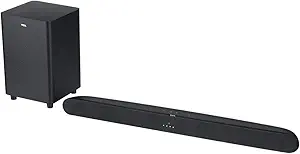
TCL delivers functional, clean designs that prioritize practical durability over high-end luxury styling. Most TCL soundbars feature sturdy matte-black polycarbonate bodies paired with either woven cloth wrappings or perforated metal front grilles. While modern and perfectly suited to sit beneath a standard entertainment unit, TCL bars exhibit a more utilitarian aesthetic with visibly simpler contouring and slightly bulkier chassis on their intermediate subwoofers. Innovations like the RAY•DANZ design show bold acoustic engineering through lateral reflective cutouts, but the overall plastic molding and tactile feedback of the interface buttons lack the refined heft and seamless micro-tolerances found across Samsung’s mid-to-premium tiers.
Affordability
Affordability represents TCL’s primary competitive wedge, making the brand an aggressive price-to-performance leader across the global audio market. TCL consistently undercuts legacy audio manufacturers by offering premium decoding capabilities, including Dolby Atmos and DTS:X, at entry-to-midrange price brackets where rivals only provide basic stereo virtualization. Consumers operating on tight budgets can secure full 3.1 or 5.1 channel setups with wireless subwoofers for the price of a basic 2.1 bar from competitors. This high-yield value equation stems from TCL's vertically integrated manufacturing pipelines, allowing them to democratize immersive spatial formats for price-sensitive households without prohibitive hardware markups.
Samsung operates with a wider pricing continuum, commanding higher MSRPs that reflect proprietary research, acoustic lab testing, and brand equity. While Samsung does offer budget-friendly options in its T- and B-Series, these entry models frequently omit Wi-Fi streaming, high-bandwidth eARC pass-through, or spatial audio codecs to preserve product hierarchy. In the mid-to-high tier, Samsung units require a substantial financial investment, often climbing into luxury price points for the flagship Q-Series. While buyers gain access to market-leading driver components, advanced room calibration, and wireless Dolby Atmos, the sheer economic investment requires buyers to weigh marginal acoustic gains against TCL's significantly lower barrier to entry.
Sound Quality
Acoustic performance heavily favors Samsung across the critical domains of frequency response, spatial imaging, and tonal neutrality. Benefiting from the engineering resources of their California-based Samsung Audio Lab, Samsung soundbars deliver remarkable balance out of the box, with clean, articulate dialogue supported by dedicated center channels and tight, well-integrated low-frequency extension. Mid-tier and flagship models utilize SpaceFit Sound calibration algorithms to map room reflections in real-time, effectively taming standing bass waves and room resonances. In complex multi-channel Dolby Atmos configurations, Samsung excels at phantom-channel steering and height localization, producing a coherent, immersive soundstage that rarely exhibits harsh sibilance or muddy mid-bass overlap.
TCL delivers punchy, energetic sound profiles that are engineered to immediately outperform integrated television speakers, but they do not match Samsung's analytical precision. TCL soundbars generally exhibit a consumer-oriented sound signature, characterized by prominent upper-bass emphasis and elevated treble intended to clarify spoken dialogue. While proprietary acoustic solutions like the RAY•DANZ technology create an impressively wide horizontal soundstage without aggressive digital signal manipulation, high volumes can occasionally expose cabinet resonance and compression artifacts. Bass from TCL’s bundled wireless subwoofers packs ample cinematic rumble for home movie viewing, but it lacks the transient speed, depth, and linear control necessary for critical music listening.