Sony vs Polk Audio: Overview
Comparing Sony and Polk Audio helps you determine which brand is best suited for your needs in Soundbars. Both brands offer strong choices depending on your budget and key feature requirements.
Key Features & Comparison
Evaluate factors such as build quality, warranty, customer satisfaction, and total value before making your final purchase choice between Sony and Polk Audio.
Product Selection
Sony offers an extensive and technologically diverse soundbar catalog that spans from entry-level stereo units to high-end, modular home theater architectures. Their flagship lineups, such as the HT-A7000 and the Bravia Theater series, highlight Sony's engineering focus on multi-channel spatial audio, incorporating dedicated up-firing Dolby Atmos drivers, side beam tweeters, and full integration with optional wireless subwoofers and rear satellite speakers. Beyond premium multi-speaker packages, Sony maintains a strong footprint in mid-tier and compact all-in-one bars, frequently updating their lineup to feature modern connectivity standards like HDMI 2.1 passthrough, 4K/120Hz gaming support, and proprietary BRAVIA Acoustic Center Sync, appealing directly to consumers seeking a fully integrated ecosystem with Sony televisions.
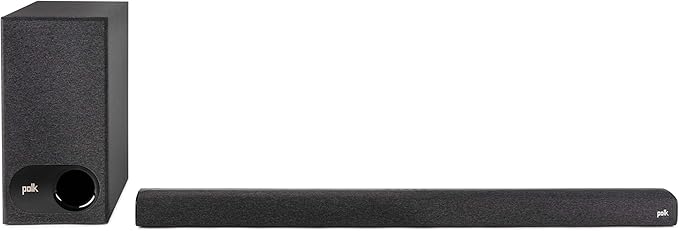
In contrast, Polk Audio adopts a more streamlined and value-driven approach to product selection, heavily centering its engineering on acoustic fidelity over sprawling feature ecosystems. Polk’s catalog is organized primarily into distinct, focused lines such as the MagniFi series for cinematic home theater immersion, the Signa series for plug-and-play living room upgrades, and specialized ultra-compact offerings like the MagniFi Mini AX. While Polk lacks the sheer volume of SKUs and bleeding-edge video passthrough specifications found in Sony’s top-tier catalog, they excel in providing well-curated packages that reliably bundle wireless subwoofers across virtually all price tiers, delivering complete low-frequency solutions right out of the box without requiring expensive piecemeal upgrades.
Design/Look
Sony’s industrial design leans heavily into a sleek, monolithic aesthetic that prioritizes premium, high-tech minimalism intended to seamlessly match modern flat-panel displays. Higher-end Sony soundbars often feature sophisticated combinations of metal speaker grilles, acoustic cloth wraps, and polished, reflective top panels that house touch-sensitive controls and discrete digital displays. In their newer Bravia Theater configurations, Sony has embraced textured, acoustic-friendly fabric shells designed to soften the visual footprint while maintaining structural rigidity to reduce internal resonance. The resulting profile is distinctly contemporary and architectural, projecting an executive, modern aesthetic that blends smoothly into high-end media rooms.
Polk Audio, on the other hand, embraces a softer, more traditional consumer-audio aesthetic characterized by rounded contours, durable matte plastics, and soft acoustic fabric wraps. Rather than pursuing an angular, tech-forward presence, Polk designs its enclosures to integrate unobtrusively into diverse living spaces, avoiding high-gloss finishes that attract fingerprints and room reflections. A prime example of their innovative design philosophy is the MagniFi Mini series, which radically rethinks soundbar geometry by packing five drivers into an enclosure barely over a foot wide. Across both compact and standard-sized models, Polk balances durable, everyday utility with homey, understated finishes that prioritize acoustic openness over high-tech flash.
Affordability
From a cost-to-performance perspective, Sony generally commands a premium price tag, positioning itself at the upper end of the consumer audio spectrum. While entry-level models are accessible, entering Sony’s immersive Dolby Atmos and DTS:X tier typically requires a substantial financial investment. Furthermore, Sony often adopts a modular sales strategy for its premium soundbars, selling the main soundbar unit independently while offering wireless subwoofers (such as the SA-SW3 or SA-SW5) and rear satellite speakers as high-cost optional add-ons. This modular approach allows for tailored expansion, but it significantly escalates the total cost of ownership for buyers seeking a true full-surround soundstage.
Polk Audio positions itself squarely as a high-value champion, offering aggressive pricing structures that make immersive audio far more accessible to budget-conscious and mainstream consumers. Even at mid-to-entry price points—such as with the Signa S4 or MagniFi series—Polk consistently includes dedicated wireless subwoofers in the base price, delivering superior out-of-the-box bass authority per dollar spent. While Polk's most economical bars may forgo luxury features like HDMI 2.1 eARC passthrough or intricate calibration software, their strategic allocation of budget toward core driver engineering ensures that consumers get maximum acoustic performance without facing expensive modular paywalls.
Sound Quality
Sony excels in acoustic engineering driven by advanced digital signal processing (DSP) and expansive spatial mapping. Utilizing proprietary processing technologies like 360 Spatial Sound Mapping, Vertical Surround Engine, and S-Force Pro Front Surround, Sony soundbars produce an remarkably wide and high soundstage that simulates discrete ceiling and surround speakers with impressive accuracy. Midrange articulation is clear and dynamic, while high-frequency detail remains crisp, making their soundbars particularly adept at reproducing cinematic sound effects and spatial video game tracks. However, all-in-one Sony bars can struggle with visceral low-frequency impact on their own, often requiring the addition of a dedicated external subwoofer to reach deep, cinematic sub-bass frequencies without digital compression.
Polk Audio approaches sound quality through traditional loudspeaker design fundamentals, prioritizing natural tonal balance, robust dynamic range, and vocal intelligibility. A key technical differentiator is Polk’s proprietary VoiceAdjust technology, which gives users independent control over the center dialogue channel to dramatically improve speech clarity without raising overall volume levels. Tuned with the musical heritage of classic hi-fi systems, Polk soundbars deliver warm, punchy mids and a smooth, fatigue-free top end that handles both stereo music playback and movie soundtracks effortlessly. Supported by well-matched wireless subwoofers that supply solid low-end authority, Polk generally provides a warmer, fuller, and more naturally balanced sound signature out of the box, whereas Sony relies more on algorithmic DSP to create a hyper-immersive cinematic envelope.