Sonos vs Samsung: Overview
Comparing Sonos and Samsung helps you determine which brand is best suited for your needs in Soundbars. Both brands offer strong choices depending on your budget and key feature requirements.
Key Features & Comparison
Evaluate factors such as build quality, warranty, customer satisfaction, and total value before making your final purchase choice between Sonos and Samsung.
Product Selection
When examining product selection, Sonos adopts a focused, modular philosophy, offering a curated lineup consisting primarily of three core standalone soundbars: the compact Ray, the mid-tier Beam, and the flagship Arc. Rather than selling dozens of pre-packaged home theater bundles, Sonos designs its hardware to act as building blocks within a broader multi-room audio ecosystem. Consumers customize their setup by pairing these standalone bars with proprietary wireless subwoofers (Sub Mini, Sub) and satellite speakers (such as the Era 100 or Era 300). While this minimalist catalog streamlines consumer choice and guarantees seamless system integration, it limits out-of-the-box variety for shoppers looking for complete 5.1 or 7.1.4 surround systems in a single retail SKU.
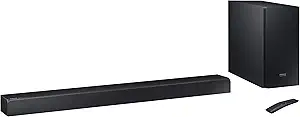
In stark contrast, Samsung deploys a sprawling, tiered portfolio that blankets every market segment, ranging from budget stereo soundbars under the B-series to elaborate, cinema-grade packages in the premium Q-series, such as the HW-Q990D. Samsung's catalog emphasizes all-in-one value by frequently bundling dedicated wireless subwoofers and multi-channel rear satellite speakers directly in the box, providing true discrete Dolby Atmos configurations up to 11.1.4 channels. Additionally, Samsung designs specialized lifestyle lines, like the ultra-slim S-series and the aesthetically driven 'The Terrace' outdoor models. This extensive catalog allows buyers to target specific price brackets, channel counts, and room dimensions precisely, though navigating the dense model numbering can be significantly more overwhelming than browsing Sonos's tightly edited range.
Design/Look
Sonos treats industrial design as an extension of modern interior architecture, crafting soundbars that blend imperceptibly into living spaces. Featuring gentle acoustic curves, matte polycarbonate finishes in stark monochromatic black or white, and precision-drilled acoustic grilles, products like the Arc and Beam boast exceptional fit and finish. By avoiding fabric wraps in their modern lineup, Sonos eliminates the dust collection and wear associated with textile surfaces. The minimalist aesthetic extends to the tactile experience, utilizing subtle capacitive touch controls and discreet status LEDs that disappear when not in active use. This design language ensures that Sonos hardware complements high-end decor without overtly announcing itself as consumer electronics.
Samsung approaches aesthetics with a more aggressive, tech-forward ethos characterized by angular geometries, metallic accents, and high-density acoustic mesh or metal grilles. While premium Q-series units possess an authoritative, robust presence that matches modern flagship televisions, they look undeniably like high-performance AV equipment rather than sculptural furniture. However, Samsung showcases immense versatility through its lifestyle hardware, notably the S-series and 'Music Frame', which feature ultra-low profiles, customizable colored bezels, and Kvadrat premium textile covers designed to disappear under low-clearance panels. While Sonos achieves a higher standard of uniform minimalist luxury across its entire line, Samsung provides greater form-factor diversity, particularly for ultra-thin wall-mount installations.
Affordability
Affordability represents the most significant barrier to entry for Sonos, which firmly positions itself as a premium audio brand. Because Sonos soundbars are sold almost exclusively as standalone units without included subwoofers or satellite surrounds, building a complete discrete surround-sound package requires a heavy cumulative investment. Adding a Sonos Sub Mini or full-size Sub alongside a pair of Era rear speakers often triples the initial purchase price, readily pushing a complete Atmos deployment well past the two-thousand-dollar threshold. While Sonos hardware benefits from exceptional long-term software support and high secondary-market resale value, consumers on a strict budget face high initial acquisition costs with virtually zero options in the entry-level tier.
Samsung dominates the value and affordability equation by leveraging immense manufacturing scale to provide aggressive price-to-performance ratios across all tiers. Shoppers with modest budgets can acquire capable standalone bars or basic 2.1 systems for a fraction of the cost of a Sonos Ray. More importantly, in the high-end home theater segment, Samsung routinely packages a flagship soundbar, high-output wireless subwoofer, and dual up-firing rear surround speakers together for less than the cost of a standalone Sonos Arc and Sub pairing. Frequent retail discounting and predictable annual refresh cycles further enhance Samsung's value proposition, making high-channel-count, immersive spatial audio accessible at price points Sonos fundamentally refuses to contest.
Sound Quality
Sonos soundbars are celebrated for their acoustic precision, balanced frequency response, and class-leading vocal intelligibility. Utilizing custom elliptical woofers, silk-dome tweeters, and advanced digital signal processing (DSP), units like the Beam and Arc deliver neutral, audiophile-adjacent sound profiles that excel equally with cinematic dialogue and high-fidelity music streaming. Sonos’s proprietary Trueplay room-calibration software meticulously tunes the acoustic output to the physical reflections of the listening space, eliminating standing bass waves and harsh treble peaks. However, without adding a discrete physical subwoofer, standalone Sonos bars lack genuine subterranean bass punch below 50Hz, relying heavily on psychoacoustic bass extension that can compress dynamic headroom at cinema-level volumes.
Samsung soundbars, engineered in their dedicated California Audio Lab, prioritize cinematic impact, immense dynamic range, and authentic spatial envelopment. By utilizing high driver counts and discrete physical up-firing and side-firing transducers across the front and rear sound stages, flagship Q-series models construct a three-dimensional acoustic bubble that virtualized systems cannot match. High-output subwoofers deliver thunderous low-frequency effects (LFE) essential for modern blockbuster films, while proprietary features like SpaceFit Sound Pro and Q-Symphony (which harmonizes the soundbar with compatible Samsung TV speakers) yield heightened verticality. While Samsung models can lean slightly brighter in the high frequencies and less cohesive for critical stereo music listening compared to Sonos, their sheer power, discrete surround immersion, and explosive cinematic dynamics remain virtually unmatched in the soundbar category.