Samsung vs Polk Audio: Overview
Comparing Samsung and Polk Audio helps you determine which brand is best suited for your needs in Soundbars. Both brands offer strong choices depending on your budget and key feature requirements.
Key Features & Comparison
Evaluate factors such as build quality, warranty, customer satisfaction, and total value before making your final purchase choice between Samsung and Polk Audio.
Product Selection
Samsung operates as a dominant juggernaut in the soundbar market, presenting an extensive catalog organized into well-defined tiers: the entry-to-mid-range B-series, the design-forward S-series, and the flagship Q-series. Within the Q-series alone, consumers can choose from compact 3.1.2 packages up to staggering 11.1.4-channel setups like the HW-Q990 series that include wireless rear surrounds with up-firing and side-firing drivers. This sheer breadth of engineering allows Samsung to capture every consumer niche, seamlessly pairing proprietary technologies like Q-Symphony with their modern television lineups to offer tightly unified home theater ecosystems.
In contrast, Polk Audio maintains a much more focused and curated lineup rooted in traditional hifi audio philosophy. Their range centers largely on the Signa series for accessible multi-channel configurations, the MagniFi series for elevated spatial audio with Dolby Atmos and multi-room wireless streaming, and the specialized React series for smart home voice integration. While Polk does not attempt to match Samsung's dizzying array of extreme multi-channel arrangements, their portfolio strategically targets critical home entertainment use cases without overwhelming the consumer with redundant product variations.
Design/Look
Samsung favors an ultra-modern, geometric industrial design that frequently leans into angular metal grilles, chiseled edges, and matte dark finishes designed to echo the aesthetic of contemporary flat-panel displays. Their premium Q-series enclosures prioritize functional acoustic dispersion, integrating acoustic lenses and angled driver ports directly into the chassis architecture. For consumers seeking architectural minimalism, Samsung's Ultra Slim (S-series) models provide exceptionally low-profile bars wrapped in acoustic fabrics, allowing them to tuck seamlessly beneath wall-mounted panels without disrupting clean wall lines.
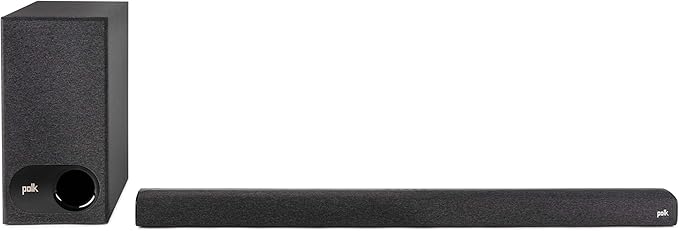
Polk Audio approaches soundbar design from an acoustic furniture perspective, often blending rounded contours, soft-touch matte plastics, and warm, textured fabric wraps. Models in the MagniFi and Signa lines exhibit a softer, less aggressive silhouette that integrates naturally into casual living rooms rather than asserting a high-tech presence. A notable design triumph for Polk is their low-profile clearance engineering, ensuring that standard units rarely obstruct television infrared sensors, paired with discreet, compact subwoofers engineered for flexible corner or cabinet placement.
Affordability
Samsung scales aggressively across the entire price spectrum, delivering value at entry points through heavily discounted standalone bars while commanding premium prices over a thousand dollars for their flagship multi-channel packages. Due to massive global supply chain efficiencies, Samsung routinely bundles wireless subwoofers and advanced processing features into competitive sub-$300 packages during promotional cycles. However, buyers seeking genuine true-surround sound through physical satellite enclosures must invest substantially into the upper tier of the Q-series lineup.
Polk Audio positions itself as an authority on accessible home audio, often delivering exceptional performance per dollar in the budget-to-midrange brackets between $150 and $500. Offerings like the Signa S2 and S4 have long represented benchmark values, outfitting buyers with dedicated wireless subwoofers and authentic physical up-firing drivers at price points where competitors offer purely virtualized height channels. While Polk lacks the four-figure ultra-luxury tiers that Samsung competes in, their pricing structure remains consistently transparent and consumer-friendly without relying on complex cross-hardware ecosystem locks.
Sound Quality
Samsung engineers soundbars with an emphasis on cinematic impact, wide dispersion, and immersive spatial immersion. Flagship units excel at rendering complex Dolby Atmos and DTS:X environments, leveraging acoustic beam technology and true physical discrete surround channels to craft a 360-degree acoustic dome. The tonal profile generally leans energetic, featuring extended, punchy low-end response from heavy-duty ported subwoofers and crisp, articulate high frequencies that enhance micro-details in high-octane movie soundtracks and modern video games.
Polk Audio approaches audio reproduction through a musical, heritage-driven lens that emphasizes vocal clarity and mid-range naturalism. A centerpiece of Polk's acoustic engineering is their proprietary VoiceAdjust technology, which allows users to isolate and boost dialogue frequencies independently without coloring the broader soundstage. While Polk's spatial processing may present a slightly more intimate soundstage than Samsung's driver-dense flagship arrays, their systems deliver smoother transitions across the crossover frequency, tighter musical bass control, and an uncolored warmth that is particularly fatigue-free during extended listening.