Samsung vs Dayton Audio: Overview
Comparing Samsung and Dayton Audio helps you determine which brand is best suited for your needs in Soundbars. Both brands offer strong choices depending on your budget and key feature requirements.
Key Features & Comparison
Evaluate factors such as build quality, warranty, customer satisfaction, and total value before making your final purchase choice between Samsung and Dayton Audio.
Product Selection
Samsung operates as a dominant commercial powerhouse in the home theater sector, maintaining an exhaustive catalog of soundbars that spans nearly every conceivable tier of the consumer market. Their lineup is systematically organized into distinct series, including entry-level essential bars (B-series), midrange lifestyle units (S-series), and flagship surround packages (Q-series). Samsung's portfolio distinguishes itself by offering turn-key, all-in-one ecosystem solutions featuring cutting-edge acoustic developments such as native wireless Dolby Atmos, discrete upward-firing height channels, physical wireless surround satellite speakers, and proprietary software integrations like Q-Symphony for synchronization with compatible televisions.
In stark contrast, Dayton Audio caters primarily to audiophiles, custom integrators, and budget-conscious DIY hobbyists, resulting in a deliberately narrow and targeted soundbar selection. Rather than flooding the market with dozens of annual SKUs, Dayton Audio focuses on functional utility and niche hardware solutions, offering passive soundbars designed to be driven by external multichannel AV receivers alongside a limited selection of compact, active soundbars. While Samsung prioritizes rapid technological updates and complete, multi-channel immersion kits directly out of the box, Dayton Audio centers its catalog on modularity, architectural flexibility, and compatibility with traditional component-based home audio systems.
Design/Look
Samsung invests heavily in contemporary, consumer-centric industrial design, engineering soundbars that integrate seamlessly into modern living room aesthetics. The brand's enclosures often feature refined geometric angles, low-profile horizontal form factors to slide under low-clearance television stands, and acoustic fabric wraps or precision-machined metal grilles. In their lifestyle-oriented ranges, such as the Ultra Slim and 'The Frame' companion units, Samsung embraces ultra-thin chassis depths and varied colorways designed to blend into high-end interior decor, ensuring that expansive driver arrays remain visually unobtrusive within residential spaces.
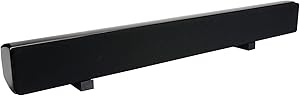
Dayton Audio adopts a no-nonsense, utilitarian aesthetic that reflects its component-audio engineering heritage. Their enclosures prioritize acoustic rigidity and internal volume over sculptural sleekness, frequently utilizing dense, black vinyl-wrapped medium-density fiberboard (MDF) or straightforward extruded aluminum housings. Rather than attempting to serve as architectural design statements, Dayton Audio soundbars resemble traditional center-channel loudspeaker arrays stretched across an elongated axis. This results in a functional, industrial appearance that feels entirely at home in a dedicated media room or custom equipment cabinet, albeit lacking the lifestyle polish found across Samsung's lifestyle catalog.
Affordability
Dayton Audio holds a distinct advantage when evaluating pure acoustic performance per dollar spent, particularly for users willing to embrace component-based configurations. By eschewing aggressive marketing, expensive licensing fees for bleeding-edge spatial audio codecs, and proprietary wireless transmitters, Dayton Audio passes substantial hardware savings directly to the consumer. Their active and passive bars deliver exceptional raw driver and crossover construction at price points that undercut mainstream commercial brands, allowing budget-minded builders to achieve robust dynamic range without paying a premium for ecosystem branding.
Samsung's pricing strategy covers a far wider spectrum, stretching from highly competitive sub-$150 budget units to flagship home theater bundles exceeding well over a thousand dollars. While Samsung's lower-tier soundbars provide solid plug-and-play value, their higher-tier products inherently command a luxury price tag driven by advanced DSP research, multi-amplifier channel topologies, auto-room calibration sensors, and integrated digital smart assistants. For consumers demanding high-order spatial audio processing and hands-off multi-speaker wireless synchronization, Samsung justifies its higher cost through comprehensive software automation, though it rarely matches Dayton Audio's pure price-to-component ratio.
Sound Quality
From an acoustic engineering standpoint, Samsung relies on cutting-edge digital signal processing (DSP), beamforming acoustic lenses, and computational audio developed at their dedicated California Audio Lab. Flagship Samsung models excel at psychoacoustic steering, successfully bouncing audio off walls and ceilings to create a wide, enveloping three-dimensional soundstage characterized by razor-sharp vocal intelligibility and dynamic object-based surround effects. While these systems yield an undeniably cinematic and thrilling modern spatial presentation, purists occasionally note that heavy digital manipulation and compact driver diameters can cause slight midrange coloration and dependence on aggressive subwoofer crossover tuning.
Dayton Audio approaches sound quality through traditional electroacoustic principles, relying on carefully calculated cabinet volumes, physical passive radiators, well-damped soft-dome tweeters, and long-throw paper or poly-cone woofers. In passive setups powered by a capable receiver, Dayton soundbars deliver an uncolored, organic frequency response marked by natural vocal timbre, superior mechanical midrange warmth, and transparent transient response free from artificial DSP expansion. The trade-off is experiential: Dayton Audio cannot replicate complex overhead Atmos steering or discrete rear-channel surround panning on its own, instead trading virtualized spatial theatrics for linear, authentic hi-fi acoustic fidelity.