Nakamichi vs JBL: Overview
Comparing Nakamichi and JBL helps you determine which brand is best suited for your needs in Soundbars. Both brands offer strong choices depending on your budget and key feature requirements.
Key Features & Comparison
Evaluate factors such as build quality, warranty, customer satisfaction, and total value before making your final purchase choice between Nakamichi and JBL.
Product Selection
Nakamichi approaches the soundbar market with a specialized, enthusiast-focused portfolio that centers almost exclusively on high-channel-count, immersive theater systems. Rather than offering dozens of individual models catering to different low-end niches, the brand concentrates on its flagship Shockwafe and Dragon product families. These configurations range from robust 7.1.4-channel setups to industry-leading 11.4.6-channel and 21-channel behemoths. Nakamichi builds its selection around discrete physical acoustic components, invariably packaging main soundbar units with dual subwoofers and multiple two-way rear surround speakers, appealing directly to home theater aficionados who refuse to compromise on true spatial audio.
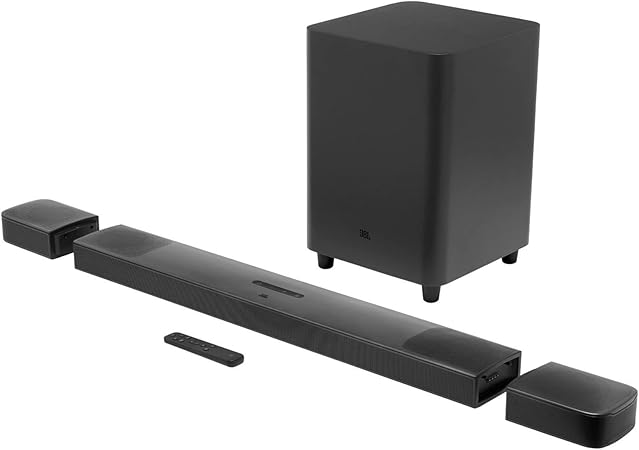
Conversely, JBL provides a much broader, tier-stratified product selection that blankets every segment from entry-level compact units to premium, modular home theater flagships. The JBL Bar lineup spans standalone all-in-one bars (such as the Bar 2.0 and Bar 300) to sophisticated multichannel solutions like the Bar 1000 and Bar 1300X. JBL’s engineering catalog stands out for its highly functional modularity, notably featuring truly wireless, battery-powered detachable rear speakers. This varied ecosystem allows consumers to select a soundbar strictly aligned with their physical footprint requirements, technical preferences, and setup constraints, granting JBL a distinct advantage in commercial versatility.
Design/Look
Aesthetic engineering differs drastically between the two manufacturers, reflecting their divergent core philosophies. Nakamichi designs prioritize functional acoustics and heavy-duty performance over minimalist elegance. The enclosures feature industrial matte black finishes, reinforced plastic chassis, prominent metal mesh grilles, and aggressive architectural angles intended to maximize internal volume and driver positioning. In high-end offerings like the Dragon, Nakamichi incorporates premium brushed aluminum plates and upward-firing acoustic reflectors, projecting a bold, utilitarian presence that unapologetically advertises raw audio power rather than disappearing into modern living room decor.
JBL champions a refined, contemporary lifestyle design language characterized by clean horizontal lines, low-profile form factors, and sleek perforated grilles. The hallmark of JBL’s premium design philosophy is the seamless mechanical integration of detachable rear surround modules, which dock cleanly into the ends of the soundbar via magnetic connectors to recharge while maintaining a cohesive aesthetic. JBL soundbars blend far more effortlessly into minimalist interior decors and under low-clearance televisions, offering understated elegance that eliminates visible cabling without requiring the aggressive, high-density physical footprint demanded by Nakamichi’s comprehensive multi-cabinet arrays.
Affordability
From an absolute pricing standpoint, Nakamichi positions itself firmly in the mid-to-ultra-premium bracket, eschewing the budget market entirely. A typical entry point for Nakamichi requires a substantial financial commitment, but the brand delivers exceptional value when evaluated on a 'performance-per-dollar' or 'channel-per-dollar' metric. Because Nakamichi packages dual subwoofers and physical surround arrays standard with almost every system, the buyer receives equipment that would cost thousands more if assembled via traditional AV receivers and separate discrete speakers, making their high price tag a remarkably high-value proposition for dedicated cinema enthusiasts.
JBL presents a much wider spectrum of financial accessibility, making it the more adaptable brand for varied budget tiers. Consumers can enter the JBL ecosystem with straightforward, sub-$200 stereo soundbars that vastly outperform integrated TV speakers, or step up gradually through midrange packages with dedicated wireless subwoofers before reaching four-figure flagship systems. While JBL's top-tier modular bars carry significant price tags comparable to Nakamichi's mid-level tiers, JBL consistently provides budget-conscious shoppers with approachable options that do not necessitate the comprehensive financial overhead of multi-subwoofer hardware architectures.
Sound Quality
Nakamichi delivers an acoustic presentation defined by immense dynamic range, cinematic authority, and unmatched low-frequency distribution. By deploying dual wireless subwoofers across most configurations, Nakamichi fundamentally resolves room acoustic modes and standing waves, yielding tight, non-directional, and physically palpable bass down to sub-bass thresholds. The high driver counts and discrete multi-directional surround arrays create a continuous, bubble-like Dolby Atmos and DTS:X soundstage with pinpoint spatial panning and immense headroom. While audiophiles may find the out-of-the-box tuning slightly forward or aggressive, extensive onboard DSP calibration tools allow users to sculpt the sound for precise cinematic impact and dialogue intelligibility.
JBL leverages the deep acoustic heritage of its parent company, Harman, ensuring a sound signature tuned meticulously to the Harman curve, which favors smooth tonal neutrality, rich midrange clarity, and natural treble extension. JBL's reliance on MultiBeam technology and proprietary beamforming drivers allows its soundbars to produce surprisingly expansive virtualized surround fields even from standalone chassis. While JBL's single-subwoofer systems cannot duplicate the visceral, pressure-equalized low-end dynamics of Nakamichi's dual-sub designs, JBL delivers a remarkably musical, cohesive, and fatigue-free acoustic performance that excels equally at detailed film score reproduction, dynamic vocal clarity, and daily high-fidelity music streaming.