







KEF vs JBL: Overview
Comparing KEF and JBL helps you determine which brand is best suited for your needs in Soundbars. Both brands offer strong choices depending on your budget and key feature requirements.
Key Features & Comparison
Evaluate factors such as build quality, warranty, customer satisfaction, and total value before making your final purchase choice between KEF and JBL.
Product Selection
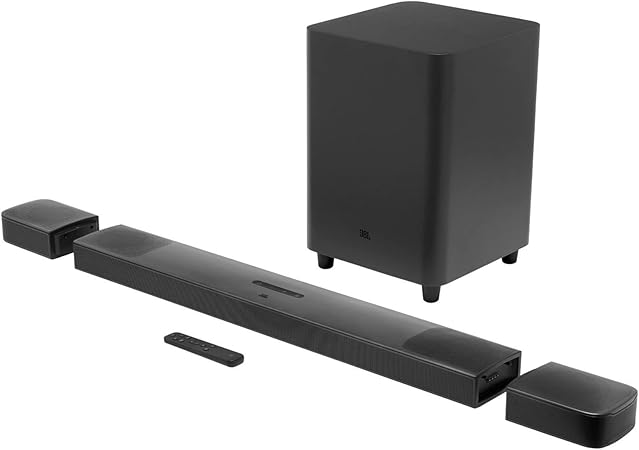
JBL offers an expansive and diverse portfolio of soundbars designed to capture nearly every tier of the consumer home entertainment market. Anchored by its popular Bar series, JBL provides everything from compact, entry-level 2.0-channel bars to elaborate 11.1.4-channel flagship home theater solutions. A signature engineering innovation in JBL's lineup is the inclusion of truly wireless, battery-powered detachable surround speakers in models like the Bar 800, Bar 1000, and Bar 1300X. This broad selection allows consumers to choose systems based on precise room dimensions, multichannel decoding needs, and personal tolerance for wired components, giving JBL a versatile footprint in mass-market retail and consumer audio.
In stark contrast, KEF maintains a highly specialized, boutique catalog that eschews mass-market iteration in favor of bespoke acoustic engineering. Rather than flooding the market with dozens of traditional active soundbars, KEF focuses on high-end passive and active solutions, prominently featuring its ultra-slim T-Series passive soundbars alongside premium architectural front-stage options. KEF caters primarily to custom integrators, audiophiles, and discerning consumers who prefer building tailored home theaters paired with dedicated AV receivers and subwoofers. Consequently, while JBL provides ready-to-use, all-in-one cinematic packages for casual and enthusiast users alike, KEF’s curated selection targets an elite architectural niche where modular system building and acoustic purism take precedence.
Design/Look
JBL’s industrial design language is contemporary, functional, and engineered for durable everyday use. Featuring clean lines, rounded edges, and dark metallic or matte plastic grilles, JBL soundbars blend inconspicuously beneath modern television panels. The aesthetic is heavily utilitarian, prioritizing functionality through subtle LED readouts hidden behind front grilles and robust mechanical docks for its detachable surround speakers. While these components look clean and modern, they are fundamentally built using high-grade plastics and utilitarian metals designed to withstand regular domestic handling rather than to serve as high-concept decorative centerpieces.
KEF approaches design from an architectural and high-design philosophy, emphasizing ultra-sleek profiles and luxury exterior finishes. Models like the KEF T205/T301c soundbars boast an extraordinary cabinet depth of just 1.4 inches (35mm), allowing them to mount perfectly flush with contemporary ultra-thin OLED displays without visually protruding into the living space. KEF utilizes premium anodized aluminum trims, acoustically transparent grilles, and elegant mounting hardware that evoke the brand's British hi-fi heritage. For consumers prioritizing minimalist living environments and seamless wall integration, KEF delivers an understated, fine-furniture aesthetic that elevates the decor far beyond the conventional soundbar form factor exemplified by JBL.
Affordability
JBL strongly emphasizes value-driven engineering, distributing its soundbars across accessible price points that range from budget-conscious options under $200 to fully featured flagship packages around $1,500. A critical financial advantage of choosing JBL is the inclusion of all necessary peripheral equipment in a single retail box. Many JBL bundles incorporate heavy-hitting wireless subwoofers and detachable or standalone surround units, sparing buyers the secondary expense of external amplification, specialized cabling, or separate subwoofers. This turn-key approach provides substantial acoustic performance per dollar, making advanced formats like Dolby Atmos and DTS:X financially attainable for a wide demographic.
Conversely, KEF operates in the premium and luxury hi-fi pricing bracket, requiring a significantly larger financial commitment. Because many of KEF’s prominent soundbar offerings are passive speaker bars, the initial purchase price of the unit itself is merely the starting point. Buyers must also budget for an external multi-channel AV receiver, clean amplification, dedicated subwoofers (such as KEF's own KC62 or Kube series), and custom installation hardware. While this elevated cost of ownership reflects high-end acoustic engineering and architectural longevity, it positions KEF strictly as an investment purchase for dedicated home theater enthusiasts, far removed from the plug-and-play affordability of JBL.
Sound Quality
JBL's sound signature is celebrated for its dynamic, energetic, and cinema-focused tuning, heavily influenced by parent company Harman's renowned acoustic target curves. JBL soundbars excel in delivering visceral impact, featuring punchy upper-bass, crisp dialogue articulation via dedicated center channels, and earth-shaking low-frequency extension powered by large 10-inch or 12-inch subwoofers. In multi-channel spatial audio, JBL leverages true discrete up-firing and side-firing drivers to create an immersive, wrap-around Dolby Atmos bubble that shines during explosive action sequences and cinematic soundtracks, though it can occasionally exhibit slight midrange coloration when reproducing complex, acoustic two-channel music.
KEF delivers an audiophile-grade sonic experience defined by pristine neutrality, breathtaking transparency, and class-leading dispersion characteristics. Leveraging proprietary Uni-Q driver arrays, KEF integrates the tweeter into the acoustic center of the midrange cone, creating a single-point-source presentation that delivers an exceptionally wide, uniform sweet spot and pinpoint imaging accuracy. Highs are smooth and free of harshness, dialogue exhibits lifelike tonal purity, and orchestral separation is immaculate. While KEF passive soundbars depend on paired subwoofers for true deep-bass reproduction, their micro-detail resolution, natural acoustic timbre, and musical fidelity substantially outperform JBL in critical listening environments.