Dayton Audio vs JBL: Overview
Comparing Dayton Audio and JBL helps you determine which brand is best suited for your needs in Soundbars. Both brands offer strong choices depending on your budget and key feature requirements.
Key Features & Comparison
Evaluate factors such as build quality, warranty, customer satisfaction, and total value before making your final purchase choice between Dayton Audio and JBL.
Product Selection
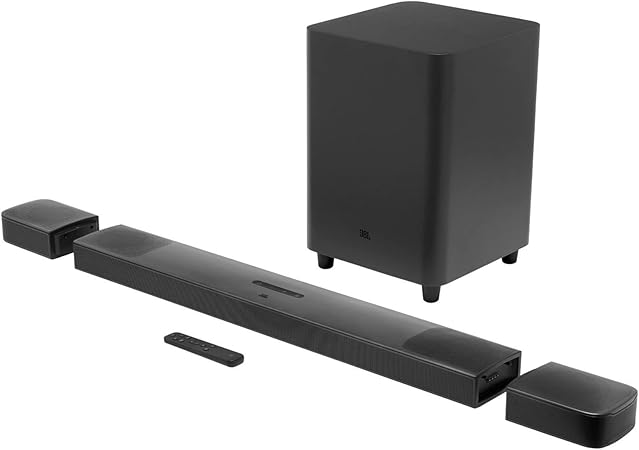
JBL offers an expansive and diverse portfolio of soundbars designed to capture every segment of the mainstream consumer home theater market. Their catalog spans from simple, compact, standalone units like the JBL Bar 2.0 All-in-One to lavish, multi-channel configurations such as the flagship JBL Bar 1300X, which boasts 11.1.4 channels, Dolby Atmos decoding, and innovative detachable wireless surround speakers. This vast array allows consumers to easily find a plug-and-play solution tailored to specific room dimensions, connectivity preferences (like HDMI eARC, Wi-Fi streaming, and voice assistant integration), and budget levels, demonstrating JBL's massive supply chain and engineering bandwidth in the consumer lifestyle audio space.
In stark contrast, Dayton Audio maintains a highly curated, niche selection that reflects its roots as an audiophile DIY component supplier rather than a mass-market lifestyle brand. Their soundbar offerings are sparse, typically limited to a few compact powered bars or unique low-profile designs intended for specific DIY home integration, small-footprint desktop use, or budget TV enhancement. Dayton Audio skips high-end Dolby Atmos arrays, multi-room ecosystems, and wireless satellite setups, choosing instead to concentrate on focused, utilitarian models that prioritize core speaker fundamentals over an exhaustive spectrum of feature-laden configurations.
Design/Look
JBL soundbars exhibit a polished, modern industrial design tailored to complement contemporary flat-panel televisions and modern living room aesthetics. Utilizing rounded contours, premium metal speaker grilles, and sleek matte plastic chassis, JBL units project an upscale, high-tech presence. The signature design hallmark of their premium line—magnetic, battery-powered rear surround speakers that dock seamlessly into the ends of the soundbar for charging—is a masterclass in functional ergonomics and cord-cutting minimalism. Subtle LED displays integrated behind the front grilles provide clear operational feedback without introducing distracting visual clutter in dark home theater environments.
Dayton Audio takes a strictly utilitarian, function-first approach to aesthetic design, often resulting in a minimalist and somewhat dated appearance. Their enclosures typically feature basic rectangular silhouettes, wrapped in simple acoustic fabric or standard vinyl veneers, emphasizing structural rigidity and internal cabinet acoustic volume over exterior flair. While these understated designs blend unobtrusively into entertainment centers and custom cabinetry, they lack the sophisticated metallic accents, seamless docking mechanisms, and cutting-edge visual refinements found across JBL’s line, appealing primarily to pragmatic users who value build simplicity over sleek consumer tech styling.
Affordability
Dayton Audio holds a definitive advantage when evaluating raw cost-to-performance ratio and entry-level accessibility. By eliminating proprietary surround sound licensing fees (such as Dolby Atmos or DTS:X), stripping away expensive software development for companion apps, and eschewing retail shelf-space markups, Dayton Audio can price its soundbars exceptionally low. Budget-conscious consumers and audio hobbyists can acquire robust acoustic amplification and competent full-range transducers at price points that significantly undercut mainstream brands, making Dayton Audio an exceptional choice for secondary bedrooms, dorms, or garage setups where cost is paramount.
JBL operates within a broader, mid-to-premium pricing bracket where pricing corresponds heavily with advanced feature sets and sophisticated driver topology. While JBL does offer entry-level bars under $200, the bulk of its celebrated value proposition lies in the mid-range to high-end brackets ($400 to $1,700), where consumers pay for licensed spatial audio codecs, high-output wireless subwoofers, network streaming capabilities, and automated room calibration. While this places JBL at a considerably higher initial investment than Dayton Audio, the expenditure is justified by the integration of cutting-edge smart features, massive power amplification, and complete surround immersion out of the box.
Sound Quality
JBL soundbars are acoustically engineered to deliver an energetic, cinema-first sound signature characterized by punchy, dynamic transients and thunderous, low-frequency extension. Leveraging proprietary racetrack drivers, precisely angled beamforming tweeters, and high-excursion dedicated subwoofers, JBL systems excel at creating an expansive, room-filling soundstage with distinct spatial localization for multichannel movie soundtracks. While their sound profile leans decidedly toward consumer-friendly bass emphasis and crisp high-frequency presence, advanced room calibration routines and robust dedicated center channels ensure that dialogue clarity remains pristine, even amid explosive cinematic sequences.
Dayton Audio approaches sound reproduction from an audiophile and DIY speaker-builder philosophy, favoring a more neutral, balanced frequency response over dramatic bass boosts. Their soundbars often utilize conventional soft-dome tweeters and paper or composite mid-bass cones housed in properly ported enclosures, delivering warm, natural mids and transparent vocal reproduction that excels with broadcast television and stereo music playback. However, due to the lack of discrete upward-firing height channels, digital psychoacoustic processing, and ultra-high-output external subwoofers, Dayton Audio units cannot replicate the immersive three-dimensional envelopment, intense dynamic slam, or expansive spatial imaging delivered by JBL’s advanced multichannel arrays.