









Creative vs Hisense: Overview
Comparing Creative and Hisense helps you determine which brand is best suited for your needs in Soundbars. Both brands offer strong choices depending on your budget and key feature requirements.
Key Features & Comparison
Evaluate factors such as build quality, warranty, customer satisfaction, and total value before making your final purchase choice between Creative and Hisense.
Product Selection
Hisense focuses its soundbar catalog primarily on the home theater and living room ecosystem, offering a traditional hierarchy that ranges from budget standalone stereo units to sophisticated multi-channel configurations. Their portfolio regularly features dedicated external subwoofers and physical rear satellite speakers, such as their flagship 5.1.2 and 7.1.4 Dolby Atmos systems. This TV-centric product strategy ensures that Hisense models seamlessly complement modern display panels, targeting consumers seeking a turnkey surround-sound cinematic setup with HDMI eARC support, dedicated wall-mounting kits, and standard optical connections tailored for wide-room media consumption.
In contrast, Creative carves out a specialized niche with a diverse catalog centered around desktop audio, PC gaming, and compact personal entertainment spaces. While Creative offers the Stage series for conventional living rooms, its true technical breadth shines in products like the Sound Blaster Katana series and low-profile soundbars built with near-field ergonomics in mind. Creative emphasizes multi-platform versatility, outfitting its soundbars with USB-C audio DACs, customized RGB lighting arrays, and headphone jacks. Consequently, while Hisense provides deeper selection for conventional living-room home theaters, Creative excels in hybrid workspaces, gaming dens, and modular desktop sound environments.
Design/Look
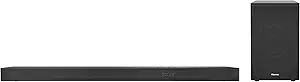
Hisense soundbars adopt an understated, utilitarian industrial design language intended to blend into modern living rooms without drawing undue attention away from the television screen. The brand favors matte-black finishes, acoustically transparent fabric or metallic speaker grilles, and low-profile heights engineered to slide cleanly beneath modern television stands without blocking infrared receivers. Subwoofers and satellite modules mirror this conservative, minimalist aesthetic. The overall physical execution is durable and unobtrusive, though it leans heavily toward generic audio chassis designs that prioritize living-room integration over striking visual personality.
Creative departs significantly from the monochrome home-theater standard by infusing gaming-forward and high-tech styling into its acoustic hardware. Models like the Katana series feature brushed aluminum chassis, chiseled angular profiles, and programmable Aurora Reactive RGB underglow systems that project vibrant lighting onto desktop surfaces. Even their more traditional options, like the Creative Stage, utilize glossy accents and compact footprints optimized for high-density computer monitors and compact stands. Creative’s design philosophy successfully blends high-performance PC aesthetics with audio engineering, appealing directly to users who want their audio gear to serve as an expressive centerpiece rather than an invisible accessory.
Affordability
Hisense leverages its massive global manufacturing scale to deliver exceptional value in the traditional home theater segment. Consumers can acquire full 5.1 or Dolby Atmos-capable physical speaker bundles from Hisense at price points where competing traditional AV brands only offer basic 2.1 stereo setups. By integrating cost-effective internal components and bundling wireless subwoofers across entry-level tiers, Hisense drives high price-to-performance metrics for living-room cinematic upgrades, making multi-channel audio accessible to budget-conscious homeowners without requiring expensive external receivers or complex wiring.
Creative attacks affordability through a lens of modular personal audio and feature-dense desktop utility. Entry-level offerings like the Creative Stage SE provide full-range drivers and dedicated bass ports at prices rarely matched by mainstream TV soundbars. In their higher-tier pricing brackets, such as the Katana line, Creative commands a premium not strictly for high channel counts, but for specialized internal hardware, including multi-core DSPs, certified high-resolution 24-bit DACs, and advanced software suites. While Hisense gives buyers more physical speakers per dollar for home theater setups, Creative provides far greater internal signal-processing fidelity and connectivity value for desktop and gaming environments.
Sound Quality
Hisense tunes its soundbars to meet the acoustic demands of cinematic media, prioritizing dialogue clarity, dynamic range, and broad atmospheric dispersion. Using hardware decoding for Dolby Atmos and DTS:X alongside upward-firing drivers in higher-tier models, Hisense creates an expansive physical soundstage that fills mid-to-large-sized rooms effectively. However, the acoustic tuning leans slightly toward consumer-grade frequency response, featuring boosted mid-bass to simulate cinematic power and aggressive center-channel equalization for voice intelligibility. While this delivers punchy, exciting blockbuster movie playback, it can occasionally introduce slight midrange boxiness or treble rolloff when reproducing nuanced, complex musical arrangements.
Creative leans on decades of internal digital sound processing (DSP) expertise via its Sound Blaster heritage to deliver precision, detail, and low-latency acoustic fidelity. Designed predominantly for near-field listening, Creative soundbars excel at micro-detail retrieval, sharp stereo imaging, and tight, controlled bass transience. The sound signature is generally crisper and more analytical than Hisense's broader living-room profile, ensuring critical gaming cues like footsteps or subtle musical instruments are rendered with spatial accuracy. Through advanced companion software, Creative also allows extensive parametric EQ tailoring and proprietary virtual surround algorithms, offering audibly superior audio transparency at close range despite lacking the raw physical acoustic spread of Hisense’s multi-satellite configurations.