






Motorola vs Polar: Overview
Comparing Motorola and Polar helps you determine which brand is best suited for your needs in Smart Watch. Both brands offer strong choices depending on your budget and key feature requirements.
Key Features & Comparison
Evaluate factors such as build quality, warranty, customer satisfaction, and total value before making your final purchase choice between Motorola and Polar.
Battery Life
When examining battery endurance, Motorola and Polar pursue fundamentally different power-management philosophies driven by their target audiences. Motorola smartwatches, primarily operating on proprietary lightweight operating systems (Moto Watch OS) or Wear OS, deliver modest battery longevity tailored for casual urban users. The modern Moto Watch models typically achieve between 7 to 10 days of general use when utilizing their streamlined RTOS, while their Wear OS counterparts drop sharply to 24 to 48 hours under mixed workloads. These figures are heavily influenced by vibrant AMOLED displays, continuous ambient screen settings, and frequent background push notifications from paired smartphones, which necessitate a frequent charging cadence.
Polar, conversely, engineers its devices with endurance athletes in mind, prioritizing power efficiency over rich visual flair. Utilizing low-power Memory-in-Pixel (MIP) transflective displays alongside advanced proprietary power-saving architectures, sports watches like the Polar Vantage and Grit X series achieve up to 7 to 14 days of typical smartwatch usage. More crucially, Polar excels in dedicated GPS training modes, delivering between 30 and 100 continuous hours of dual-frequency GNSS and optical heart-rate tracking with configurable battery-saver profiles. For users embarking on multi-day outdoor excursions or demanding marathon training blocks, Polar provides an unmatched energy buffer compared to Motorola's lifestyle-focused platforms.
Build Quality & Durability
Motorola focuses on sleek, contemporary consumer aesthetics that balance lightweight comfort with executive styling. Utilizing zinc alloy or aerospace-grade aluminum chassis paired with tempered 2.5D curved glass, Motorola smartwatches mimic the sophisticated look of premium traditional timepieces. While they provide adequate resistance against daily desktop wear and tear, and feature 5ATM or IP68 water resistance ratings sufficient for swimming and handwashing, they are fundamentally engineered for office, gym, and urban environments rather than harsh backcountry exposure.
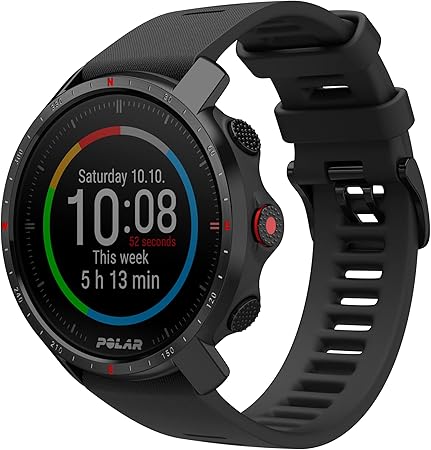
Polar builds its hardware for severe environmental stresses and performance athletics. Top-tier Polar models frequently feature lightweight aerospace titanium or high-grade stainless steel bezels, fiberglass-reinforced polymer cases, and scratch-resistant sapphire crystal lenses. The Polar Grit X series in particular is rigorously tested against MIL-STD-810G military standards, certifying resistance against extreme drops, thermal shocks, salt water, and moisture. Polar's mechanical textured buttons are also explicitly engineered for tactile operation through thick winter gloves or in driving rain, starkly outclassing Motorola's capacitive and dress-style crown interfaces in rugged utility.
Health & Fitness Tracking
Motorola delivers foundational biometric tracking suited for casual wellness enthusiasts rather than serious performance athletes. Modern Moto smartwatches include optical PPG sensors that monitor resting heart rate, blood oxygen (SpO2), daily steps, and basic sleep stages. However, Motorola's fitness ecosystem functions primarily as a passive logger. Its accompanying mobile application offers basic daily aggregates, but lacks deep physiological insights, sophisticated recovery modeling, or nuanced analysis of training load, making it unsuitable for competitive endurance preparation.
Polar stands as an industry benchmark in sports science and physiological tracking, underpinned by decades of clinical cardiovascular research. Leveraging its Precision Prime sensor fusion technology, Polar devices accurately mitigate motion artifacts to monitor heart rate, continuous HRV (Heart Rate Variability), and skin temperature. The brand’s proprietary analytics suite—incorporating Nightly Recharge, Training Load Pro, and Orthostatic Testing—delivers elite-grade actionable guidance regarding autonomic nervous system recovery and overtraining risks. For serious runners, triathletes, and performance-minded individuals, Polar's analytical depth completely surpasses Motorola's basic metric collection.
Smart Features & Connectivity
In the domain of day-to-day smart capabilities and ecosystem integration, Motorola holds a distinct advantage for urban convenience. Depending on the model, Motorola devices integrate closely with the broader Android platform, featuring rich interactive notification handling, Bluetooth calling via integrated speakers and microphones, onboard music storage, and access to third-party app environments. The intuitive touch interfaces, smooth menu navigation, and integration with voice assistants make Motorola watches natural extensions of a modern smartphone, optimizing office productivity and communication on the go.
Polar deliberately restricts smart features to maintain an uncompromising focus on athletic telemetry and battery conservation. While modern Polar watches provide essential phone notifications, music controls for connected media, and rudimentary weather widgets, they do not support standalone cellular connectivity, voice dictation, or third-party lifestyle apps. Polar's connectivity is instead channeled into sports sensor ecosystems, featuring robust dual-band Bluetooth LE compatibility for external chest straps, cycling power meters, and running stride sensors. Consequently, users seeking a seamless lifestyle smartwatch will prefer Motorola, whereas those prioritizing sports telemetry will lean toward Polar.