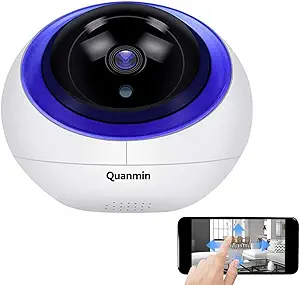
Quanmin vs Google Nest: Overview
Comparing Quanmin and Google Nest helps you determine which brand is best suited for your needs in Security Cameras. Both brands offer strong choices depending on your budget and key feature requirements.
Key Features & Comparison
Evaluate factors such as build quality, warranty, customer satisfaction, and total value before making your final purchase choice between Quanmin and Google Nest.
Picture Quality
When evaluating picture quality, Google Nest and Quanmin cater to fundamentally different philosophies and hardware executions. Google Nest cameras, particularly the Nest Cam (indoor/outdoor, battery or wired), utilize premium optical sensors combined with sophisticated computational photography. While Nest often caps raw resolution at 1080p with HDR, the image processing pipeline is exceptionally refined. The high dynamic range capabilities allow Nest cameras to preserve critical details in scenes with harsh backlighting, deep shadows, or direct sunlight. Furthermore, Nest's night vision utilizes high-efficiency infrared LEDs paired with adaptive exposure algorithms, producing clean, low-noise nighttime footage that avoids the common "whiteout" blur when subjects approach the lens.
In contrast, Quanmin, a brand focused on budget-friendly and industrial-leaning surveillance, frequently markets higher on-paper resolutions, such as 2K or 4K (5MP/8MP) sensors, but lacks the advanced digital signal processing found in Nest. Under balanced lighting conditions, Quanmin cameras can deliver sharp center-frame clarity and decent pixel density, which is useful for static surveillance tasks. However, Quanmin hardware often struggles with challenging dynamic ranges; high-contrast environments lead to blown-out highlights or crushed dark tones. Night vision on Quanmin relies heavily on standard IR arrays or intense white-light LEDs for color night vision, which can suffer from motion artifacts, digital noise, and optical flare compared to Google's heavily optimized visual output.
Smart Features & Connectivity
Google Nest sets the industry benchmark for smart automation, edge processing, and seamless home integration. Powered by custom Google machine learning chips, modern Nest cameras process intelligent alerts on-device, accurately differentiating between people, animals, vehicles, and packages without requiring an immediate cloud round-trip. This edge computing significantly cuts down on false positive notifications. The connectivity ecosystem is built around the Google Home platform, offering unified control, reliable Wi-Fi protocols (including dual-band 2.4/5GHz support), and proactive fallbacks like local onboard storage to capture footage during intermittent Wi-Fi outages.
Quanmin takes a far more utilitarian and generic approach to smart features and network connectivity. Typically relying on third-party mobile applications like CamHi or proprietary mobile interfaces, Quanmin offers foundational motion detection that frequently relies on simple pixel-change algorithms rather than advanced computer vision. While some newer models introduce rudimentary humanoid detection, false triggers from moving foliage, insects, or light shifts are common. In terms of connectivity, Quanmin often shines in physical deployment versatility, providing models with wired Ethernet, PoE (Power over Ethernet), or 4G LTE SIM options, but it lacks sophisticated smart home automation, offering no deep integration with ecosystems like Google Assistant, Apple Home, or Amazon Alexa.
Privacy & Data Control
Privacy and data governance represent a stark ideological divide between Google Nest and Quanmin. Google Nest operates within a highly secured, corporate-governed cloud infrastructure. Video streams are protected using enterprise-grade encryption (TLS/SSL in transit and 128-bit AES at rest), fortified by two-factor authentication requirements via Google Accounts. The trade-off is an almost total reliance on Google's cloud ecosystem; users must trust Google with their telemetry and video metadata, and direct access to raw video feeds via standard local streaming protocols (like RTSP or ONVIF) is strictly locked down or nonexistent.
Conversely, Quanmin appeals to privacy enthusiasts who prioritize local data ownership and network isolation over closed-source cloud security. Many Quanmin cameras support open surveillance standards, including ONVIF and RTSP, allowing users to integrate them directly into local Network Video Recorders (NVRs) or home automation servers like Home Assistant, completely air-gapped from the internet. However, this flexibility places the security burden entirely on the consumer. Out of the box, Quanmin devices often utilize generic peer-to-peer (P2P) firmware with questionable encryption standards and sparse patch management, exposing users to severe vulnerabilities if the camera is exposed directly to the public internet without proper firewall configuration.
Subscription Plans
Google Nest's ongoing cost model revolves around the Nest Aware subscription framework. While the camera functions out of the box with basic features and a limited three-hour event-based snapshot history, the device's true capabilities are gatekept behind a recurring fee. Nest Aware provides 30 days of event video history and intelligent features like Familiar Faces recognition, while Nest Aware Plus extends this to 60 days of event history and 10 days of 24/7 continuous video recording (for wired units). Although the flat-fee model covers all Google Nest devices under a single household, the recurring cost is a mandatory long-term consideration for users seeking a fully functional security archive.
Quanmin provides a financially liberating alternative with virtually zero mandatory subscription overhead. The majority of Quanmin cameras are designed around local storage paradigms, featuring on-device MicroSD card slots capable of handling continuous or motion-based recording indefinitely. Users can review, overwrite, and manage video archives without recurring fees. While some companion apps provide optional, third-party cloud hosting plans, they are neither pushed aggressively nor required for core functionality. For budget-conscious consumers seeking fixed one-time hardware expenditures without software paywalls, Quanmin's no-subscription model is a compelling economic advantage over Nest.