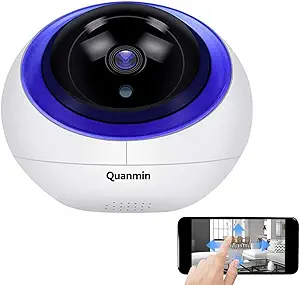
OHWOAI vs Quanmin: Overview
Comparing OHWOAI and Quanmin helps you determine which brand is best suited for your needs in Security Cameras. Both brands offer strong choices depending on your budget and key feature requirements.
Key Features & Comparison
Evaluate factors such as build quality, warranty, customer satisfaction, and total value before making your final purchase choice between OHWOAI and Quanmin.
Picture Quality
OHWOAI focuses heavily on turnkey commercial and residential surveillance, equipping its cameras with high-grade optical sensors that typically output in 3MP, 5MP, or true 4K (8MP) resolutions. The brand's emphasis on outdoor perimeter security shows through its advanced night vision configurations, often combining traditional 850nm infrared arrays with high-lumen spotlight modules for full-color nighttime recording. Image processing in OHWOAI units handles dynamic range well, preventing license plates or human faces from washing out under intense spotlight glare, while maintaining sharp edge fidelity and uniform exposure across broad field-of-view lenses.
Quanmin, by contrast, operates with a heavy bias toward specialized, industrial-adjacent hardware, often supplying CCTV board cameras, miniature pinhole lenses, and standalone dome units. While Quanmin offers competitive resolutions ranging up to 4K on paper, optical clarity can vary significantly based on the lens module selected. In standard configurations, Quanmin units deliver reliable center-frame sharpness, but they frequently lack the aggressive HDR tone mapping and white balance tuning found in OHWOAI systems. In low-light environments, Quanmin leans predominantly on raw IR sensor sensitivity, which delivers dependable monochrome feeds but lacks the polished, noise-suppressed color night vision that makes OHWOAI compelling for casual residential identification.
Smart Features & Connectivity
When examining intelligence and networking, OHWOAI positions itself as an integrated ecosystem brand. Most OHWOAI systems rely on proprietary Network Video Recorders (NVRs) running custom, localized wireless networks (cascading Wi-Fi) or Power over Ethernet (PoE) to minimize local network congestion. The brand incorporates AI-driven human and vehicle detection algorithms natively within the NVR firmware, successfully filtering out false alerts caused by moving foliage or insects. Remote connectivity is achieved via mobile apps like HonestView or EseeCloud, which deliver relatively streamlined peer-to-peer (P2P) remote viewing, push notifications, and two-way audio support, though advanced smart home cross-compatibility (such as Google Home or Apple HomeKit) remains minimal.
Quanmin takes a far more modular, protocol-agnostic engineering approach. Rather than locking users into a single closed ecosystem, Quanmin cameras are typically built around open standard protocols including ONVIF, RTSP, and direct IP web interfaces. While Quanmin cameras often feature baseline motion detection, complex edge analytics like perimeter tripwires or facial categorization are rarely processed on-camera; instead, the hardware is engineered to feed low-latency streams into third-party software like Blue Iris, Synology Surveillance Station, or custom NVRs. This makes Quanmin considerably more flexible for advanced homelab networks and industrial integrations, though decidedly less user-friendly for non-technical consumers seeking an out-of-the-box smart security setup.
Privacy & Data Control
OHWOAI provides a hybrid approach to user privacy that tilts favorably toward local-first architecture. Because most consumer systems are sold bundled with a dedicated NVR featuring an internal hard drive, live video streams and recorded archives do not inherently require an off-site cloud server to function. Homeowners can isolate the NVR on a separate virtual local area network (VLAN) without completely breaking core functionality. However, when users do enable remote viewing, traffic routes through third-party P2P relay servers, introducing potential supply-chain software vectors that require users to maintain strict administrative passwords and keep up with occasional firmware updates.
Quanmin offers the highest ceiling for privacy and data autonomy, provided the system architect has the technical capability to configure it. Because Quanmin cameras are fundamentally IP devices that operate via direct local web interfaces, they can be deployed entirely air-gapped from the public internet. They do not force users into proprietary cloud environments, nor do they require account registration with a manufacturer-controlled server to unlock baseline features. For security-conscious consumers who refuse to transmit video feeds through commercial cloud relays, Quanmin offers a clean, transparent platform that leaves network ingress and egress entirely under the administrator's control.
Subscription Plans
The economic model of OHWOAI is centered on eliminating recurring operational expenditures, a significant selling point in the modern surveillance market. The vast majority of OHWOAI hardware packages include pre-installed 1TB to 3TB surveillance-grade hard drives, providing continuous 24/7 loop recording without monthly fees. While OHWOAI does offer optional cloud storage packages through its companion apps for users desiring off-site redundancy, the core smart features—such as human shape detection, app alerts, and multi-channel remote playback—remain completely unlocked out of the box, ensuring the total cost of ownership stays flat after the initial equipment purchase.
Quanmin operates completely free of native subscription models, positioning itself firmly as a hardware-only supplier. There are no proprietary Quanmin cloud tiers, no locked premium software features, and no recurring billing structures tied to camera activations. To achieve remote storage or redundancy, users must independently budget for local Network Attached Storage (NAS), internal MicroSD media, or third-party cloud hosting via S3-compatible buckets managed through an external VMS. This makes Quanmin an attractive, predictable cost choice for institutional buyers and DIY hobbyists who prefer self-hosted infrastructure over brand-mandated subscriptions.