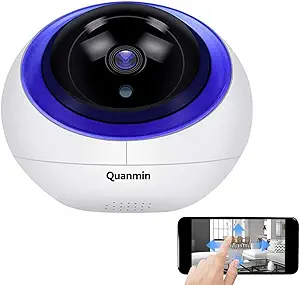








Kasa vs Quanmin: Overview
Comparing Kasa and Quanmin helps you determine which brand is best suited for your needs in Security Cameras. Both brands offer strong choices depending on your budget and key feature requirements.
Key Features & Comparison
Evaluate factors such as build quality, warranty, customer satisfaction, and total value before making your final purchase choice between Kasa and Quanmin.
Picture Quality
When evaluating picture quality, TP-Link's Kasa brand delivers a refined, consumer-optimized visual experience. Most Kasa cameras offer resolutions ranging from 1080p Full HD to 2K (3MP/4MP), backed by well-tuned image signal processors that balance dynamic range and exposure automatically. In daytime scenarios, Kasa hardware captures sharp details with natural color reproduction, minimizing digital noise and preventing backlight blowouts common near windows. Their night vision typically relies on high-efficiency 850nm infrared LEDs, with select outdoor models offering full-color night vision via integrated spotlights, ensuring consistent clarity, low ghosting, and legible facial features up to 30 feet in complete darkness.
In contrast, Quanmin generally operates in the specialized and white-label hardware space, frequently utilizing off-the-shelf Sony Starvis or generic CMOS image sensors that cater to technical hobbyists. On paper, Quanmin often matches or exceeds Kasa with 4K or 5MP raw resolution options and wide-aperture lenses that excel in low-light sensitivity. However, the lack of proprietary image-tuning software often leads to over-sharpening, inconsistent white balance, and chromatic aberration under challenging lighting conditions. While Quanmin's high-spec sensors can deliver raw pixel count for resolving distant license plates or stationary objects in controlled lighting, Kasa provides a more dependable, balanced image pipeline with superior motion de-blurring for everyday home security.
Smart Features & Connectivity
Kasa excels in smart home interoperability and intuitive automation, designed to mesh seamlessly with mainstream ecosystems. Kasa cameras feature reliable dual-band or robust 2.4 GHz Wi-Fi connectivity and leverage local edge AI for person detection, sound anomaly alerts, and customizable activity zones. Integration with Amazon Alexa, Google Assistant, and platforms like SmartThings is polished, allowing users to effortlessly view live camera feeds on smart displays or trigger ecosystem-wide routines, such as turning on living room lights when motion is detected outdoors. The companion Kasa app is widely regarded for its low latency, high uptime, and user-friendly interface.
Quanmin takes a more industrial, protocol-centric approach to connectivity, often relying on wired PoE (Power over Ethernet) or standard IP network configurations alongside basic Wi-Fi models. While lacking proprietary native cloud AI, Quanmin cameras frequently support open protocols like ONVIF and RTSP. This makes them significantly more flexible for integration into advanced Network Video Recorders (NVRs) and self-hosted automation platforms like Home Assistant, Blue Iris, or Frigate. While Quanmin offers virtually zero consumer-grade polish—lacking direct, intuitive voice-assistant features out of the box—it grants technical power users the freedom to implement their own machine-learning detection pipelines without ecosystem lock-in.
Privacy & Data Control
Privacy and data control represent a fundamental architectural divergence between the two brands. Kasa employs a hybrid consumer model: it secures data through end-to-end industry-standard encryption (AES-128 and SSL/TLS) and allows users to store recordings locally on internal microSD cards (up to 256GB on most models). Additionally, many Kasa indoor models feature physical privacy shutters that block the lens electronically. However, telemetry, authentication, and push notifications remain tied to TP-Link’s cloud servers, which means users must trust a centralized infrastructure to broker their camera connections and manage credential security.
Quanmin appeals directly to zero-trust privacy advocates by operating essentially as open-standard IP surveillance hardware. Because Quanmin cameras are typically managed via localized RTSP streams and ONVIF controls, they can be entirely air-gapped from the wider internet within a dedicated Virtual Local Area Network (VLAN). This setup prevents unauthorized external data harvesting, proprietary cloud leaks, or sudden firmware changes that alter functionality. The trade-off is that user security is entirely self-managed: without proper network segmentation and firewall configurations, an unpatched Quanmin camera can be exposed to automated network exploits, unlike Kasa’s managed security updates.
Subscription Plans
Kasa provides a traditional tiered subscription model via Kasa Care, designed to enhance convenience without mandating recurring fees for core hardware usability. Users can operate Kasa cameras entirely for free using on-board microSD storage for event-based or continuous 24/7 recording, retaining basic motion alerts and live streaming. Upgrading to Kasa Care (available in single-camera or multi-camera tiers) adds 30 days of rolling cloud video history, rich push notifications with visual snapshots, and streamlined video clip exporting, making it an accessible, low-maintenance choice for everyday homeowners.
Quanmin fundamentally rejects the recurring subscription paradigm, offering a true zero-subscription ownership model. There are no proprietary cloud services, locked software features, or tiered paywalls for extended recording history or resolution unthrottling. Storage retention and archival capabilities are dictated entirely by the user's external hardware, such as an on-premises NVR, a Network Attached Storage (NAS) drive, or a dedicated hard drive server. While this completely eliminates ongoing monthly operating costs, the burden of upfront hardware expenses, storage redundancy, and technical maintenance falls squarely on the consumer.
Compare current retail pricing, active promotions, and verified stock availability directly from authorized stores:
Compare current retail pricing, active promotions, and verified stock availability directly from authorized stores: